How to Evaluate an IPO: DRHP, Valuation, and Red Flags
 Written by Team Lemonn
 Reviewed by Gaurav Garg, SEBI-registered Research Analyst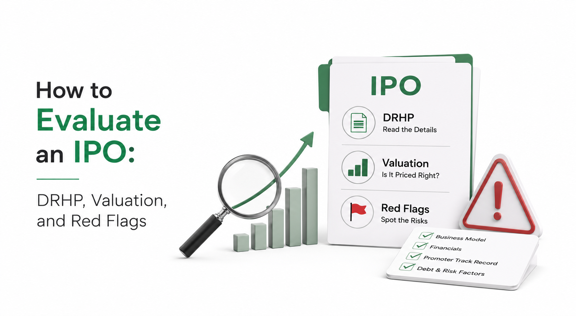
Every IPO season, the same pattern repeats. A company announces its listing, Grey Market Premium (GMP) screenshots start doing the rounds, and investors rush to apply because “everyone is applying.” Some of these IPOs do well. Many don’t.
Here’s the thing: an IPO isn’t a lottery ticket. When you apply for one, you’re buying a stake in a real business, with real risks and real financials. Learning how to evaluate an IPO properly, using the company’s own disclosures, takes less time than you’d think, and it’s the single best way to avoid an expensive mistake.
This guide walks through the three pillars of IPO evaluation: reading the Draft Red Herring Prospectus (DRHP), checking whether the valuation is fair, and spotting red flags before you invest.
Read More: What is an IPO? A Beginner’s Guide for Indian Investors
Start With the DRHP, Not the Hype
The Draft Red Herring Prospectus (DRHP) is the document every company must file with the Securities and Exchange Board of India (SEBI) before it can go public. It’s filed through a SEBI-registered merchant banker, also called a Book Running Lead Manager (BRLM), and it stays in the public domain for at least 21 days for feedback before the issue opens. You can find it on SEBI’s website, the stock exchange (NSE or BSE) websites, or the registrar’s website.
Yes, it often runs into hundreds of pages. You don’t need to read all of it. Focus on these five sections.
1. Business Overview and Industry
Understand what the company actually does and how it makes money. Is it selling a product, a service, or both? Is the industry growing or shrinking? A company operating in a shrinking industry has a harder road ahead, no matter how well it’s run today.
2. Objects of the Issue
This section tells you where the IPO money is going. Broadly, IPO proceeds fall into two buckets:
- Fresh issue: New shares are created, and the company receives the money. This is generally a positive sign when it funds expansion, debt reduction, or technology investment.
- Offer for Sale (OFS): Existing shareholders (promoters, private equity investors, or early backers) sell their shares, and the company gets nothing. The money goes straight to the sellers.
A mix of fresh issue and OFS is normal and not a concern by itself. But when an IPO is almost entirely OFS, ask why existing owners are choosing this moment to cash out. It doesn’t automatically make the IPO bad, but it deserves a closer look.
3. Risk Factors
This is usually the most skipped section, and it shouldn’t be. Companies are legally required to disclose the risks facing their business here, including customer concentration, pending litigation, regulatory dependence, and competitive threats. If a company earns most of its revenue from one client or one product, that’s a genuine vulnerability worth weighing.
4. Financial Statements
The DRHP includes restated financials for the last three years. Look at:
- Revenue trend: Is growth steady across three years, or is there a sudden spike right before the IPO? A one-year jump deserves scrutiny.
- Profit and margins: Is the company profitable? If not, does it have a credible, time-bound path to profitability?
- Operating cash flow versus net profit: Profit can be shaped by accounting choices; cash flow is harder to manipulate. If operating cash flow tracks close to or above net profit, that’s a healthy sign. If profit keeps rising while cash flow stays weak, dig deeper.
- Debt levels: Check the debt-to-equity ratio. A heavily leveraged company is more exposed during a downturn.
5. Promoter and Management Background
Look at the promoters’ experience, their track record, and any past regulatory or legal issues disclosed in the DRHP. Also check promoter shareholding after the IPO. A high post-issue stake usually signals continued commitment. A sharp reduction in promoter holding isn’t automatically a red flag, but a large one warrants questions.
Since April 2026, SEBI has also allowed companies to update their DRHP into the Red Herring Prospectus (RHP), which adds the final price band, so keep an eye out for the RHP closer to the issue date since it reflects the latest disclosures.
Read More: DRHP | Lemonn Blog
How to Check If the IPO Valuation Is Fair
A fundamentally strong company can still be a poor investment if you overpay for it. Valuation tells you whether the IPO price already reflects the company’s growth prospects, or whether it’s asking you to pay for growth that hasn’t happened yet.
| Metric | What It Measures | Best Used For |
| Price-to-Earnings (P/E) | Price paid per rupee of profit | Profitable, established companies |
| EV/EBITDA | Enterprise value against operating earnings | Companies with debt or fluctuating profits |
| Price-to-Sales (P/S) | Price paid per rupee of revenue | Loss-making or early-stage companies |
Here’s how to use them:
Price-to-Earnings (P/E) ratio. Compare the IPO’s P/E with listed peers in the same sector. If the IPO is priced at 45 times earnings while comparable listed companies trade at 25 times, you’re paying a significant premium. That premium can be justified if the company is growing meaningfully faster than its peers. If growth rates are similar, the IPO likely looks expensive.
EV/EBITDA (Enterprise Value to Earnings Before Interest, Taxes, Depreciation, and Amortisation). This is more useful when profits are thin, volatile, or distorted by one-off items, since it looks at operating performance before financing and accounting decisions.
Price-to-Sales (P/S) ratio. For loss-making companies with little or no profit, this compares valuation to revenue. A high P/S ratio means investors are betting on future profitability that hasn’t arrived yet. Revenue alone doesn’t create value. What matters is whether that revenue eventually converts into profit and cash flow.
The core question to ask is simple: is the IPO asking you to pay noticeably more than comparable listed companies, and if so, is there a clear reason (faster growth, stronger margins, a bigger addressable market, a durable moat)? If you can’t find a convincing answer in the DRHP, treat the valuation with caution.
Read More: How to Do Valuation Analysis of a Company: A Guide
Red Flags to Watch For
Some warning signs show up consistently across risky IPOs. None of these alone should be a dealbreaker, but two or more together deserve real caution.
- Revenue or profit jumps only in the year before the IPO. Genuine business improvement tends to be visible across multiple years, not one convenient year.
- Operating cash flow persistently below net profit. This can indicate aggressive revenue recognition or collection problems.
- Heavy reliance on a single customer, supplier, or product. Losing that one relationship could materially hurt the business.
- IPO dominated by Offer for Sale with little fresh capital for growth. The company itself isn’t raising much; existing shareholders are largely exiting.
- Valuation far above listed peers without a clear growth or margin justification.
- Frequent related-party transactions or unclear corporate governance history, both of which are disclosed in the DRHP’s risk factors and related-party sections.
- Rising debt-to-equity ratio without a clear plan to use IPO proceeds to reduce it.
- Weak or declining Qualified Institutional Buyer (QIB) interest during the roadshow, relative to strong retail hype. QIBs, comprising mutual funds, insurance companies, pension funds, and foreign portfolio investors, run detailed due diligence before committing capital, so their participation carries more informational weight than retail enthusiasm alone.
Where GMP and Subscription Numbers Fit In
Grey Market Premium (GMP) is the unofficial premium at which IPO shares trade before listing, in a market that is unregulated and not monitored by SEBI. It reflects short-term sentiment, not business quality. A high GMP doesn’t mean the company is fundamentally sound, and a low or negative GMP doesn’t automatically mean it’s weak. Treat it as one small data point, not a basis for your decision.
Subscription data, especially in the QIB category, is more informative once bidding opens. Strong institutional demand suggests professional investors, after their own due diligence, found the business and pricing reasonable. Heavy retail or Non-Institutional Investor (NII) subscription with weak QIB interest is a less reassuring combination.
Read More: IPO GMP Explained: Grey Market Premium Meaning & Risk
A Simple Evaluation Checklist
Before you apply, run through this list:
- Do I understand how the company makes money, and is its industry growing?
- Is the majority of the issue fresh capital for growth, or mostly an Offer for Sale?
- Has revenue grown consistently over three years, or is there an unexplained spike?
- Is operating cash flow keeping pace with net profit?
- Is the debt-to-equity ratio reasonable for the sector?
- Is the valuation (P/E, EV/EBITDA, or P/S, as applicable) in line with listed peers, and if not, is there a good reason?
- Do promoters retain meaningful ownership after the IPO?
- What do the risk factors in the DRHP disclose about customer concentration, litigation, or regulatory dependence?
- How is QIB demand shaping up relative to retail and NII demand?
Final Thoughts
IPO investing rewards patience over impulse. The company’s DRHP, not the GMP chatter or social media buzz, is where the real answers live. Spend thirty minutes on the objects of the issue, the financials, and the risk factors, and you’ll be better informed than most people applying around you.
If you’re a Retail Individual Investor (RII) applying for shares worth up to ₹2 lakh, remember that allotment in an oversubscribed issue is decided by lottery, not by how thoroughly you’ve researched the company. But that research is still what protects you from holding a bad business after listing, long after the allotment lottery is forgotten.
Frequently Asked Questions (FAQs)
Q: What is the difference between a DRHP and an RHP?
A: The Draft Red Herring Prospectus (DRHP) is the initial filing with SEBI and doesn’t include the price band. The Red Herring Prospectus (RHP) is the updated version, filed closer to the IPO launch, that includes the price band and any changes SEBI required.
Q: Can I evaluate an IPO without reading the entire DRHP?
A: Yes. Focus on the objects of the issue, risk factors, three-year financial statements, and promoter shareholding pattern. These sections cover most of what you need to make an informed decision.
Q: Is a high GMP a reliable sign that an IPO will perform well?
A: No. GMP reflects short-term market sentiment in an unregulated market and says nothing about the company’s financial health, valuation, or long-term prospects. Use it, if at all, as a minor supplementary signal.
Q: Why does a large Offer for Sale (OFS) component matter?
A: In an OFS, existing shareholders sell shares and keep the proceeds, the company receives no funds. A heavily OFS-weighted IPO means little fresh capital goes toward the business itself, so it’s worth understanding why existing investors are exiting.
Q: What is considered a red flag in IPO valuation?
A: A valuation significantly higher than listed peers, without a clear justification like faster growth or stronger margins, is a common red flag. Compare P/E, EV/EBITDA, or P/S ratios against similar listed companies before applying.
Q: How much can a retail investor apply for in a mainboard IPO?
A: A Retail Individual Investor (RII) can apply for shares worth up to ₹2 lakh in a single application. Applications above this amount are classified under the Non-Institutional Investor (NII) category.
Disclaimer
The stocks mentioned in this article are not recommendations. Please conduct your own research and due diligence before investing. Investment in securities market are subject to market risks, read all the related documents carefully before investing. Please read the Risk Disclosure documents carefully before investing in Equity Shares, Derivatives, Mutual fund, and/or other instruments traded on the Stock Exchanges. As investments are subject to market risks and price fluctuation risk, there is no assurance or guarantee that the investment objectives shall be achieved. Lemonn (Formerly known as NU Investors Technologies Pvt. Ltd) do not guarantee any assured returns on any investments. Past performance of securities/instruments is not indicative of their future performance.