What Is a Post Office Recurring Deposit? Your Complete Guide
 Written by Ipsita Baishya
 Reviewed by Gaurav Garg, SEBI-registered Research Analyst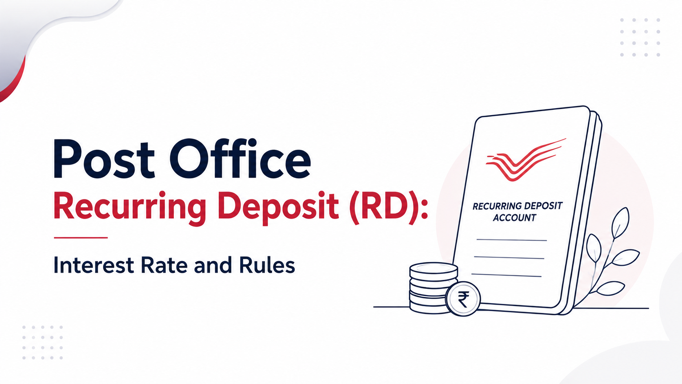
Introduction
Post Office Recurring Deposit, or RD, is a government-backed savings scheme where you have to deposit a fixed amount every month for a period of 5 years. You just have to start off with Rs 100 every month. You can earn interest at the rate of 6.7% per annum, compounded quarterly, on an RD from July to September 2026. So if you want to save regularly and want assured returns, then, unlike aggressive market-linked investment schemes, a Post Office RD can be your go-to option in 2026.
In this article, we will discuss the features and benefits of Post Office RD, how to open an account, and things to keep in mind before investing.
What is the Post Office RD Scheme?
A Post Office RD comes under the umbrella of India Post’s small savings scheme, where you invest a certain amount every month for a fixed term of 5 years and earn interest. This scheme is dissimilar to bank RDs, which sometimes have flexible tenures.
A Post Office RD is designed for individuals with a fixed monthly income. It is a reliable choice for salaried individuals and small business owners who want to save a fixed percentage of their earnings regularly. You can also link your bank account for automatic debits so you won’t miss your payments.
“Start investing with confidence! Explore
0 demat account
and grow your wealth.”
All you need to know about post office recurring deposit
Let’s look at some of the key features and benefits in the Post Office RD scheme.
1. Quarterly Compound Interest: Post Office RD gives 6.7% interest per annum for the quarter from April to June 2026, compounded quarterly. This rate is reviewed by the government every quarter, as are other policies of the post office. So, upon maturity, the interest rate may vary when the account is renewed or extended.
2. Minimum Deposit Amount: To open a Recurring Deposit (RD) account, you need to deposit a minimum of Rs 100 every month. You can invest any amount each month; there is no maximum limit. Pick an amount of Rs 500 or Rs 5,000 that is within your financial goal and budget. All deposits should be in multiples of Rs. 10.
3. Renew Your RD Upon Maturity: Post Office RD matures after 5 years of tenure. Open another account? No need. You can renew the same account for another 5 years. This way you will be able to keep up with your monthly saving habit.
4. Early Withdrawal Option: Life doesn’t always go as planned, and the scheme has your back when it throws a few curveballs. You can make regular deposits for 3 years and withdraw early in case of any emergency.
Note: If you close your account early, you won’t be able to enjoy the RD interest rate. Instead, your deposits get a lower interest rate at the post office savings account.
5. Loan Against Your RD: After you have paid 12 regular monthly instalments, you can get a loan up to 50% of your RD balance. If you need cash for a short period and do not want to break your RD and lose out on the better rate of interest, it can be useful. Keep making your monthly payments and pay off the loan separately.
Is Post Office RD Interest Taxable?
Interest earned on a Post Office RD is fully taxable and is added to your total income under the head “Income from Other Sources.” However, unlike many bank RDs where banks deduct TDS if the interest exceeds a certain level, there is no TDS (Tax Deducted at Source) on Post Office RD interest.
That doesn’t mean the interest is tax-free. It just means that you need to declare it yourself while filing your income tax return and pay tax as per your applicable slab rate.
Who can open a Post Office RD account
A Post Office RD account can be opened by:
1. A person who is an adult
2. Max 3 adults together
3. A minor of ten years or upwards in his or her own name
4. A guardian of a minor or a person of unsound mind
Post Office RD Account Documents
Opening an RD account in a post office is quite simple. Documents needed are: Post office account opening form, ID proof, PAN card, address proof, and passport-size photographs.
How to open a Post Office RD Account
1. Visit your local post office.
2. Fill up the RD application form.
3. Send in the application and the supporting documents.
4. Pay your first month’s deposit to fund the account.
Note: If you have a Post Office savings account and have activated internet banking, then login and select General Services. Go to Service Request and New Request to open an RD. Fill in the required details and make the initial deposit to activate your RD. Once done, make all your future payments on the go with the IPPB app, seamlessly.
Conclusion
A post office recurring deposit helps create a regular savings discipline. It is a safe and hassle-free savings option with fixed returns for investors with a low-risk appetite. It does not offer any tax benefits. It supports your short- and medium-term financial objectives. Get professional advice to help you make the right decision for yourself. Get expert advice to make informed decisions tailored to your needs.
Frequently Asked Questions
1. What happens if I miss a monthly deposit in my Post Office RD?
In case you default in payment of any instalment due on your RD you will be liable for a default penalty. And for serial defaulters, your account may even be closed.
2. Is there any benefit to senior citizens in the Post Office RD scheme?
No, the Post Office RD plan does not provide any special benefit for senior citizens.
3. How to calculate the maturity value of my Post Office RD?
You can calculate the maturity amount and the interest on your RD either using the compound interest formula or by using the online Post Office RD Calculator.
4. Why is my RD debit not happening?
Your RD amount may not get debited because of insufficient funds in your account, a system-generated error, or even an expired or deactivated auto-debit mandate.
5. Can I view my RD balance in the post office?
You can check the balance of your Post Office RD online on the India Post e-banking portal, mobile banking app or at your nearest post office.
Disclaimer
The stocks mentioned in this article are not recommendations. Please conduct your own research and due diligence before investing. Investment in securities market are subject to market risks, read all the related documents carefully before investing. Please read the Risk Disclosure documents carefully before investing in Equity Shares, Derivatives, Mutual fund, and/or other instruments traded on the Stock Exchanges. As investments are subject to market risks and price fluctuation risk, there is no assurance or guarantee that the investment objectives shall be achieved. Lemonn (Formerly known as NU Investors Technologies Pvt. Ltd) do not guarantee any assured returns on any investments. Past performance of securities/instruments is not indicative of their future performance.
Related Posts


Download Lemonn
Download my app for share market trading, ipo investment, trading account, and all your investment needs.