What Is a Bearer Cheque and How Does It Work?
 Written by Ipsita Baishya
 Reviewed by Gaurav Garg, SEBI-registered Research Analyst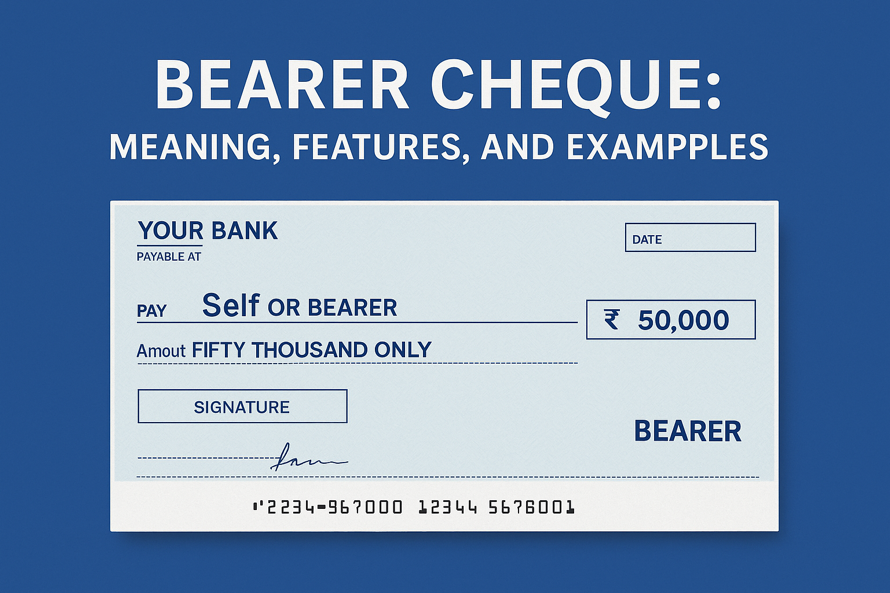
Introduction
A bearer cheque is a financial instrument that is payable to anyone who presents it to the bank for encashment. The cheque on which the word “Bearer” is written or printed authorises the bank to give cash to the person presenting it on the spot. Even in 2026, companies, dealers, and people still depend on bearer cheques for immediate cash withdrawals and speedy settlements, despite the world having moved ahead to UPI and digital payments.
In this article, we will discuss why bearer cheques are commonly used, their features, benefits, disadvantages, how they are different from other types of cheques, and the actions required in drafting one.
Features and Benefits of a Bearer Cheque
Bearer cheques are useful when speed is more important than documentation. Here are some of its key features and benefits:
1. Payable to the Bearer of the Instrument: The most crucial aspect of a bearer cheque is that the bank will honour the payment to anybody who physically submits the cheque to the bank without the requirement for endorsement or identification.
2. Availability of Instant Payment Between Bank Branches: Bearer cheques are normally payable over the counter to the bearer if there are sufficient funds and subject to the bank’s verification procedures, regulations and limits. They are also easily transferrable, since ownership can be transferred by actual delivery.transferrable,
3. Suitable for Small Cash Payments: Bearer cheques are ideal for daily wages, vendor payments, and emergency cash requirements.
“Start investing with confidence! Explore the
free demat account
and grow your wealth.”
Disadvantages and Risks
Exercise caution when using bearer cheques, as payment depends mostly on physical ownership.
1. High Risk of Loss, Theft, and Fraud: Like cash, a bearer cheque can be encashed by the person presenting it. If lost or stolen, it could be misused, subject to the bank’s verification procedures.
2. Limited Payee Traceability: It is difficult to find out who encashed a bearer cheque, but banks may maintain identification and transaction records.
3. Limited Use for Business Transactions: Bearer cheques may not be able to provide the necessary transparent payment trail for auditing, invoicing, and accounting records. Businesses tend to favour more traceable payments.
A Step-by-Step Process to Write a Bearer Cheque
Step 1: Fill in the proper date in the space given.
Step 2: Don’t leave the “Pay” field blank. Fill in the “Pay” field with the name of the recipient.
Step 3: Do not strike through the printed words “Bearer.”
Step 4: Write the amount clearly and add the word “only” at the end.
Step 5: Type the same amount in numbers in the box provided.
Step 6: Write the cheque in the signature established with your bank.
Step 7: Verify the date, amount, payee’s name and signature before you pass it over.
Note: Do not cross the cheque or mark “A/C Payee” since doing so will block over-the-counter bearer payment.
What Makes Bearer Cheques Different from Other Cheques
There are several types of cheques for different purposes and levels of risk and paperwork.
- Order Cheque: An order cheque requires identification and endorsement, but a bearer cheque does not.
- Crossed Cheque: A crossed cheque is to be placed in a bank account, while a bearer cheque gives cash immediately at the counter.
- Account Payee Cheques: The safest option is to have cheques drawn to the account, as this method ties the cash to a specific account number. The bearer cheque is wholly dependent on physical ownership.
- Post-dated cheque: A cheque that has been written for a future date and usually cannot be presented for payment until that date. It is often used to prearrange payments.
Legal Rules and RBI Guidelines for Bearer Cheques
The Reserve Bank of India is quite cautious about bearer cheques as massive cash transactions can affect compliance, safety and transparency.
The RBI permits the issuance of bearer cheques for day-to-day cash withdrawals. For large bearer cheque payments of significant value, however, banks may carry out identity checks on the presenter, signature and cheque data verification, and odd activity checks on the account.
Conclusion
Bearer cheques are useful for quick cash withdrawals, although they have significant security risks. They may offer convenience, but always apply caution and assess your needs before using them.
FAQs
What should I do in case of loss of a bearer cheque?
If a bearer cheque is lost, you should immediately call the issuing bank and ask for a stop payment. You will also be required to report to the police to prevent fraudulent encashment.
How to change a bearer cheque to an order cheque?
A bearer cheque can be converted into an order cheque by crossing out the word “bearer” and writing “order” in its place.
Is there any maximum restriction for a bearer cheque?
The RBI does not specify any upper limit. The constraint on large withdrawals comes from the cash available in a particular bank, its internal risk controls, and anti-money laundering legislation.
How long is a bearer cheque valid?
A bearer cheque can be encashed within three months from the date of issue written on the instrument.
Can bearer cheques be deposited in a bank account?
Yes, a bearer cheque can be deposited in a bank account, although some institutions may require you to encash it or verify your identity due to fraud risks.
Disclaimer
The stocks mentioned in this article are not recommendations. Please conduct your own research and due diligence before investing. Investment in securities market are subject to market risks, read all the related documents carefully before investing. Please read the Risk Disclosure documents carefully before investing in Equity Shares, Derivatives, Mutual fund, and/or other instruments traded on the Stock Exchanges. As investments are subject to market risks and price fluctuation risk, there is no assurance or guarantee that the investment objectives shall be achieved. Lemonn (Formerly known as NU Investors Technologies Pvt. Ltd) do not guarantee any assured returns on any investments. Past performance of securities/instruments is not indicative of their future performance.