India: Silver Price Outlook 2026–2030
 Written by Ipsita Baishya
 Reviewed by Gaurav Garg, SEBI-registered Research Analyst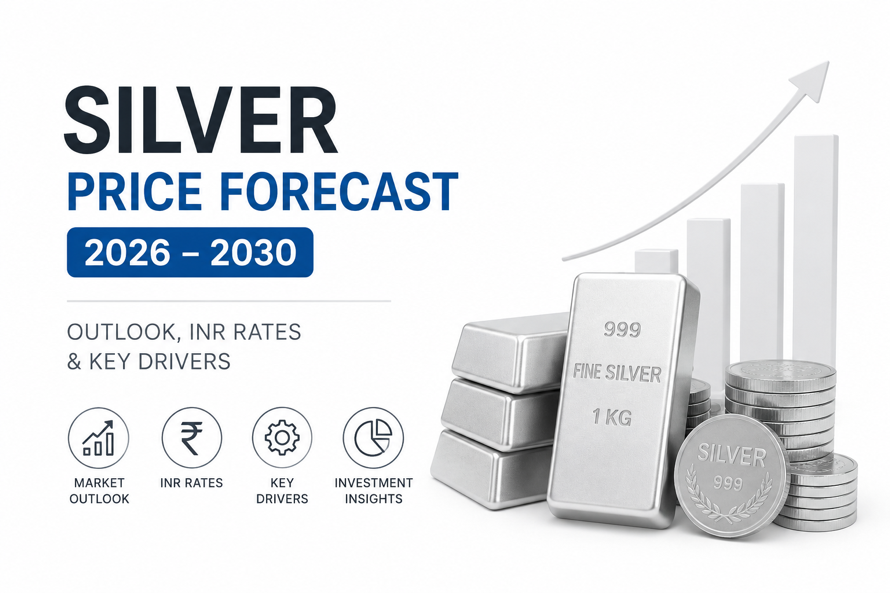
Silver is trading at Rs 2,44,900 per kg as of September 25, 2026. Between surging industrial use and tight global supply, silver’s price trajectory over the next five years leans bullish, though short-term swings of 20 to 30 per cent remain very much on the table.
Here is what the year-wise forecast looks like for Indian investors:
| Year | India Price Range (per kg) | Global Outlook |
|---|---|---|
| 2026 | Rs 2,60,000 to Rs 3,20,000 | Volatile but firm |
| 2027 | Rs 2,80,000 to Rs 3,50,000 | Industrial demand support |
| 2028 | Rs 3,10,000 to Rs 3,90,000 | Solar and EV demand accelerates |
| 2029 | Rs 3,40,000 to Rs 4,30,000 | Supply pressure builds |
| 2030 | Rs 3,80,000 to Rs 5,00,000 | Bullish long-term case |
These are projections based on current market trends, Silver Institute data, and analyst consensus. Actual prices depend on global events, INR/USD movement, import duties, and monetary policy.
Why Silver Prices in India May Keep Increasing
Silver is not just a precious metal used for jewellery and savings. It is a critical industrial input, and that distinction makes its demand story fundamentally different from gold’s.
Industrial Demand: Solar, EVs, and Electronics
Solar panels are the single largest source of new silver demand growth globally. Each photovoltaic panel requires a small but meaningful quantity of silver in its cells. India’s push to reach 500 GW of solar capacity by 2030 under the National Solar Mission directly translates into growing domestic industrial silver consumption.
Electric vehicles are adding a second wave of demand. EV batteries, charging systems, and onboard electronics all require silver. Global EV adoption is accelerating annually, creating sustained demand that barely existed ten years ago.
Few other upcoming sectors with high growth potential include 5G infrastructure rollouts, medical devices, defence electronics, and semiconductor manufacturing. These are not cyclical demand sources. They are structural, which is what makes this silver price outlook different from past commodity cycles.
Persistent Global Supply Deficit
The Silver Institute has reported a structural supply deficit for three consecutive years. Primary silver mines are concentrated in Mexico, Peru, Chile, and China, and production growth has not kept pace with rising industrial demand.
Recycled silver partially bridges this gap, but not fully. The combination of flat supply and growing industrial consumption is one of the clearest fundamental drivers behind the bullish medium-term price view.
Rupee Depreciation and Import Costs
Silver trades globally in US dollars. When the rupee weakens against the dollar, India’s silver import cost rises even if the global dollar price stays flat. Over the last decade, the rupee has depreciated from around 60 per dollar to over 84. This structural depreciation trend inflates silver prices in rupee terms over time, directly benefiting holders of physical silver and silver ETFs.
Gold-Silver Ratio and Relative Value
The gold-silver ratio measures how many units of silver it takes to buy one unit of gold. Historically, this ratio has averaged around 60:1. When it extends well above 80:1, silver tends to outperform gold in subsequent rallies as the ratio compresses back towards its mean.
A high ratio often signals that silver is undervalued relative to gold. Tracking this ratio can help investors time their silver accumulation more effectively.
Silver Price Forecast: Year-wise Analysis
Silver Price Forecast 2026 (Rs 2,60,000 to Rs 3,20,000 per kg)
As of September 25, 2026, silver is trading at Rs 2,44,900 per kg, which is the lower end of the year’s forecast range. The pullback from highs earlier in 2026 has brought the price to a level where value-oriented buyers are beginning to take interest.
A sustained strong US dollar or further cooling in investor risk appetite could keep prices near this level through year-end. A recovery in global industrial sentiment and ETF inflows could push prices towards the upper end near Rs 3,20,000.
Per gram: Rs 260 to Rs 320
Per 10 grams: Rs 2,600 to Rs 3,200
Silver Price Forecast 2027 (Rs 2,80,000 to Rs 3,50,000 per kg)
The base case for 2027 assumes continued industrial demand growth, a moderate supply deficit, and gradual rupee depreciation. If India’s solar and EV sectors hit their growth targets, demand could push prices toward the upper end of this range.
Per gram: Rs 280 to Rs 350
Per 10 grams: Rs 2,800 to Rs 3,500
Silver Price Forecast 2028 (Rs 3,10,000 to Rs 3,90,000 per kg)
By 2028, the compounding effect of industrial demand becomes more structurally visible in supply-demand data. This forecast assumes supply deficits persist and no major new silver mining projects come online at scale. Green energy targets across the US, Europe, and India are net positives for silver demand throughout this window.
Per gram: Rs 310 to Rs 390
Per 10 grams: Rs 3,100 to Rs 3,900
Silver Price Forecast 2029 (Rs 3,40,000 to Rs 4,30,000 per kg)
Supply pressure could become more acute in 2029. Industrial inventory depletion, if it materialises, would push prices sharply toward the upper band. This forecast also assumes continued moderate rupee depreciation following its historical trend.
Per gram: Rs 340 to Rs 430
Per 10 grams: Rs 3,400 to Rs 4,300
Silver Price Forecast 2030 (Rs 3,80,000 to Rs 5,00,000 per kg)
The five-year target represents a potential appreciation of 46 to 92 per cent from August 2026 levels. The wide band reflects genuine uncertainty: if global green energy adoption hits ambitious targets, the Rs 5,00,000 upper end is plausible. A global economic slowdown that reduces industrial activity points to the lower band.
Per gram: Rs 380 to Rs 500
Per 10 grams: Rs 3,800 to Rs 5,000
Silver Price Quick Reference: All Units
| Unit | August 2026 (Current) | Forecast Range 2030 |
|---|---|---|
| Per gram | Rs 260 | Rs 380 to Rs 500 |
| Per 10 grams | Rs 2,600 | Rs 3,800 to Rs 5,000 |
| Per 100 grams | Rs 26,000 | Rs 38,000 to Rs 50,000 |
| Per kg | Rs 2,60,000 | Rs 3,80,000 to Rs 5,00,000 |
How to Invest in Silver in India
Indian investors have five practical options, each with different cost structures, liquidity, and risk profiles.
Silver ETFs (Most Suitable for Most Investors)
Silver ETFs listed on NSE and BSE track physical silver prices and let you buy in small units without worrying about storage or purity. They are liquid, transparent, and SEBI-regulated.
Available options include Mirae Asset Silver ETF, HDFC Silver ETF, and Nippon India. Silver ETF. You can buy through any SEBI-registered broker or investment app.
Best for: Investors who want clean, liquid silver exposure with no storage hassle.
Physical Silver
Buying silver bars, coins, or jewellery gives you direct ownership of the metal. The trade-offs are storage costs, making charges on jewellery (which you lose on resale), and the need to find a fair buyer when you sell.
Best for: Long-term holders with a 5-year-plus horizon and secure storage.
Digital Silver
Several platforms offer digital silver in quantities starting from 1 gram or less, backed by physical silver in secure vaults. These are convenient for small investors but carry platform-specific risks and exit liquidity that depends on the platform’s scale and longevity.
Best for: First-time silver investors testing the asset class with small amounts.
Silver Mutual Funds
These are fund-of-funds that invest in silver ETFs. They are SEBI-regulated and offer SIP options, making them useful for systematic, disciplined silver accumulation over time.
Best for: Investors who prefer automatic, scheduled investments rather than active buying.
Silver Futures on MCX
The Multi Commodity Exchange (MCX) trades silver futures contracts. The standard lot size is 30 kg, requiring significant capital and active risk management. Futures are leveraged, meaning losses can exceed your initial margin.
Best for: Experienced commodity traders with a clear risk management framework.
Tax on Silver Investments in India
Getting the tax treatment right before you invest saves surprises at year-end.
For physical silver and silver ETFs: gains are taxed as capital gains. Holding for less than 24 months means short-term capital gains (STCG) are taxed at your income tax slab rate. Holding for 24 months or more means long-term capital gains (LTCG) at 12.5 per cent without indexation, following the 2024 budget revision.
For silver futures on MCX, profits are typically treated as either non-speculative business income or speculative income, depending on your trading frequency and how your tax advisor categorises the activity.
Consult a SEBI-registered investment advisor or chartered accountant for advice tailored to your situation.
Risks That Could Keep Silver Prices Suppressed
The bull case for silver is not guaranteed. Here are the real downside risks to factor in before buying.
Strong US dollar: When the Fed keeps rates high and the dollar appreciates, commodity prices in dollar terms tend to fall. Since silver trades globally in dollars, a dollar rally directly hurts prices.
Industrial slowdown or recession: Silver has more industrial demand exposure than gold. A global recession that cuts manufacturing activity reduces silver demand more sharply than it does gold demand.
Technological substitution: If developers create cheaper alternatives to silver for solar panels or EV systems, one of silver’s key demand growth pillars weakens. This is a longer-term risk rather than an immediate one.
Import duty and policy changes: India charges GST and customs duty on silver imports. Any increase in duties raises retail prices and could suppress domestic jewellery and industrial demand.
Profit-taking corrections: Even in a structural bull market, silver can fall 20 to 30 percent sharply after major runs. Buying near a local peak without a long-term horizon means absorbing meaningful drawdowns before recovering.
Is This a Good Time to Buy Silver in India?
At Rs 2,44,900 per kg as of September 25, 2026, silver is trading at the lower end of its 2026 forecast range, having retreated from highs earlier in the year. For investors who missed the earlier rally, this is a more attractive entry point than the year’s peak.
That said, a strategic approach still makes sense. Buying small quantities periodically (applying SIP logic to silver ETFs or digital silver) reduces the risk of catching another leg lower if global conditions deteriorate.
For portfolio sizing, most financial planners suggest keeping commodity allocations to 5 to 15 per cent of your total portfolio. Silver can sit alongside gold within that allocation as a higher-volatility, higher-growth-potential complement.
If you have a 5-year or longer horizon and can hold through a 20 to 25 per cent correction without panic-selling, the structural drivers make a reasonable case for silver at current prices.
Frequently Asked Questions
1. Why is the silver price increasing in India?
The primary drivers are rising industrial demand from solar panels and EVs, a persistent global supply deficit, rupee depreciation against the dollar, and safe-haven demand from investors hedging against inflation.
2. When will silver prices go down in India?
A meaningful correction would most likely require a strong US dollar rally, a global economic slowdown reducing industrial activity, or a significant increase in silver mining supply. Silver already corrected from its 2026 highs to the current Rs 2,60,000 level, which many analysts see as a better entry point.
3. Is silver a better investment than gold in India?
Silver and gold serve different purposes. Silver has higher growth potential driven by industrial demand, but it is significantly more volatile than gold. Gold is more stable and a purer safe haven. Most investors do better holding both rather than choosing one over the other.
4. What is the best way to invest in silver in India?
Silver ETFs are the most practical option for most investors. They are SEBI-regulated, liquid, have no storage risk, and can be bought through any broker or investment app. Mirae Asset Silver ETF, HDFC Silver ETF, and Nippon India Silver ETF are the main options available.
Disclaimer: This article is for educational and informational purposes only. It does not constitute investment advice. Silver prices are subject to market risk, currency fluctuation risk, and global events. Past performance does not indicate future results. Please consult a SEBI-registered investment advisor before making investment decisions.
Disclaimer
The stocks mentioned in this article are not recommendations. Please conduct your own research and due diligence before investing. Investment in securities market are subject to market risks, read all the related documents carefully before investing. Please read the Risk Disclosure documents carefully before investing in Equity Shares, Derivatives, Mutual fund, and/or other instruments traded on the Stock Exchanges. As investments are subject to market risks and price fluctuation risk, there is no assurance or guarantee that the investment objectives shall be achieved. Lemonn (Formerly known as NU Investors Technologies Pvt. Ltd) do not guarantee any assured returns on any investments. Past performance of securities/instruments is not indicative of their future performance.