GMP in IPO: Grey Market Premium Explained
 Written by Team Lemonn
 Reviewed by Gaurav Garg, SEBI-registered Research Analyst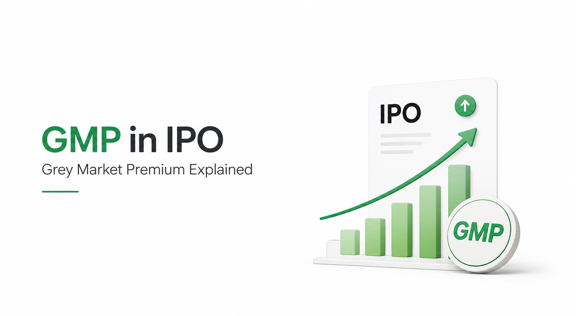
If you have ever checked “IPO GMP today” on your phone the night before an allotment, you already know how much buzz this one number creates. A high IPO GMP feels like a green signal. A low or negative one can make you second-guess an application you were excited about just hours ago.
But what is the grey market premium (GMP) in an IPO, really? In simple terms, GMP is the extra price that traders in an unofficial, unregulated market are willing to pay for IPO shares before they list on the NSE or BSE. It is watched closely, but it is not issued, verified, or backed by SEBI, the stock exchanges, or the company itself.
This guide explains what GMP means, how it is calculated, the types of grey market deals, and the real risks Indian retail individual investors (RIIs) should know before letting GMP influence an IPO decision.
What Is Grey Market Premium (GMP) in an IPO?
Grey Market Premium is the amount over and above the IPO issue price that buyers are willing to pay for shares in the grey market, an informal, over-the-counter space where IPO shares and applications change hands before the official listing.
The grey market itself is called “grey” because it sits between fully legal, regulated exchange trading (white) and outright illegal trading (black). It is not authorised by SEBI, but it is also not a criminal offence to participate in it. It operates in a legal grey area, neither banned by law nor authorized or governed by the Securities and Exchange Board of India.
Trading in the grey market typically starts once a company announces its price band and IPO dates, and continues right up to the listing day. This unofficial market operates through informal networks of brokers and dealers, completely outside SEBI’s regulatory purview. There are no contracts, no digital records, and no exchange platform. Deals are usually verbal, based on the trust and reputation of local dealers.
How Is IPO GMP Calculated? (Formula and Example)
The GMP formula is straightforward:
GMP = Grey Market Trading Price − IPO Issue Price
And once you have the GMP, you can estimate the grey market’s expected listing price:
Expected Listing Price = IPO Issue Price + GMP
Example
Suppose a company sets its IPO issue price at ₹500 per share, and grey market dealers are quoting a premium of ₹150.
| Detail | Value |
| IPO Issue Price | ₹500 |
| Grey Market Premium (GMP) | ₹150 |
| Expected Listing Price | ₹650 |
| Implied Listing Gain | 30% |
This means grey market participants expect the stock to open around ₹650 on listing day, a 30% gain over the issue price. Remember, this is only an unofficial estimate, not a confirmed outcome.
GMP can also turn negative. If the issue price is ₹500 and the GMP is minus ₹40, the grey market is pricing the stock at around ₹460, signalling weak demand and a possible listing below the issue price.
Read More: IPO GMP Grey Market Premium
Types of Grey Market Deals: GMP, Kostak Rate, and Subject to Sauda
GMP is the most talked-about figure, but the IPO grey market runs on three related types of deals.
| Term | What It Means | Who Bears the Risk |
| GMP (Grey Market Premium) | Premium per share that buyers pay over the issue price, used to estimate listing price | Buyer, if listing price is lower than expected |
| Kostak Rate | A fixed, lump-sum price paid for an entire IPO application, regardless of whether shares are allotted | Buyer takes on full allotment risk; seller is guaranteed profit |
| Subject to Sauda (SS) | Similar to Kostak, but the deal is valid only if the seller actually receives an allotment; it is cancelled otherwise | Shared, since the deal depends on allotment |
In a Kostak deal, an applicant who does not want to wait for allotment can sell the entire application at an agreed price and walk away with a locked-in amount. In a Subject to Sauda deal, that payment only happens if shares are actually allotted, which is why the rate is usually higher than Kostak for the same IPO.
How IPO Shares Are Sold Before Official Listing
Here is the general sequence of how grey market transactions unfold around an IPO:
- Price band announcement: Once a company files its Red Herring Prospectus (RHP) and announces the price band, grey market dealers start quoting an initial GMP based on early sentiment.
- Subscription period: As the IPO opens for bidding, GMP is updated frequently, often several times a day, tracking retail, HNI, and QIB (Qualified Institutional Buyer) subscription numbers.
- Bidding closes: Once the issue closes, dealers estimate demand more precisely using final subscription data, and Kostak and Subject to Sauda rates become more active.
- Allotment: After allotment, applicants who did not get shares exit the grey market, while successful allottees may choose to sell in the grey market itself, informally, ahead of the listing.
- Listing day: Once shares list on the NSE or BSE, the grey market for that IPO closes, since shares can now be traded officially.
This entire window, from price band announcement to listing, is typically about one to two weeks for mainboard IPOs, though it can vary.
What Affects IPO GMP?
GMP is not fixed. It moves constantly based on:
- Subscription demand: Strong retail, HNI, or QIB interest tends to push GMP higher.
- Market sentiment: A bullish broader market usually lifts GMP across live IPOs, while volatility can pull it down within a day or two.
- Company fundamentals: Valuation, profitability, promoter background, and sector outlook all influence pricing.
- Anchor investor response: A strong anchor book often sets an early tone for GMP.
- Peer performance: Recent listings in the same sector can pull GMP up or down by association.
Is GMP a Reliable Predictor of Listing Price?
GMP is a sentiment indicator, not a guarantee. It has correctly hinted at strong or weak listings in several cases, but there are also plenty of instances where IPOs with a healthy GMP listed flat or at a discount, and others where a muted GMP was followed by a strong debut.
A few reasons GMP can mislead investors:
- It reflects the views of a small, informal group of dealers and traders, not the full market.
- It can be manipulated, since there is no regulatory check on who quotes what.
- It can swing 30 to 50% in either direction within days if market conditions shift.
- It says nothing about the company’s long-term fundamentals, only short-term listing-day sentiment.
Risks of Relying on the Grey Market Premium
Before you treat “IPO GMP today” numbers as investment advice, keep these risks in mind:
- No regulatory backing: Grey market trading is completely unregulated by SEBI, and participants have no legal protection, investor grievance mechanism, or recourse if disputes arise or counterparties default.
- No legal recourse: Since these are informal, often verbal, cash-based deals, there is no exchange, broker, or court that will enforce a grey market agreement if the other party backs out.
- Data reliability varies: GMP figures circulate through unofficial channels and websites without independent verification, and no official source exists, so rates can vary significantly across platforms.
- Encourages short-term speculation: Applying for an IPO purely because of a high GMP, without reading the RHP or checking fundamentals, can lead to poor decisions if sentiment reverses before listing.
- Regulatory direction is changing: SEBI has proposed a regulated pre-IPO trading platform to formalise price discovery and reduce dependence on the unofficial grey market, which signals that authorities view the current system as needing more oversight, not less.
GMP vs IPO Listing Price: Key Differences
| Aspect | Grey Market Premium (GMP) | IPO Listing Price |
| Source | Informal dealers and traders | Actual demand and supply on NSE/BSE at market open |
| Regulation | Unregulated, not recognised by SEBI | Fully regulated by SEBI and the exchanges |
| Reliability | Indicative, can change quickly | Final, reflects real trading |
| Legal Standing | No legal protection for participants | Legally enforceable, exchange-settled |
How Should Retail Investors Use IPO GMP?
GMP can be one input in your research, but never the deciding factor:
- Read the RHP for financials, promoter background, and objects of the issue.
- Check subscription data across retail, HNI, and QIB categories on the exchange’s IPO page.
- Compare the IPO’s valuation with listed peers in the same sector.
- Use GMP only as a rough sentiment check, not a standalone signal.
- Avoid applying solely because “IPO watch GMP” trackers show a large number.
Key Takeaways
- GMP is the unofficial premium over the issue price at which IPO shares trade in the grey market before listing.
- Formula: Expected Listing Price = Issue Price + GMP.
- Kostak Rate and Subject to Sauda are related grey market deal types, differing in how allotment risk is handled.
- GMP is unregulated, unverified, and can change quickly, so it should never be the sole basis for an IPO application.
- SEBI has been exploring a regulated pre-listing trading platform, which may eventually reduce reliance on the informal grey market.
Read More: What Is IPO GMP (Grey Market Premium) and Should You Trust It?
Frequently Asked Questions (FAQs)
Q: What does GMP mean in an IPO?
A: GMP, or Grey Market Premium, is the extra amount buyers are willing to pay over an IPO’s issue price in the unofficial grey market, before the shares list on a stock exchange.
Q: Is checking IPO GMP legal in India?
A: Yes, viewing GMP data online is not illegal. However, actually trading IPO applications or shares in the grey market is unofficial and unregulated by SEBI, so it carries no legal protection.
Q: Does a high GMP guarantee listing gains?
A: No. GMP is a sentiment indicator based on informal trading, not a confirmed price. Many IPOs with strong GMP have listed flat or below the issue price when market conditions changed.
Q: Where can I check IPO GMP today?
A: Several IPO tracking websites publish live GMP, Kostak rate, and Subject to Sauda figures for open and upcoming IPOs. Treat these figures as indicative and cross-check across more than one source.
Q: What is the difference between GMP and Kostak rate?
A: GMP is the per-share premium used to estimate the listing price. Kostak rate is a fixed, lump-sum amount paid for an entire IPO application, regardless of whether the applicant receives an allotment.
Disclaimer
The stocks mentioned in this article are not recommendations. Please conduct your own research and due diligence before investing. Investment in securities market are subject to market risks, read all the related documents carefully before investing. Please read the Risk Disclosure documents carefully before investing in Equity Shares, Derivatives, Mutual fund, and/or other instruments traded on the Stock Exchanges. As investments are subject to market risks and price fluctuation risk, there is no assurance or guarantee that the investment objectives shall be achieved. Lemonn (Formerly known as NU Investors Technologies Pvt. Ltd) do not guarantee any assured returns on any investments. Past performance of securities/instruments is not indicative of their future performance.