Gold Price Forecast 2026 to 2030: India Outlook (INR)
 Written by Ipsita Baishya
 Reviewed by Gaurav Garg, SEBI-registered Research Analyst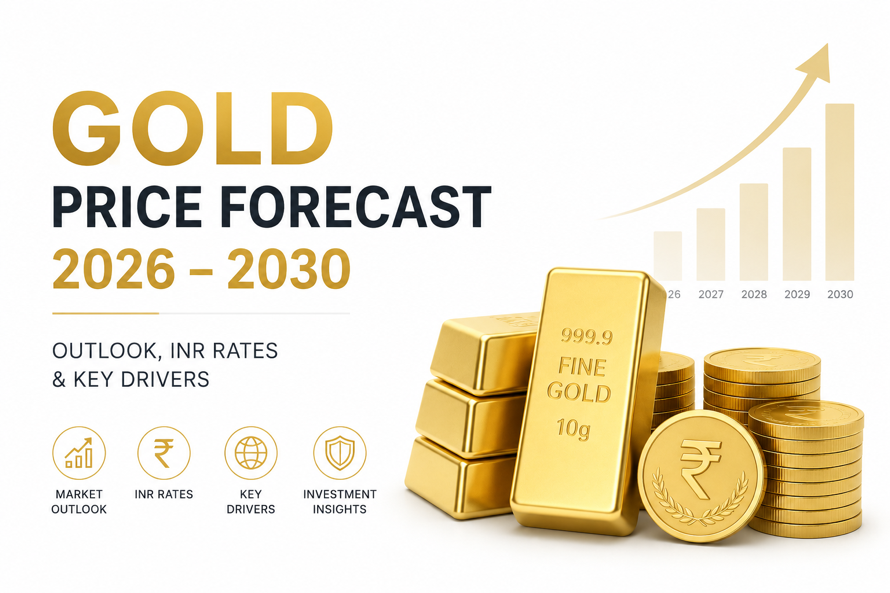
Gold is trading at Rs 1,52,670 per 10 grams (24-carat) as of September 25, 2026, with international spot prices at around $4,268 per ounce. If the forces driving this rally hold, most major bank forecasts point to significantly higher levels by 2030.
Here is the year-wise price forecast for Indian investors across both carats:
| Year | 24K per 10g | 22K per 10g | Global Outlook |
|---|---|---|---|
| 2026 | Rs 1,28,000 – Rs 1,58,000 | Rs 1,18,000 – Rs 1,45,000 | Volatile but elevated |
| 2027 | Rs 1,35,000 – Rs 1,69,000 | Rs 1,25,000 – Rs 1,55,000 | Central bank demand |
| 2028 | Rs 1,43,000 – Rs 2,15,000 | Rs 1,31,000 – Rs 1,97,000 | De-dollarisation trend |
| 2029 | Rs 1,52,000 – Rs 2,20,000 | Rs 1,40,000 – Rs 2,02,000 | Supply and demand tightening |
| 2030 | Rs 1,62,000 – Rs 2,60,000 | Rs 1,49,000 – Rs 2,38,000 | Bullish long-term case |
These are forecasts based on current market trends, central bank data, and major bank analyst consensus. Actual prices depend on US monetary policy, import duties, INR/USD movement, and global demand shifts.
What Is Driving Gold Prices Higher
Three structural forces are behind this rally, and unlike past gold bull cycles, all three are playing out simultaneously.
Central Bank Buying at Record Pace
Central banks globally bought an average of around 225 tonnes of gold per quarter between 2021 and 2025. In Q2 2026, that figure rose to 289 tonnes. China’s People’s Bank alone expanded its monthly gold purchases from roughly 1 tonne to 5 to 8 tonnes per month.
This is not typical investor sentiment driving prices. It is sovereign demand. Countries diversifying their reserves away from US dollar assets are accumulating gold at a pace that keeps a structural floor under prices regardless of short-term Fed policy moves.
India’s 15% Import Duty Creates a Price Floor
In May 2026, India raised its gold import duty from 6% to 15%. This single policy decision added a substantial premium to domestic gold prices independent of what happens to global spot prices.
To understand how this works in practice, here is the formula that translates global gold prices into what you pay in India:
INR per 10 g = (Spot USD per ounce / 31.1035) x 10 x USD/INR x (1 + import duty) x (1 + GST)
At a 15% import duty plus 3% GST, even a flat global gold price still results in elevated domestic prices. A rollback of the duty to 6% would cut local prices by roughly 8% overnight. That is a policy risk worth keeping in mind.
Rupee Depreciation Amplifies Price Gains for Indian Buyers
The rupee weakened approximately 7% against the dollar in 2026. Since gold is priced globally in US dollars, rupee depreciation inflates gold prices in Indian rupee terms even when global prices are flat.
Over the last decade, the rupee has moved from around 60 per dollar to over 84, a structural depreciation trend that has amplified gold returns for Indian holders compared to global returns measured in dollar terms.
What Major Banks Are Forecasting for Gold
The institutional consensus on gold is more bullish than it has been in years.
| Bank | 2027 Target (per ounce) | 2030 View |
|---|---|---|
| J.P. Morgan | $5,400 | Up to $8,000 in upside case |
| Goldman Sachs | $5,400 to $5,600 | $6,000 to $6,200 |
| Westpac | $5,000 peak | Around $4,970 |
In rupee terms, a $5,400 to $5,600 per ounce price in 2027 (assuming USD/INR around 92 and the current 15% duty structure) would translate to approximately Rs 1,90,000 to Rs 1,96,000 per 10 grams. The Goldman Sachs 2030 scenario at $6,000 to $6,200 per ounce would push domestic prices toward Rs 2,30,000 to Rs 2,50,000 per 10 grams, while the high-end J.P. Morgan case of $8,000 would push well above Rs 3,00,000.
These are not base cases but they illustrate the range of outcomes analysts are pricing in.
How to Invest in Gold in India
Indian investors have several options. Sovereign Gold Bonds (SGBs) issued by the RBI have been discontinued for new tranches, so the practical choices now are:
Gold ETFs (Best for Most Investors)
Gold ETFs listed on NSE and BSE track 24K gold prices and trade like any stock. They are SEBI-regulated, liquid, and carry no storage or purity risk. You can buy as little as 1 unit (roughly 1 gram) through any broker or investment app.
The tax treatment is favourable: long-term capital gains (LTCG) at 12.5% apply after a holding period of just 12 months for gold ETFs, unlike 24 months for physical gold.
Best for: Most individual investors who want straightforward, tax-efficient gold exposure.
Gold Mutual Funds
Gold fund-of-funds invest in gold ETFs but do not require a demat account. SIP (Systematic Investment Plan) options are available, making them useful for investors who want to automate regular gold accumulation.
The tax treatment mirrors that of gold ETFs. The only downside is a slightly higher expense ratio compared to buying ETFs directly.
Best for: SIP-oriented investors without a demat account.
Physical Gold (Coins, Bars, Jewellery)
Direct ownership of gold gives you the metal itself. The trade-offs are storage costs, making charges on jewellery (which you lose entirely on resale), and the risk of buying at a premium over market rates.
For physical gold and coins, the LTCG holding period is 24 months (not 12 months like ETFs), after which gains are taxed at 12.5% without indexation.
Best for: Investors with secure storage and a genuinely long-term mindset, or those buying for cultural and family occasions.
Digital Gold
Several platforms offer digital gold backed by physical gold held in vaults, in quantities starting from Rs 1. These are convenient for tiny amounts but carry platform risk and limited exit options compared to ETFs.
Best for: New investors wanting to start with modest amounts.
Sovereign Gold Bonds (Existing Holdings Only)
The RBI has discontinued issuing new SGB tranches. If you hold existing SGBs, the maturity tax exemption applies only if you hold the bond for the full 8-year term from the original issue date. Selling before maturity on the secondary market is treated as capital gains at standard rates.
Tax on Gold Investments in India
| Investment Type | Short-Term (Under Holding Period) | Long-Term Rate | Holding Period for LTCG |
|---|---|---|---|
| Gold ETFs | At slab rate | 12.5% | 12 months |
| Gold Mutual Funds | At slab rate | 12.5% | 12 months |
| Physical Gold / Coins | At slab rate | 12.5% | 24 months |
| SGBs (held to maturity) | Exempt | Exempt | 8 years (full term) |
These rates reflect the post-2024 budget changes. Always verify the current rules with a chartered accountant, as tax laws on capital gains can change in subsequent budgets.
Risks That Could Push Gold Prices Lower
The bull case is not guaranteed. Here are the scenarios that could reverse the current trend.
Federal Reserve rate surprise: If the Fed pivots to rate hikes or keeps rates higher for longer than markets expect, the dollar strengthens and gold typically falls. This is the single biggest short-term risk.
Import duty rollback: India could reduce gold import duty in a future Union Budget to curb the current account deficit. A rollback from 15% to 6% would cut domestic prices by roughly 8% independent of global movements.
Central bank demand pause: If China, Russia, or other major central bank buyers reduce purchases, one of the structural demand pillars weakens meaningfully.
Strong dollar environment: A prolonged dollar bull market compresses gold prices in USD terms and adds headwinds even if rupee depreciation partially offsets it.
Demand substitution in jewellery: If high gold prices cause Indian households to shift significantly toward diamond, platinum, or artificial jewellery, the large domestic consumption base shrinks, removing some demand support.
Is This a Good Time to Buy Gold in India?
Gold at Rs 157,000 per 10 g is expected to maintain an upward, bullish trend. That does not make it a bad time to buy for a long-term investor, but it does mean position sizing and entry strategy matter more than usual.
A staggered buying approach (purchasing in smaller portions over 6 to 12 months) reduces the risk of catching a short-term peak. Even if gold corrects 10 to 15 per cent from current levels, the 5-year thesis based on central bank demand, de-dollarisation, and rupee depreciation remains intact.
Most financial planners suggest keeping gold at 5 to 15 per cent of your total investment portfolio. Many Indian households already exceed this through inherited jewellery, which is worth factoring in before adding more financial gold exposure.
Gold ETFs are the most efficient vehicle for new financial gold allocations at current prices given their 12-month LTCG period, low costs, and SEBI oversight.
FAQs
1. Why is the gold price so high in India right now?
Three factors are at work together: record central bank gold buying globally (especially China), India’s 15% gold import duty raising the domestic price floor above global prices, and rupee depreciation adding to import costs. All three are structural rather than temporary, which is why analysts remain broadly bullish.
2. What happened to Sovereign Gold Bonds?
The RBI has discontinued issuing new SGB tranches. Existing SGB holders who hold to the full 8-year maturity retain the capital gains tax exemption. Early exits via the secondary market are taxed as capital gains at standard rates.
3. Are gold ETFs better than physical gold in India?
For most investors, yes. Gold ETFs are SEBI-regulated, carry no storage or purity risk, can be bought and sold at market price, and qualify for LTCG at 12.5% after just 12 months versus 24 months for physical gold. The only case for physical gold is if you have specific cultural or family reasons to hold the metal directly.
4. How much of my portfolio should be in gold?
Financial planners generally recommend 5 to 15 per cent in gold as part of an overall portfolio. If you already hold significant gold jewellery or family heirlooms, count that before adding more. Gold works best as a stabiliser alongside equity and debt investments, not as a standalone growth bet.
5. How does the rupee affect gold prices in India?
Since gold is priced globally in US dollars, every percentage point of rupee depreciation against the dollar raises the cost of imported gold in rupee terms. The formula is: INR per 10 g = (spot USD per ounce / 31.1035) x 10 x USD/INR x (1 + import duty) x (1 + GST). This is why Indian gold prices can rise even on days when dollar gold prices fall if the rupee weakens enough to offset the move.
Disclaimer: This article is for educational and informational purposes only. It does not constitute investment advice. Gold prices are subject to market risk, currency fluctuation risk, import duty changes, and global events. Past performance does not indicate future results. Please consult a SEBI-registered investment advisor before making investment decisions.
Disclaimer
The stocks mentioned in this article are not recommendations. Please conduct your own research and due diligence before investing. Investment in securities market are subject to market risks, read all the related documents carefully before investing. Please read the Risk Disclosure documents carefully before investing in Equity Shares, Derivatives, Mutual fund, and/or other instruments traded on the Stock Exchanges. As investments are subject to market risks and price fluctuation risk, there is no assurance or guarantee that the investment objectives shall be achieved. Lemonn (Formerly known as NU Investors Technologies Pvt. Ltd) do not guarantee any assured returns on any investments. Past performance of securities/instruments is not indicative of their future performance.