Technical Analysis for Indian Stock Market Beginners: A Practical 2026 Guide
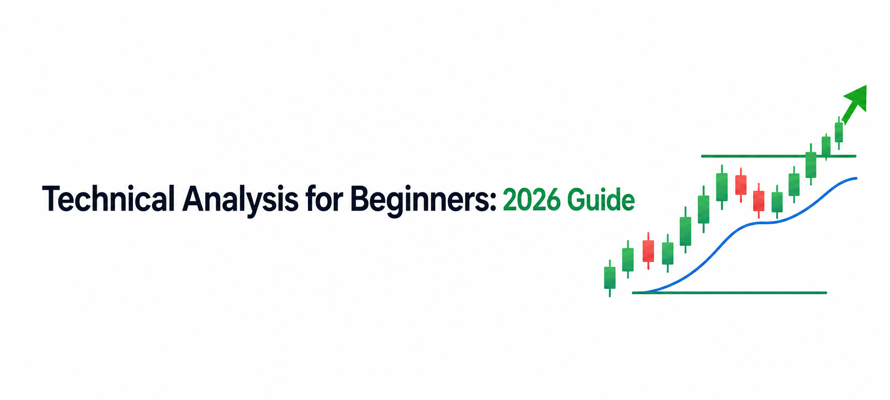
What is Technical Analysis?
Technical analysis (TA) is the study of historical price and volume data to forecast future price movements. Unlike fundamental analysis (which examines company financials), TA focuses entirely on price charts and market-generated data. The core assumption is that all available information is already reflected in the price.
Why Technical Analysis Matters for Indian Traders
NSE and BSE produce highly liquid, well-charted markets for Nifty 50, Bank Nifty, and hundreds of individual stocks. Technical patterns repeat across Indian equity markets with reasonable reliability, especially in liquid large-cap stocks and index derivatives.
“Start investing with confidence! Explore
share market
and grow your wealth.”
Candlestick Charts: The Foundation
Every technical analysis begins with understanding candlestick charts. Each candle represents a time period (1-minute, 5-minute, daily, weekly) and shows four data points: Open, High, Low, Close.
| Candle Color | Meaning | Open vs Close |
|---|---|---|
| Green (Bullish) | Price rose during period | Close > Open |
| Red (Bearish) | Price fell during period | Close < Open |
| Doji (cross) | Indecision; open equals close | Open ≈ Close |
| Hammer | Bullish reversal signal | Long lower wick, small body |
| Shooting Star | Bearish reversal signal | Long upper wick, small body |
Support and Resistance: The Most Important Concept
Support is a price level where buying demand has historically been strong enough to stop price declines. Resistance is a level where selling pressure has historically capped price rises. When price breaks through resistance, that level often becomes new support (and vice versa). This is called role reversal.
Moving Averages: Trend Identification
A moving average smooths price data by averaging closing prices over a defined period. The most commonly used are 20 EMA (short-term trend), 50 SMA (medium-term trend), and 200 SMA (long-term trend). When price is above all three, the stock is in a strong uptrend.
| Moving Average | Period | Use Case |
|---|---|---|
| 20 EMA (Exponential) | 20 days | Short-term momentum, swing trade |
| 50 SMA (Simple) | 50 days | Medium-term trend filter |
| 200 SMA (Simple) | 200 days | Long-term trend: above is bullish |
| 9 EMA | 9 days | Very short-term, intraday trading |
RSI (Relative Strength Index)
RSI is a momentum oscillator ranging from 0 to 100. Readings above 70 indicate overbought conditions (potential selling opportunity). Readings below 30 indicate oversold conditions (potential buying opportunity). In strong trending markets, stocks can remain overbought or oversold for extended periods; do not use RSI alone.
MACD (Moving Average Convergence Divergence)
MACD shows the relationship between two EMAs (typically 12-day and 26-day). When the MACD line crosses above the signal line (9-day EMA of MACD), it generates a bullish crossover signal. Crossover below generates a bearish signal. Best used for trend confirmation, not as standalone signals.
Volume Analysis
Volume confirms price moves. A breakout above resistance on high volume is more reliable than one on low volume. Similarly, a price decline on low volume may not be sustained. Always check volume when interpreting price pattern breakouts.
Disclaimer
The stocks mentioned in this article are not recommendations. Please conduct your own research and due diligence before investing. Investment in securities market are subject to market risks, read all the related documents carefully before investing. Please read the Risk Disclosure documents carefully before investing in Equity Shares, Derivatives, Mutual fund, and/or other instruments traded on the Stock Exchanges. As investments are subject to market risks and price fluctuation risk, there is no assurance or guarantee that the investment objectives shall be achieved. Lemonn (Formerly known as NU Investors Technologies Pvt. Ltd) do not guarantee any assured returns on any investments. Past performance of securities/instruments is not indicative of their future performance.
Related Posts


Download Lemonn
Download my trading app for SIP, demat account services—get a free demat account with our demat apps.