
Snowflake Stock Surges 26% After Strong Quarterly Results
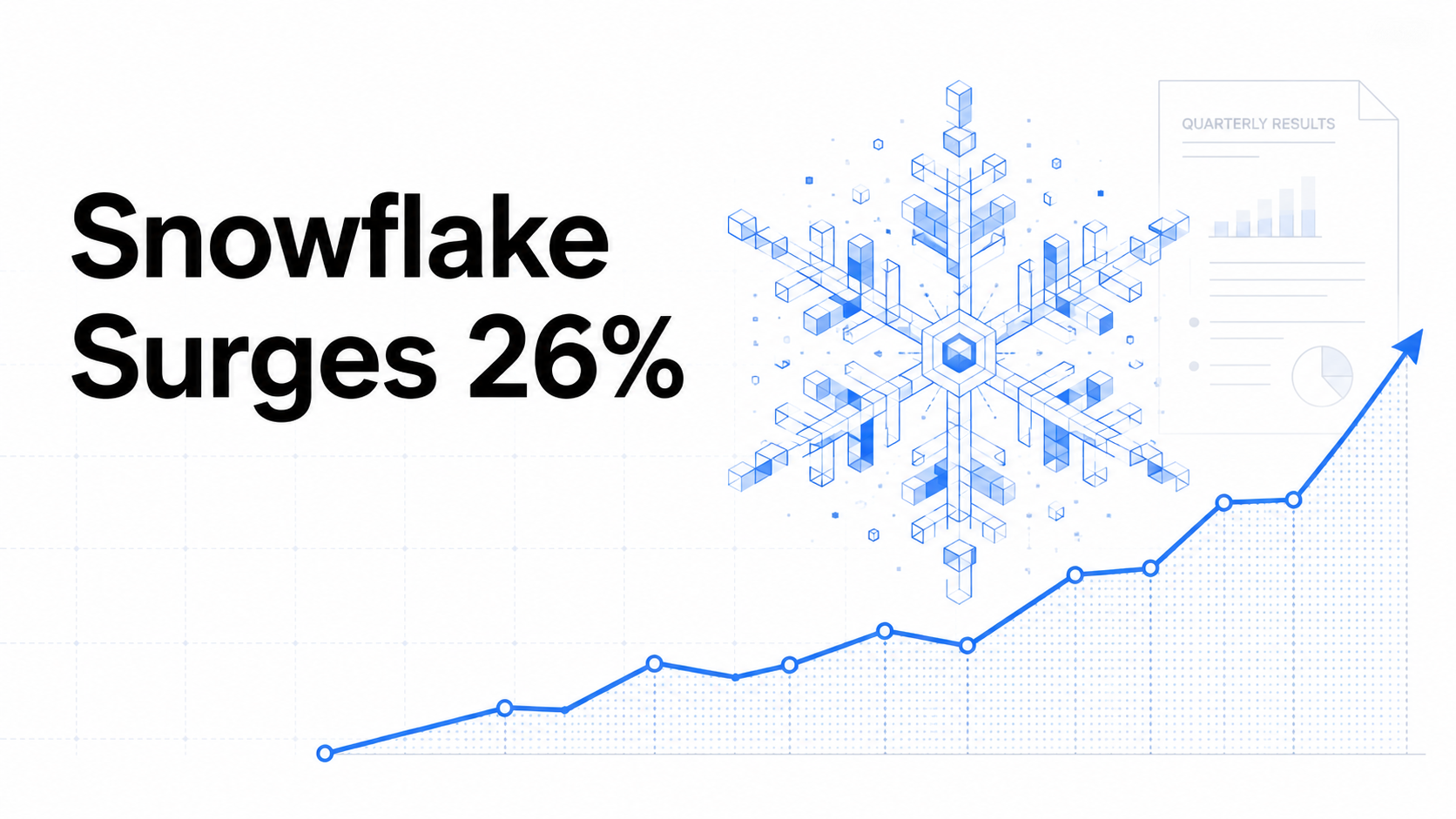
Snowflake shares surged about 26% after the cloud data company reported quarterly results that came in ahead of market expectations. The sharp rally reflected stronger business momentum and renewed investor confidence in Snowflake’s ability to benefit from rising enterprise spending on data, analytics, and artificial intelligence.
For investors, however, a one-day stock jump is only part of the story. The more important questions are what drove the earnings beat, whether Snowflake can sustain its growth, and how AI could influence demand for its data platform.
Why Did Snowflake Stock Surge 26%?
Snowflake stock rallied after its quarterly performance exceeded expectations and gave investors stronger signals about the company’s growth trajectory.
The reaction appears particularly significant because high-growth software companies are often valued on future expectations rather than current earnings alone. When results and management’s outlook improve at the same time, investors may quickly reassess what they are willing to pay for the stock.
Three factors are particularly important when assessing Snowflake’s results:
- Better-than-expected quarterly business performance
- Healthy demand for its cloud data platform
- Growing expectations around AI-related workloads
The results helped ease concerns that slower enterprise technology spending could permanently weaken Snowflake’s growth.
What Does Snowflake Actually Do?
Snowflake operates a cloud-based data platform that allows businesses to store, process, analyse, and share large amounts of data.
Instead of companies maintaining separate data systems across different cloud environments, Snowflake provides infrastructure designed to bring much of that work together.
Its platform works across major cloud providers, including Amazon Web Services, Microsoft Azure, and Google Cloud.
This matters because modern companies generate enormous amounts of information from customer transactions, applications, websites, internal systems, connected devices, and other sources.
Businesses increasingly want to use that data not only for traditional analytics but also to train and operate AI applications.
That puts data infrastructure companies such as Snowflake in an important position in the AI ecosystem.
“Start investing with confidence! Explore
Lemonn
and grow your wealth.”
Why Were Snowflake’s Quarterly Results Important?
A quarterly earnings beat becomes meaningful when it suggests that underlying demand is stronger than investors had previously assumed.
For Snowflake, investors generally pay close attention to product revenue because it provides a clearer picture of customer usage of the company’s platform.
Unlike traditional subscription software businesses that charge a relatively predictable fixed fee, Snowflake has historically had significant consumption-based elements in its business model.
Customers effectively consume computing and data resources based on their needs.
That means customer optimisation can affect near-term growth. When companies reduce unnecessary cloud usage, Snowflake can feel the impact even when customers remain on the platform.
Conversely, increasing workloads can accelerate consumption.
Product revenue remains a key metric
Investors evaluating Snowflake earnings should therefore look beyond headline revenue.
Important indicators include:
| Metric | Why investors watch it |
|---|---|
| Product revenue | Shows demand for Snowflake’s core platform |
| Remaining performance obligations | Indicates contracted future business |
| Customer growth | Measures expansion of Snowflake’s user base |
| Large customers | Helps assess enterprise adoption |
| Net revenue retention | Shows spending trends among existing customers |
| Operating margins | Indicates progress toward profitability |
A strong quarter across several of these indicators can support a much more positive assessment of Snowflake’s long-term earnings potential.
Is Artificial Intelligence Helping Snowflake?
AI is becoming increasingly important to Snowflake’s investment story.
Generative AI models require access to large amounts of organised, secure, and usable data. For enterprises, much of that valuable information already sits inside corporate databases and cloud infrastructure.
That creates an opportunity for platforms that help companies manage and analyse their data while building AI applications.
Snowflake has been expanding its capabilities beyond conventional data warehousing, positioning its platform for analytics, application development, machine learning, and generative AI workloads.
Why enterprise data matters for AI
Consider a large retailer that wants to build an AI assistant capable of answering questions about inventory, customer demand, and sales.
The AI model itself is only one part of the system.
The company also needs reliable access to:
- Historical sales information
- Product databases
- Inventory data
- Customer information
- Supply-chain records
- Security and governance controls
This is where data platforms can become an important part of enterprise AI infrastructure.
If businesses move more AI workloads onto Snowflake, the company could potentially benefit from higher platform consumption.
Can Snowflake Compete With Databricks and Cloud Giants?
Competition remains one of the biggest questions surrounding Snowflake.
The company operates in a market that includes Databricks as well as cloud giants such as Amazon, Microsoft, and Google.
Each of these companies wants a larger share of enterprise spending on data infrastructure and AI.
Snowflake therefore needs to convince customers that its platform provides enough performance, flexibility, governance, and ease of use to justify continued spending.
Competition could also put pressure on pricing.
That makes customer retention and expansion particularly important. A company can report strong new-customer growth, but if existing customers reduce spending or move workloads elsewhere, long-term growth can suffer.
What Does the 26% Rally Mean for Snowflake Investors?
A 26% rally signals that the quarterly update materially changed market expectations.
It does not necessarily mean the stock will continue rising at the same pace.
Large post-earnings movements often occur because investors rapidly adjust forecasts for future revenue and profitability. Short sellers closing positions and momentum trading can further amplify the initial move.
Investors considering Snowflake after the rally should therefore separate the business improvement from the stock-price reaction.
A strong company can still become expensive if its valuation rises faster than its expected earnings.
What Could Drive Snowflake’s Next Phase of Growth?
Several trends could influence Snowflake’s performance over the coming quarters.
1. Enterprise AI adoption
More companies are experimenting with AI applications using their proprietary data.
If these projects move from pilots to large-scale deployment, demand for data infrastructure could increase.
2. Higher customer consumption
Snowflake benefits when customers run more workloads on its platform.
Growing data volumes and increasingly complex analytics could support consumption.
3. New products
Expanding beyond traditional cloud data warehousing can increase Snowflake’s addressable market.
AI, machine learning, applications, and data engineering are particularly important areas to watch.
4. Large enterprise customers
Winning and expanding major corporate accounts can generate significant recurring consumption.
Large organisations also tend to have substantial amounts of data that can support multiple workloads.
What Are the Biggest Risks for Snowflake?
The post-results rally does not eliminate the company’s risks.
Investors should monitor:
- Intense competition in cloud data platforms
- Slower enterprise technology spending
- Customer efforts to optimise cloud costs
- High expectations embedded in the stock valuation
- Execution risk around new AI products
- Pressure on margins as Snowflake invests for growth
AI enthusiasm can also raise expectations quickly. Snowflake will eventually need to demonstrate that AI-related demand translates into meaningful platform usage and financial performance.
Is Snowflake’s Earnings Rally Sustainable?
The sustainability of Snowflake’s rally will depend less on one quarterly report and more on whether the company can deliver consistent product growth over several quarters.
Investors should watch management guidance, customer consumption patterns, large-client additions, remaining performance obligations, and operating margins.
AI adoption could provide an additional growth engine, but the market will likely expect measurable results rather than AI announcements alone.
Snowflake’s quarterly beat has given investors a reason to become more optimistic. The next challenge is turning that optimism into sustained financial performance.
FAQs About Snowflake Stock
Why did Snowflake stock rise 26%?
Snowflake shares jumped after quarterly results exceeded market expectations, strengthening investor confidence in the company’s growth outlook and demand for its cloud data platform.
How does Snowflake make money?
Snowflake primarily generates revenue through customer consumption of its cloud-based data platform. Usage can increase as customers store, process, and analyse more data or deploy additional workloads.
Is Snowflake an AI stock?
Snowflake is primarily a cloud data platform company, but AI has become an increasingly important growth opportunity because enterprise AI applications depend heavily on accessible and well-managed data.
Who are Snowflake’s biggest competitors?
Snowflake competes with data-platform specialists such as Databricks and services offered by major cloud providers including Amazon Web Services, Microsoft Azure, and Google Cloud.
What should investors watch after Snowflake earnings?
Product revenue growth, customer consumption, remaining performance obligations, large-customer additions, margins, guidance, and adoption of AI-related products are among the key indicators.
Key Takeaways
- Snowflake shares surged around 26% following stronger-than-expected quarterly results.
- The rally reflects improved expectations around the company’s growth trajectory.
- Product revenue and customer consumption remain crucial metrics.
- Enterprise AI adoption could create additional demand for Snowflake’s data infrastructure.
- Competition from Databricks and major cloud providers remains a key risk.
- Investors should focus on sustainable growth and valuation rather than the one-day share-price move alone.
Disclaimer
The stocks mentioned in this article are not recommendations. Please conduct your own research and due diligence before investing. Investment in securities market are subject to market risks, read all the related documents carefully before investing. Please read the Risk Disclosure documents carefully before investing in Equity Shares, Derivatives, Mutual fund, and/or other instruments traded on the Stock Exchanges. As investments are subject to market risks and price fluctuation risk, there is no assurance or guarantee that the investment objectives shall be achieved. Lemonn do not guarantee any assured returns on any investments. Past performance of securities/instruments is not indicative of their future performance.
To read the RA disclaimer
Research Analyst - Gaurav Garg
Related Posts


Download Lemonn
Download my share market app for stock trading—trade stocks effortlessly in the market.



