
Zerodha Arbitrage Fund: How It Works, Tax and Risks
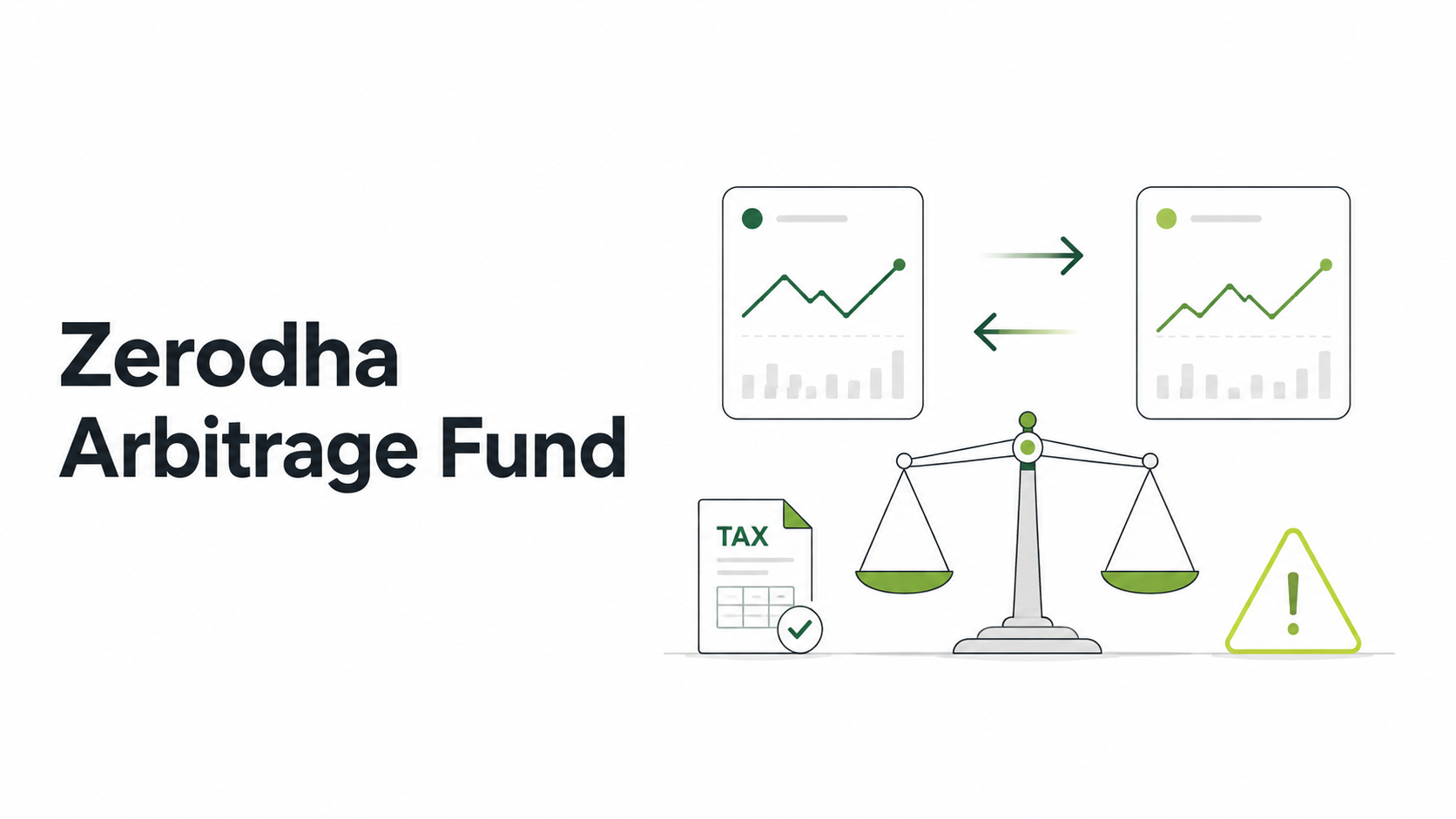
Zerodha Arbitrage Fund is an open-ended mutual fund that seeks to earn from price differences between the cash and derivatives markets. It aims to provide relatively low directional equity exposure while qualifying for equity-oriented mutual fund taxation under current tax rules.
The fund’s NFO ran from August 12 to August 14, 2026. It has since started reporting daily NAVs, with Zerodha Fund House reporting an NAV of ₹10.0197 as of August 28, 2026.
For investors looking to park surplus cash for a few months, an arbitrage fund can be worth understanding. However, it is still a market-linked mutual fund, so neither capital nor returns are guaranteed.
What is the Zerodha Arbitrage Fund?
Zerodha Arbitrage Fund is an open-ended arbitrage scheme from Zerodha Fund House.
Its investment objective is to generate income and capital appreciation by investing in arbitrage opportunities in the cash and derivatives segments of the equity market. Money that cannot be efficiently deployed in arbitrage opportunities can be invested in debt and money market instruments.
The scheme tracks the NIFTY 50 Arbitrage Index TRI.
Unlike a traditional equity mutual fund, an arbitrage fund generally does not depend heavily on predicting whether the stock market will rise or fall.
Instead, it tries to benefit from temporary pricing differences.
How does Zerodha Arbitrage Fund work?
Suppose a company’s share trades at ₹1,000 in the cash market while its futures contract trades at ₹1,008.
The fund could:
- Buy the share at ₹1,000.
- Sell its futures contract at ₹1,008.
- Hold the positions until the prices converge.
- Earn the spread after transaction costs and other expenses.
Because the fund simultaneously buys the share and takes an opposite position in futures, much of its directional equity-market exposure is hedged.
If the stock price rises, the cash position gains while the futures position loses.
If the stock falls, the cash position loses while the futures position gains.
The fund is mainly interested in the difference between the two prices.
“Start investing with confidence! Explore the best
mutual funds
and grow your wealth.”
Why do cash and futures prices differ?
Futures can trade above or below spot-market prices because of factors such as:
- interest rates,
- financing costs,
- expected dividends,
- market demand,
- liquidity,
- time remaining until expiry.
These differences create arbitrage opportunities.
However, spreads are not always equally attractive.
If many investors and institutions compete for the same opportunities, spreads can become smaller, reducing potential returns.
Where does Zerodha Arbitrage Fund invest?
The portfolio can broadly contain three types of exposure.
Equity shares
The fund buys equity shares where arbitrage opportunities are available.
Equity derivatives
Corresponding futures positions are generally used to hedge the shares and capture the spread.
Debt and money market instruments
When arbitrage opportunities are limited, part of the portfolio may be parked in short-term instruments such as TREPS or treasury bills. Zerodha specifically notes that the scheme may use short-term debt instruments when pricing gaps shrink.
What is the Zerodha Arbitrage Fund NAV?
The NFO allotment NAV was ₹10, subject to applicable stamp duty.
The fund has now moved beyond the NFO stage.
Zerodha Fund House reported the Zerodha Arbitrage Fund NAV at ₹10.0197 as of August 28, 2026. NAV changes daily, so investors should check the latest official number before transacting.
What is the minimum investment?
According to Zerodha Fund House:
- Minimum lump-sum investment: ₹5,000
- Minimum SIP investment: ₹1,000
The fund can be accessed through Coin by Zerodha and several other mutual fund platforms.
What is the exit load?
An exit load of 0.25% of the applicable NAV applies if units are redeemed or switched out within 30 days from allotment.
After 30 days, the exit load is nil.
This matters for anyone considering the scheme as an extremely short-term parking option.
How is Zerodha Arbitrage Fund taxed?
One of the key attractions of arbitrage funds is their tax treatment.
Although the strategy can produce a relatively low-volatility return profile, qualifying arbitrage funds are generally treated as equity-oriented mutual funds for taxation.
Tax treatment
| Holding period | Current tax treatment |
|---|---|
| 12 months or less | STCG taxed at 20% |
| More than 12 months | LTCG rules apply |
| Eligible annual equity LTCG exemption | ₹1.25 lakh |
| LTCG above exemption | 12.5% |
Applicable surcharge and cess can also apply.
The ₹1.25 lakh threshold should not be interpreted as a special Zerodha Arbitrage Fund exemption.
It applies to eligible aggregate long-term capital gains covered by the relevant equity tax provisions in a financial year.
Tax laws can change, so investors should verify the rules applicable when they redeem.
Is an arbitrage fund better than a fixed deposit?
Not necessarily.
The two products work differently.
| Feature | Arbitrage fund | Bank FD |
|---|---|---|
| Return | Market-linked | Predetermined interest |
| Capital guarantee | No | Deposit protection subject to applicable rules |
| Equity-oriented taxation | Potentially yes | No |
| Volatility | Usually relatively low | No daily market NAV |
| Liquidity | Redemption based | Depends on FD terms |
For a higher-tax-bracket investor, tax treatment may make an arbitrage fund attractive in certain situations.
However, an FD is easier to understand for someone who wants predictable interest.
Arbitrage fund vs liquid fund
Liquid funds invest primarily in short-term debt and money market securities.
Arbitrage funds earn mainly through cash-futures spreads while maintaining sufficient equity exposure to qualify for equity-oriented tax treatment.
Liquid-fund taxation can therefore be very different.
The better choice depends on your holding period, tax position, liquidity requirements and willingness to accept market-linked returns.
What returns can investors expect?
There is no fixed return.
Returns depend on:
- available arbitrage spreads,
- short-term interest rates,
- portfolio expenses,
- execution efficiency,
- debt-market returns,
- market volatility.
A period of high market volatility can sometimes create wider arbitrage spreads.
When spreads are narrow, return opportunities may reduce.
Zerodha explicitly states that neither returns nor capital safety are guaranteed.
What are the risks?
Arbitrage spread risk
Cash and futures price differences can shrink.
Lower spreads can reduce expected returns.
Basis risk
Cash and futures prices may not converge exactly as expected at every point before expiry.
Execution risk
The strategy requires efficient execution of multiple transactions.
Price changes during execution can reduce the available spread.
Counterparty and derivative risk
Derivative transactions carry risks associated with market infrastructure and counterparties, although exchange-traded derivatives have established settlement mechanisms.
Debt-market risk
The fund can invest part of its assets in debt and money market securities.
That creates interest-rate, liquidity, valuation and credit-related risks depending on the portfolio.
No guaranteed capital
An arbitrage fund is not a bank deposit.
Its NAV can move up or down.
Who may consider Zerodha Arbitrage Fund?
It may suit investors who:
- have surplus cash for a few months,
- understand market-linked mutual funds,
- want relatively low directional equity exposure,
- are considering tax efficiency,
- can stay invested beyond the early exit-load period.
It may not suit investors who require guaranteed returns or cannot tolerate any fluctuation in investment value.
FAQs
Is Zerodha Arbitrage Fund safe?
It is designed to have relatively low directional market exposure, but it is not risk-free. Returns and capital are not guaranteed.
What is the Zerodha Arbitrage Fund exit load?
The exit load is 0.25% for redemption or switch-out within 30 days. There is no exit load after 30 days.
What is its latest NAV?
Zerodha reported an NAV of ₹10.0197 as of August 28, 2026. NAV changes daily.
Is Zerodha Arbitrage Fund tax-free?
No. Applicable short-term or long-term capital gains tax must be paid.
Is an arbitrage fund better than an FD?
It can provide more favourable taxation for some investors, but returns are market-linked rather than guaranteed.
What is the ideal holding period?
Zerodha describes the fund as suitable for parking surplus cash for at least a few months, ideally around three months or more.
Key takeaways
- Zerodha Arbitrage Fund seeks to earn from cash-futures price differences.
- The NFO ran from August 12 to August 14, 2026.
- NAV was ₹10.0197 as of August 28, 2026.
- STCG is currently taxed at 20%.
- Eligible LTCG above the annual exemption is taxed at 12.5%.
- A 0.25% exit load applies within 30 days.
- Returns and capital are not guaranteed.
Disclaimer
The stocks mentioned in this article are not recommendations. Please conduct your own research and due diligence before investing. Investment in securities market are subject to market risks, read all the related documents carefully before investing. Please read the Risk Disclosure documents carefully before investing in Equity Shares, Derivatives, Mutual fund, and/or other instruments traded on the Stock Exchanges. As investments are subject to market risks and price fluctuation risk, there is no assurance or guarantee that the investment objectives shall be achieved. Lemonn (Formerly known as NU Investors Technologies Pvt. Ltd) do not guarantee any assured returns on any investments. Past performance of securities/instruments is not indicative of their future performance.
Related Posts

Download Lemonn
Download my mutual fund app - your mutual funds, stock, invest in ipo, mf, trade invest hub with demat account features.



