Instant Margin Pledge for F&O Trading in India: What to Compare Across Brokers
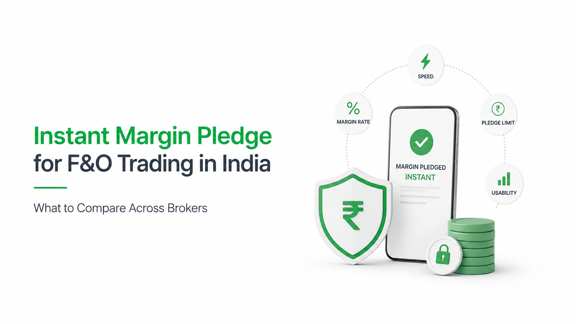
If you are asking which broker offers instant margin pledge for F&O trading India, ask a better question first: how usable is that pledged margin when you actually need to trade?
For active Indian traders, especially in options and futures, speed matters. But speed alone is not enough. A broker can market an “instant margin pledge India” flow and still leave you with delays, low usable collateral, extra OTP friction, or segment-level restrictions that show up only after you open the account.
This guide is a practical buyer’s checklist. It explains what “instant margin pledge” means in the Indian market, the hidden constraints that actually matter, and where Lemonn fits if you want to use existing holdings as margin without hopping across multiple apps.
Important: F&O trading carries high risk. SEBI’s updated study said 93% of individual traders in equity F&O incurred losses between FY22 and FY24, with aggregate losses above ₹1.8 lakh crore. Use leverage and collateral carefully, and verify live broker terms before pledging. SEBI’s updated study
What ‘instant margin pledge’ actually means in Indian F&O
In India, a margin pledge is a SEBI-approved mechanism that lets you use eligible securities already sitting in your Demat account as collateral for trading margin, instead of selling them or adding fresh cash. That usually means selected stocks, ETFs, and sometimes other approved securities can contribute margin value after the broker applies a haircut.
So when a broker says instant margin pledge India, it usually means the pledge request, OTP authorisation, and collateral visibility happen fast enough for usable margin to show up in the same session. Sometimes in minutes. Sometimes later. But “instant” does not mean every product or segment is treated the same way.
A few terms matter here:
- Pledged securities: the holdings you keep in your Demat but mark as collateral
- Haircut: the percentage deducted from market value before margin is credited
- Approved collateral list: securities the broker and clearing member actually accept
- Usable margin: what you can really deploy for your intended F&O trade, not just what appears as a total collateral number
If you want the basic mechanics in plain English, the Lemonn margin pledge explainer is a good starting point.
Why instant pledge matters when margin requirements move fast
In F&O, timing is not a side issue. It can decide whether you get the setup you planned for.
Margins can change quickly because of:
- volatility spikes
- expiry-day positioning
- lot-size and contract-value changes
- portfolio-level hedge adjustments
- intraday opportunities that do not wait for next-day collateral activation
Say you hold a long-term portfolio and want to deploy some of that value toward an options-selling strategy or a futures position. If your broker takes until the next trading day to activate collateral, that setup may be gone. If collateral shows up fast but is not usable for your segment, you still miss the window.
That is why traders comparing the best broker for pledge margin F&O should focus on what happens in practice, not marketing language. Speed matters only if the collateral becomes usable in the product you actually trade.
Traders who care about fast execution usually care about in-app responsiveness, chart-to-order flow, and low-friction exits too. So margin workflow and platform speed often belong in the same checklist, especially if you trade weekly expiries or scalp options. This overlaps with what matters in fast order execution brokers in India for expiry day trades and a fastest options broker India comparison.
“Start investing with confidence! Explore
option trading
and grow your wealth.”
The 7 broker checkpoints to compare before you choose
If you are comparing brokers for instant pledge in F&O, use these seven checkpoints before opening an account:
- Turnaround time from pledge request to visible margin
- What asset types are accepted as collateral
- Haircut level and approved security list
- How much of that collateral is actually usable for F&O
- Segment-wise usability: option buying, option selling, futures, intraday
- Charges, unpledge or revocation rules, and OTP steps
- Whether the entire flow works inside one app without extra app-hopping
A broker can look good on one of these and weak on the other six. That is where many traders get caught.
Compare turnaround time: real-time, ~15 minutes, or next trading day
This is the first practical filter.
When brokers describe margin pledge timing, you will usually see one of three user experiences:
1. Near real-time or same-session activation
This is what most traders mean when they search which broker offers instant margin pledge for F&O trading India. You complete the pledge flow, approve it with OTP, and usable margin reflects quickly enough to matter during market hours.
2. Short delay, often around 15 minutes or more
This can still work for planned trades. It is less useful for reactive F&O setups.
3. Next trading day credit
This may be fine for investors. It is less useful for active F&O users who need margin when volatility expands or expiry-day opportunities appear.
The right benchmark depends on how you trade. A beginner placing occasional hedged trades may tolerate a delay. An active options trader probably will not.
Lemonn positions pledge as a low-friction, in-app experience where margin is added in just a few clicks and can be used across segments, while the holdings remain in the Demat account. That convenience matters if you want fewer moving parts between portfolio and trade execution. See the Pledge: Cashless Trading with Pledge on Lemonn product update.
Check what you can pledge: stocks, ETFs, mutual funds, bonds, SGBs
Not every broker supports the same collateral universe.
When comparing platforms, ask exactly which of these are accepted:
- stocks
- ETFs
- mutual funds
- government securities or bonds
- sovereign gold bonds
Do not assume broader support just because the broker supports pledge in general. For many retail traders, the most relevant bucket is still approved stocks and ETFs. But if a chunk of your capital sits in debt funds, gold products, or other instruments, unsupported collateral can make the broker less useful for you.
Also check whether the broker’s list is broad enough for your actual portfolio, not just a few liquid names. A broker may support pledged holdings on paper and still reject a meaningful share of what you own.
If you are deciding whether to use existing holdings as collateral versus separate funding routes, it also helps to understand how pledge differs from loan against securities.
Look beyond the headline: haircut, approved list, and usable collateral
This is where the headline often falls apart.
Suppose your portfolio is worth ₹5 lakh. That does not mean you automatically get ₹5 lakh of usable margin. Brokers and clearing corporations apply haircuts, and only approved securities count. So the value available for margin can be much lower than the portfolio value you see on screen.
Three questions matter here:
What is the haircut?
If a stock has a 20% haircut, only 80% of its market value may count toward collateral.
Is your stock on the approved collateral list?
Popular holdings are not automatically accepted. Approval depends on the collateral framework followed by the broker and clearing member.
Is the collateral stable enough?
Highly volatile securities may have steeper haircuts or become less suitable as margin assets.
In short, compare usable collateral, not portfolio value. That number affects real F&O buying power.
Cash vs collateral: why full trading power is not the same as fully usable F&O margin
A common retail mistake is assuming total margin displayed equals total freely usable F&O margin.
It does not.
In Indian markets, collateral and cash are not always treated the same way for every margin purpose. Depending on the product and risk requirement, some positions may need a cash component, while others may allow broader collateral usage. This matters most for traders moving from investing into active derivatives.
So before choosing a broker, ask:
- how much of margin can come from collateral
- whether a minimum cash component is required
- whether collateral usage differs between buying options and writing options
- whether collateral value changes intraday or only after end-of-day processes
This is one reason the “best” broker depends on trader profile. A trader who mostly buys options may need something different from a trader who writes index options or carries futures overnight.
For a broader risk view around leverage and borrowing mechanics, the Lemonn breakdowns of is MTF safe in India and what is margin in F&O help frame why collateral usability matters more than headline leverage.
Can you use pledged holdings for option buying, option selling, futures, and intraday?
This is one of the most important broker-comparison questions, and many traders ask it too late.
Do not stop at “pledge available.” Ask these four specific use cases:
1. Option buying
Can collateral support premium payment directly, or is fresh cash required?
2. Option selling
Can pledged collateral count toward SPAN and exposure requirements, and if yes, in what mix with cash?
3. Futures
Can collateral be used for futures margin, and are there extra restrictions for overnight carry?
4. Intraday
Can pledged holdings support intraday derivative trades, or only certain carry-forward positions?
Different brokers, risk systems, and clearing setups can lead to different answers. The only safe approach is to verify the live policy before you fund and pledge.
This matters even more if you are a strategy-driven trader using scalping, weekly expiry, or structured entry-stop-loss-target workflows. In that case, margin access, execution speed, and position management need to work together. That is also why many traders comparing F&O platforms look at built-in F&O signal tools in India, because a fast margin flow helps most when trade execution is just as smooth.
What charges, revocation rules, and OTP steps to check before opening an account
A broker’s pledge setup can feel smooth until you look at the operational details.
Here is what to check before opening the account:
Pledge or unpledge charges
Some brokers charge for creating or revoking a pledge. On Lemonn’s materials, pledge and unpledge charges are disclosed as ₹20 in the MTF-related product communication, alongside its flat ₹20 per executed order pricing. Always verify the latest tariff or fee page before acting because charges can change over time. Rates and charges are subject to change. See A Detailed Look at Lemonn Brokerage Charges and Fees.
OTP and depository flow
In India, pledge creation typically involves an OTP flow routed through the depository-linked process. Lemonn’s regulatory information explicitly reminds investors to keep their mobile number and email updated to receive OTP directly from the depository for creating pledge. That is a useful reminder because old contact details can slow down what should have been an instant process. Regulatory and Other Information
Revocation timing
How quickly can you unpledge or revoke? Is there a cut-off time? Does it affect your ability to sell the holding immediately?
Hidden operational constraints
Ask whether there are:
- segment-wise restrictions
- minimum collateral values
- cut-off timings near market close
- restrictions on newly bought holdings
- delays on corporate action dates
This is where trust and disclosure quality matter. A broker with clear policies is easier to compare than one with vague “instant” claims.
How Lemonn fits the comparison for traders who want to use holdings as margin without extra app-hopping
For traders who want portfolio-backed margin in a simple app, Lemonn fits best on three points: all-in-one workflow, transparent pricing, and active-trader usability.
Lemonn is a product of PeepalCo and the broking service is provided by NU Investors Technologies Private Limited, a SEBI-registered broker and Research Analyst, CDSL DP, and NSE/BSE member. It also highlights ISO/IEC 27001:2022 certification, bank-grade encryption, and 24×7 support, trust signals that matter when your securities, margin, and trading flow sit in one place. About Us and Regulatory and Other Information
From a user-flow perspective, Lemonn’s pledge feature is designed so traders can keep holdings in Demat, unlock margin in a few clicks, and use that margin across segments rather than moving money between disconnected systems. That stands out if you do not want a fragmented setup with one app for holdings, another for research, and another for F&O execution.
For active traders, the broader stack matters too. Lemonn combines F&O access with features like BOLT, which provides structured F&O signals with predefined entry, target, and stop-loss inside the broker-native environment. That does not remove trading risk and it is not hands-free automation, but it can reduce workflow friction for traders who want structured setups without app-switching. Past performance is not indicative of future results. If that use case is relevant, explore BOLT by Lemonn: Simplifying FnO Trading for Everyone and Trade F&O Fast.
Lemonn’s flat ₹20 per executed order across equity delivery, intraday, futures, and options is also straightforward for cost-conscious traders comparing ongoing execution costs. And if your use case includes stock leverage alongside collateral-based workflows, its MTF offering currently highlights up to 4x leverage on 1400+ stocks, though the live interest rate should always be checked on the current page before quoting or acting. Margin Trading Facility
Best broker type by trader profile: beginner, active options trader, and capital-efficient portfolio holder
There is no single best answer for everyone searching best broker for pledge margin F&O. The better answer depends on how you trade.
Beginner
If you are newer to F&O, prioritise:
- clear disclosures
- simple UI
- visible fees
- strong regulation and support
- easy account opening
For this profile, an all-in-one app is usually better than an advanced but fragmented setup. If you are still comparing account types more broadly, this Demat account comparison by usage type is useful context.
Active options trader
If you trade often, especially around weekly or expiry setups, prioritise:
- fast pledge activation
- usable collateral for your actual strategy
- strong order execution
- quick exits
- in-app strategy support without extra friction
Here, workflow quality matters more than feature count on paper.
Capital-efficient portfolio holder
If you hold a long-term portfolio and occasionally want to unlock margin without selling your investments, prioritise:
- broad collateral support
- reasonable haircuts
- clear unpledge rules
- low operational friction
- safety and transparency
This profile often benefits most from a broker that treats pledge as part of a wider capital-efficiency journey, not just a side feature.
The practical shortlist question to ask before you decide
Instead of only asking, “Which broker offers instant margin pledge for F&O trading India?”, ask this:
Which broker lets my actual holdings become usable F&O margin with the least friction, the clearest rules, and the fewest unpleasant surprises?
That framing usually leads to a better decision.
If your priority is using existing holdings as margin inside a single beginner-friendly but active-trader-capable platform, Lemonn belongs on the shortlist. The combination of pledge, flat pricing, broker-native F&O tools, and all-in-one app design makes it relevant for traders who want less operational clutter and better execution continuity.
As always, verify the live collateral list, segment-level usability, charges, and policy terms before opening the account or creating a pledge. Investments in the securities market are subject to market risks. Read all related documents carefully before investing.
FAQs
Which broker offers instant margin pledge for F&O trading in India?
Several Indian brokers offer margin pledge workflows, but the real comparison is not who uses the word “instant.” It is who gives you fast activation, clear collateral rules, and usable F&O margin for your intended trade type. Compare turnaround time, haircut, approved list, charges, and segment-wise usability before deciding.
Is instant margin pledge India really instant?
Sometimes yes, but not always in the way traders expect. For some brokers, margin reflects in minutes; for others, it can take longer or become fully usable only under certain conditions. Always verify live turnaround times and cut-off rules.
Can pledged holdings be used for options trading?
They can often be used as collateral for parts of F&O margin, especially for futures and option-selling setups, but the exact usage depends on broker policy, clearing setup, and cash-versus-collateral requirements. Option buying may be treated differently from option writing.
What should I compare to find the best broker for pledge margin F&O?
Focus on seven things: activation speed, supported securities, haircut, approved collateral list, true usable margin, charges, and segment restrictions. These matter more than a generic “instant” label.
Is Lemonn suitable for traders who want pledge plus F&O in one place?
Yes, Lemonn is relevant for traders who want a single app for holdings, pledge, and F&O execution, with flat pricing and broker-native F&O tools. Still, you should verify live terms, charges, and segment-level margin usability before opening an account.
Is margin pledge safer than selling holdings to create cash?
It can be more capital-efficient because you keep ownership of eligible holdings while unlocking margin, but it still carries trading risk. If the trades go against you, you can still face losses or margin issues. Use pledged collateral conservatively.
Disclaimer
The stocks mentioned in this article are not recommendations. Please conduct your own research and due diligence before investing. Investment in securities market are subject to market risks, read all the related documents carefully before investing. Please read the Risk Disclosure documents carefully before investing in Equity Shares, Derivatives, Mutual fund, and/or other instruments traded on the Stock Exchanges. As investments are subject to market risks and price fluctuation risk, there is no assurance or guarantee that the investment objectives shall be achieved. Lemonn (Formerly known as NU Investors Technologies Pvt. Ltd) do not guarantee any assured returns on any investments. Past performance of securities/instruments is not indicative of their future performance.
Related Posts


Download Lemonn
Download my app for option trading, IPO, 0 demat account, stocks, and dive into the stock market.