Why Investors Pause SIPs, and Should You Too?
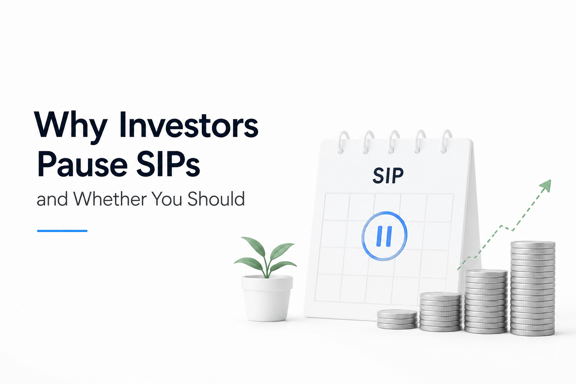
Systematic Investment Plans (SIPs) are designed to help investors build wealth through disciplined, long-term investing. Yet many investors pause their SIPs at some point, whether because of market volatility, financial stress, or changing priorities.
The key question is this: Should you pause your SIP too? In most cases, the answer is no. A temporary pause can be useful during genuine financial hardship, but stopping investments because markets are falling often hurts long-term returns more than it helps.
This guide explains the most common reasons investors pause SIPs, when it is justified, and how to decide what’s right for your financial goals.
What Is an SIP Pause?
An SIP pause is a facility offered by many mutual fund platforms and asset management companies (AMCs) that lets investors temporarily stop automatic SIP contributions without cancelling the investment entirely.
Depending on the fund house, you can usually pause an SIP for a few months and restart it later without creating a new mandate.
An SIP pause differs from:
| Action | What happens |
|---|---|
| SIP Pause | Contributions stop temporarily, investment continues to remain invested. |
| SIP Cancellation | Future contributions stop permanently until a new SIP is created. |
| Mutual Fund Redemption | Existing investments are sold, which may trigger taxes and exit loads. |
Why Do Investors Pause SIPs?
There is rarely a single reason. Most investors pause SIPs because of changes in their financial situation or emotions during uncertain markets.
“Start investing with confidence! Explore
0 demat account
and grow your wealth.”
1. Temporary Cash Flow Problems
Unexpected expenses can make monthly investments difficult.
Common examples include:
- Job loss
- Medical emergencies
- Home repairs
- Business slowdown
- Education expenses
In these situations, protecting your emergency fund and essential expenses usually comes first.
2. Market Volatility Creates Fear
Many investors become uncomfortable when markets fall sharply.
Watching portfolio values decline often creates the urge to stop investing until “things improve.”
Ironically, this is usually when SIPs become more valuable.
During market corrections:
- The same SIP amount buys more units.
- Lower purchase prices can improve long-term returns.
- Rupee cost averaging works more effectively.
Stopping investments during downturns means missing this potential advantage.
3. Changing Financial Priorities
Life goals evolve.
Investors may redirect money toward:
- Buying a house
- Marriage expenses
- Starting a business
- Children’s education
- Higher loan repayments
A temporary SIP pause may make sense if these goals require immediate liquidity.
4. Overcommitting to Investments
Some investors begin multiple SIPs during periods of high income without fully considering future expenses.
If monthly commitments become difficult to sustain, reviewing the portfolio is often better than defaulting on payments.
5. Portfolio Rebalancing
Sometimes investors pause SIPs while reviewing asset allocation.
For example:
- Reducing equity exposure before retirement
- Increasing debt allocation
- Consolidating multiple mutual funds
- Switching investment strategies
A pause for strategic portfolio management is very different from reacting emotionally to market movements.
Is Pausing an SIP a Good Idea?
It depends on why you want to pause.
Situations Where Pausing Can Make Sense
A temporary pause may be appropriate if you are experiencing:
- Temporary unemployment
- Significant medical expenses
- Short-term cash flow shortages
- Major unavoidable financial commitments
- A planned review of your investment strategy
In these cases, avoiding high-interest debt may be more important than continuing investments.
Situations Where You Should Usually Continue
Avoid pausing your SIP simply because:
- Markets are falling.
- News headlines seem negative.
- Friends are exiting the market.
- Your portfolio is temporarily in the red.
- You are trying to time the market.
Long-term investing rewards consistency more than perfect timing.
What Happens If You Pause an SIP?
An SIP pause affects only future investments.
Your existing mutual fund units remain invested and continue to participate in market movements.
However, there are trade-offs.
Advantages
- Improves short-term cash flow
- Avoids unnecessary SIP cancellations
- Easy to restart
- Helps during temporary financial stress
Disadvantages
- Missed buying opportunities during market declines
- Smaller investment corpus over time
- Reduced benefit from compounding
- Possible delay in achieving financial goals
How Much Can Pausing Cost?
Even a short break can have a noticeable impact over the long term.
Consider a simplified example.
| Scenario | Monthly SIP | Investment Period | Estimated Outcome* |
|---|---|---|---|
| Continuous SIP | ₹10,000 | 20 years | Higher final corpus |
| Pause for 12 months | ₹10,000 | 19 years of contributions | Lower final corpus due to fewer investments and reduced compounding |
*Illustrative only. Actual mutual fund returns are not guaranteed.
The longer your investment horizon, the more valuable uninterrupted compounding becomes.
Alternatives to Pausing Your SIP
Before stopping investments entirely, consider these options.
Reduce the SIP Amount
Many AMCs allow investors to start a smaller SIP instead of stopping completely.
Even a reduced investment helps maintain investing discipline.
Pause Only Non-Essential SIPs
If you have multiple SIPs, evaluate each one individually instead of stopping all investments.
Use Your Emergency Fund
If the financial challenge is temporary and you have an adequate emergency fund, using part of it may help you avoid interrupting long-term investments.
Review Your Budget
Small adjustments to discretionary spending can sometimes free enough cash to continue your SIP.
Questions to Ask Before Pausing Your SIP
Before making a decision, ask yourself:
- Is this financial problem temporary or permanent?
- Am I reacting to market fear?
- Do I have an emergency fund?
- Will pausing delay an important financial goal?
- Could reducing the SIP amount work instead?
Answering these questions often provides greater clarity than reacting in the moment.
Common SIP Pause Myths
“I’ll Restart When Markets Recover”
By the time markets recover, prices are often significantly higher.
Waiting may reduce the benefit of buying during market lows.
“Pausing Protects My Investments”
A pause only stops future contributions.
Your existing investments continue to move with the market.
“Missing a Few Months Doesn’t Matter”
A few months may seem insignificant, but consistent interruptions can reduce the long-term benefits of compounding.
Final Thoughts
An SIP pause is a useful feature when genuine financial challenges arise. It provides flexibility without forcing investors to cancel their investment plan completely.
However, pausing an SIP simply because markets are falling is rarely the best strategy. Market downturns are a normal part of investing, and consistent SIP investing helps investors benefit from rupee cost averaging and long-term compounding.
Instead of reacting to short-term volatility, review your financial situation, investment goals, and time horizon. If the challenge is temporary, a short pause may be reasonable. If your finances remain stable, staying invested is often the stronger long-term decision.
Frequently Asked Questions
Q. Can I pause my SIP without closing it?
Yes. Most AMCs and investment platforms offer an SIP pause facility that temporarily stops future instalments while keeping your existing investments active.
Q. Will I lose money if I pause my SIP?
Pausing does not affect the mutual fund units you already own. However, you may miss opportunities to invest at lower prices and reduce the long-term benefits of compounding.
Q. How long can an SIP be paused?
The duration depends on the AMC or investment platform. Many allow pauses ranging from one to several months. Check the terms applicable to your specific fund.
Q. Is pausing better than cancelling an SIP?
If your financial difficulty is temporary, pausing is generally better because it is easier to restart than creating a new SIP after cancellation.
Q. Should I stop my SIP during a market crash?
In most cases, no. Continuing SIPs during market declines allows you to purchase more units at lower prices, which can improve long-term outcomes if markets recover.
Key Takeaways
- SIP pauses are best suited for temporary financial difficulties.
- Market volatility alone is usually not a good reason to stop investing.
- Consistent SIP investing supports rupee cost averaging and long-term compounding.
- Reducing your SIP amount may be a better option than stopping completely.
- Review your financial goals and cash flow before deciding to pause an SIP.
Disclaimer
The stocks mentioned in this article are not recommendations. Please conduct your own research and due diligence before investing. Investment in securities market are subject to market risks, read all the related documents carefully before investing. Please read the Risk Disclosure documents carefully before investing in Equity Shares, Derivatives, Mutual fund, and/or other instruments traded on the Stock Exchanges. As investments are subject to market risks and price fluctuation risk, there is no assurance or guarantee that the investment objectives shall be achieved. Lemonn (Formerly known as NU Investors Technologies Pvt. Ltd) do not guarantee any assured returns on any investments. Past performance of securities/instruments is not indicative of their future performance.
Related Posts

Download Lemonn
Download my app for share market trading, ipo investment, trading account, and all your investment needs.