
Vishwas 2026 Employees’ Provident Fund Scheme: What Employees Should Know
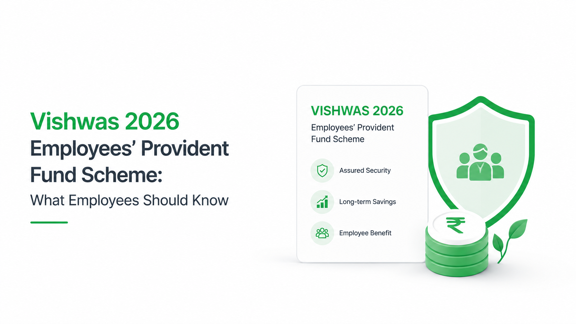
The Vishwas 2026 Employees’ Provident Fund (EPF) Scheme is a one-time settlement facility for employers with pending disputes over penalties imposed for delayed provident fund payments.
As an employee, you cannot apply for this scheme. You also do not receive any direct payment, bonus, or additional interest under it.
The scheme matters to employees because it may help the Employees’ Provident Fund Organisation (EPFO) resolve older cases involving employer defaults. However, it does not reduce the employer’s obligation to deposit the provident fund contribution and applicable interest due in relation to employees.
In simple terms, Vishwas 2026 offers eligible employers relief on certain penalties. It does not waive the actual provident fund dues that should be credited to employees’ accounts.
What is the Vishwas 2026 EPF Scheme?
Employers covered by EPFO must deposit provident fund contributions within the prescribed time. When they delay these payments, they may face three separate liabilities:
- The unpaid provident fund contribution.
- Interest for the period of delay.
- Damages imposed as a penalty for non-compliance.
Vishwas 2026 deals only with the third item, damages.
The scheme allows eligible employers to settle pending damages cases at reduced, graded rates. It became effective on 29 June 2026 and was introduced for an initial period of six months.
The scheme covers eligible damages matters under Section 14B of the Employees’ Provident Funds and Miscellaneous Provisions Act, 1952, or Section 128 of the Code on Social Security, 2020.
Employees do not need to understand these legal provisions in detail. The key point is that damages are penalties payable by the employer. They are not part of the employee’s EPF balance.
Can an individual employee apply under Vishwas 2026?
No. Vishwas 2026 is not an employee benefit, withdrawal facility, or claims scheme.
Only eligible employers or establishments can use it to settle specified damages cases with EPFO.
An employee does not need to:
- Submit an application,
- Upload documents,
- Provide consent,
- Pay any settlement amount, or
- Contact EPFO merely because the employer has applied.
Your employer’s decision to use the scheme does not change your normal EPF membership or require any action from you.
“Start investing with confidence! Explore
0 demat account
and grow your wealth.”
Who is eligible for the Vishwas 2026 EPF Scheme?
Eligibility is assessed at the employer or establishment level, not at the employee level.
An establishment may qualify when it has a pending or disputed case involving damages for delayed EPF payments. This can include cases where:
- A notice has been issued, but no final order has been passed.
- A final damages order has been issued, but the amount remains unpaid or partly paid.
- The damages order is being challenged before a court or tribunal.
- A delay has been identified, but formal damages proceedings have not started.
The employer must also clear the applicable contribution and interest liabilities. Vishwas 2026 does not allow an establishment to settle only the penalty while ignoring the underlying provident fund dues.
Cases involving fully recovered damages, fraud, misappropriation, or deliberate falsification of records are not covered.
Does Vishwas 2026 affect your EPF balance?
The scheme should not directly reduce your EPF balance because it offers relief only on damages payable by an employer.
| Question | Answer for employees |
| Can the employee contribution be waived? | No |
| Can the employer contribution be waived? | No |
| Is interest on delayed contributions waived? | No |
| Can eligible employer damages be reduced? | Yes |
| Will employees receive a direct payment? | No |
| Do employees need to apply? | No |
| Should employees monitor their EPF passbook? | Yes |
EPFO’s official guidance states that neither the principal contribution nor the applicable interest is waived under Vishwas 2026.
Read More: How to Check EPF Balance & PF Withdrawal Process
Will employees lose interest if their employer deposits EPF late?
According to EPFO’s general guidance, after delayed dues are realised from the employer, members are entitled to the applicable interest for each due month. The employer may separately face interest charges and damages for the delay.
This means Vishwas 2026 does not allow an employer to reduce the interest legally due on an employee’s contribution.
However, there may be a practical delay. If the employer has not deposited the contribution and EPFO has not yet recovered it, the missing amount may not immediately appear in your passbook or be available while processing a claim.
EPFO states that provident fund amounts due to a member may be paid to the extent that the dues have been realised from the employer.
Employees should therefore not assume that their account has been fully updated merely because the employer has entered a settlement process.
Does the scheme benefit employees?
The benefit to employees is indirect.
Vishwas 2026 gives eligible employers an incentive to settle older penalty disputes instead of continuing prolonged legal or administrative proceedings. This may help EPFO close pending cases and improve compliance.
However, the scheme does not guarantee that a missing contribution will immediately appear in an employee’s account. It also does not provide separate compensation for the inconvenience caused by a delayed deposit.
The important protection for employees is that:
- Principal contributions remain payable.
- Statutory interest remains payable.
- The employer’s underlying EPF obligations continue.
- Employees retain the right to report missing deposits.
The employer may receive relief from part of the penalty, but not from the actual provident fund liability connected to employees.
How can you check whether your employer is depositing EPF?
Employees should check their EPF records regularly, particularly when provident fund is being deducted from salary.
1. Review your salary slip
Check the amount shown as the employee’s provident fund deduction. Keep copies of your salary slips because they may support a complaint if the deducted amount does not appear in your EPF account.
2. Check your EPF passbook
Use your Universal Account Number (UAN) to review monthly contributions in the EPF passbook.
Compare the passbook entries with your salary slips. Check whether both the employee and employer portions appear for the correct wage months.
EPFO states that members can identify defaults through their passbooks. Members may also receive an SMS notification when a monthly contribution is credited.
3. Look for repeated missing months
A contribution may occasionally appear late because of processing or technical delays. However, repeated missing entries, particularly when provident fund continues to be deducted from salary, require follow-up.
4. Request a statement if you work for an exempted establishment
Some employers manage provident fund money through an approved private trust. Employees of these exempted establishments may not see a regular passbook on the UAN portal.
In such cases, request a provident fund statement from the employer or the trust managing the account.
Read More: EPF Explained: Contribution, Interest & Withdrawal Rules
What should you do if EPF is deducted but not deposited?
Start by raising the issue in writing with your payroll or human resources team. Ask for the contribution status, payment details, and expected date of credit.
If the issue is not resolved:
- Save your salary slips, bank statements, UAN details, and employment records.
- Download or take screenshots of your EPF passbook.
- Submit a grievance through the Employees’ Provident Fund Integrated Grievance Management System (EPFiGMS).
- Track the grievance using the registration number provided by the portal.
EPFiGMS is EPFO’s official platform for registering and tracking member grievances. Complaints are routed to the EPFO office responsible for the concerned account or establishment.
EPFO’s guidance also states that it can use statutory recovery and penal provisions when an employer deducts provident fund from wages but does not deposit it.
Do you need to take any action because of Vishwas 2026?
No, most employees do not need to take any special action because of the scheme.
You only need to act when you notice a problem with your own EPF records, such as:
- Missing monthly contributions,
- Contributions lower than the deduction shown on your salary slip,
- Several months of delayed deposits,
- An incorrect employer or member identification entry, or
- Difficulty withdrawing or transferring funds because contributions are missing.
Your action should focus on correcting your EPF account. You do not need to monitor or participate in your employer’s Vishwas 2026 settlement proceedings.
Key takeaways
- The Vishwas 2026 EPF Scheme is a settlement facility for eligible employers, not an employee benefit scheme.
- Individual employees cannot apply under it.
- The scheme deals only with damages, which are penalties charged for delayed compliance.
- It does not waive employee contributions, employer contributions, or statutory interest.
- It does not directly increase or reduce an employee’s EPF balance.
- Any benefit to employees is indirect, as the scheme may help resolve older employer-default cases.
- Employees should continue checking their EPF passbooks and comparing entries with salary slips.
- Missing contributions should first be raised with the employer and then reported through EPFiGMS when necessary.
Frequently Asked Questions (FAQs)
Can employees register for the Vishwas 2026 EPF Scheme?
No. Only eligible employers and establishments can use the scheme. Individual EPF members do not apply.
Will Vishwas 2026 increase my EPF balance?
No. The scheme does not provide an additional contribution, bonus, or direct payment to employees.
Can my employer avoid depositing my EPF contribution under this scheme?
No. Vishwas 2026 reduces eligible damages only. It does not waive principal provident fund contributions or statutory interest.
Will I lose interest if my employer deposits EPF late?
No. EPFO states that after delayed dues are realised, the member is entitled to the applicable interest for each due month.
Should I apply if contributions are missing from my EPF passbook?
No. Do not apply under Vishwas 2026. Raise the issue with your employer and submit an EPFiGMS grievance if it is not resolved.
Is Vishwas 2026 an EPF withdrawal scheme?
No. It is unrelated to employee withdrawals, advances, transfers, pensions, or claim settlements.
Does my employer’s settlement mean missing contributions will appear immediately?
Not necessarily. The timing depends on whether the outstanding dues have been deposited, recovered, processed, and credited. Continue monitoring your passbook until the relevant entries appear.
Disclaimer
The stocks mentioned in this article are not recommendations. Please conduct your own research and due diligence before investing. Investment in securities market are subject to market risks, read all the related documents carefully before investing. Please read the Risk Disclosure documents carefully before investing in Equity Shares, Derivatives, Mutual fund, and/or other instruments traded on the Stock Exchanges. As investments are subject to market risks and price fluctuation risk, there is no assurance or guarantee that the investment objectives shall be achieved. Lemonn (Formerly known as NU Investors Technologies Pvt. Ltd) do not guarantee any assured returns on any investments. Past performance of securities/instruments is not indicative of their future performance.
Related Posts

Download Lemonn
Download my app for share market trading, ipo investment, trading account, and all your investment needs.



