
SIP Investment at Age 30 vs 45: Who Wins Bigger?
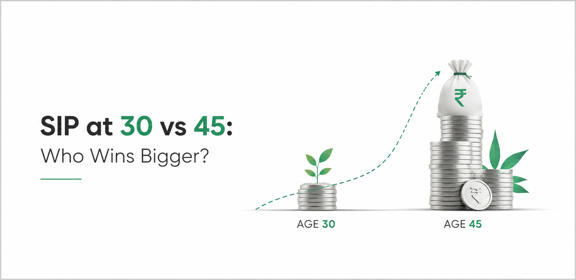
Start a Systematic Investment Plan (SIP) at 30, and time does much of the heavy lifting. Start at 45, and you may have to invest far more each month to reach the same retirement goal. In the SIP investment age 30 vs 45 comparison, the early starter has a clear advantage because every rupee gets more time to compound, recover from market declines, and grow without placing excessive pressure on monthly cash flow.
However, the usual comparison misses an important point: ₹5 crore received 15 years from now and ₹5 crore received 30 years from now do not have the same purchasing power.
A fair comparison must use constant-rupee logic, meaning all amounts are adjusted for inflation and expressed in today’s purchasing power. When inflation is included, the early starter still wins decisively. With the same inflation-adjusted monthly investment, starting at 30 can create about 3.3 times the real corpus of starting at 45.
The lesson is not that investing at 45 is pointless. It is that lost time usually has to be replaced through higher savings, faster Systematic Investment Plan (SIP) increases, lump-sum investments, a realistic retirement age, or some combination of these measures.
What Does a SIP Actually Do?
A Systematic Investment Plan allows an investor to invest a fixed amount in a mutual fund scheme at regular intervals, such as monthly, instead of investing one large lump sum.
A SIP creates discipline, but it does not guarantee returns. The outcome depends on:
- The amount invested
- The investment period
- Market performance
- Fund expenses
- Taxes
- The risk level of the chosen scheme
The biggest advantage of starting early is time.
Returns earned during the initial years remain invested and can earn additional returns. At age 30, this process can continue for 30 years before retirement at 60. At age 45, it has only 15 years.
Read More: Investment lessons: Everything you wanted to know about SIP
Why the Usual ₹5 Crore Comparison Can Mislead
Many SIP illustrations compare the monthly investment required to reach the same nominal target, such as ₹5 crore, by age 60.
The problem is that the two investors reach age 60 in different calendar years.
- A 45-year-old retires after 15 years.
- A 30-year-old retires after 30 years.
Inflation affects the younger investor’s target for twice as long.
The Consumer Price Index (CPI) measures changes in the general level of retail prices paid by households. As prices rise, the purchasing power of a fixed amount falls.
Assume long-term inflation of 6% a year:
| Goal in today’s purchasing power | Amount needed after 15 years | Amount needed after 30 years |
| ₹5 crore | ₹11.98 crore | ₹28.72 crore |
Giving both investors a future target of ₹5 crore does not provide the same retirement lifestyle.
For the 45-year-old, ₹5 crore is received after 15 years. For the 30-year-old, it is received after 30 years, when prices may be considerably higher.
At 6% inflation:
| Future amount | Time until retirement | Value in today’s rupees |
| ₹5 crore | 15 years | About ₹2.09 crore |
| ₹5 crore | 30 years | About ₹87 lakh |
This is why retirement planning should begin with the lifestyle or spending goal in today’s rupees. The target can then be inflated based on the number of years remaining.
The Reserve Bank of India (RBI) follows an inflation target of 4%, with a tolerance band of 2% to 6%. The 6% inflation rate used here is an illustration and a relatively cautious planning assumption, not a forecast.
A household’s personal inflation rate may also differ from headline inflation, particularly when healthcare, education, housing, travel, and lifestyle expenses form a large part of its budget.
“Start investing with confidence! Explore
0 demat account
and grow your wealth.”
SIP Investment Age 30 vs 45: Same Real Monthly Investment
Consider two investors who plan to retire at age 60.
They both start with a SIP of ₹10,000 per month in today’s money. To keep the contribution’s purchasing power broadly stable, they increase the SIP by 6% every year.
Assumptions
- Expected nominal return: 12% a year
- Inflation: 6% a year
- Annual SIP increase: 6%
- Investment period: 30 years for the younger investor and 15 years for the older investor
- Taxes, fund expenses, and exit loads are ignored
- Returns are assumed to be smooth only for illustration
Under these assumptions, the inflation-adjusted, or real, return is approximately 5.66% a year.
It is calculated as:
(1.12 ÷ 1.06) − 1
Simply subtracting inflation from the expected return would be less accurate.
Inflation-Adjusted Result
| Metric | Start at 30 | Start at 45 |
| Years invested | 30 | 15 |
| Starting monthly SIP | ₹10,000 | ₹10,000 |
| Annual SIP increase | 6% | 6% |
| Corpus in today’s rupees | About ₹89.7 lakh | About ₹27.3 lakh |
| Early-starter advantage | About 3.3 times | Base case |
The investor starting at age 30 ends with roughly 3.3 times the real wealth.
The difference is not caused only by contributing for twice as many years. The earliest instalments made by the 30-year-old also remain invested for much longer.
This is the real power of starting early. Time supports the investor even before income becomes large enough to support a substantial monthly contribution.
How Much SIP Is Needed for the Same Real Retirement Goal?
Now consider the comparison from the opposite direction.
Suppose both investors want a retirement corpus equal to ₹5 crore in today’s purchasing power at age 60.
Their SIP increases by 6% every year, matching the assumed inflation rate.
| Metric | Start at 30 | Start at 45 |
| Investment horizon | 30 years | 15 years |
| Real target at retirement | ₹5 crore | ₹5 crore |
| Nominal target at retirement | ₹28.72 crore | ₹11.98 crore |
| Approximate starting monthly SIP | ₹55,700 | ₹1.83 lakh |
| Required starting SIP multiple | 1 time | About 3.3 times |
The 45-year-old needs to begin with more than three times the monthly contribution.
That higher investment requirement can place pressure on:
- Monthly household cash flow
- Emergency savings
- Insurance premiums
- Home loan repayments
- Children’s education goals
- Other short-term financial priorities
The calculation shows why retirement targets should first be estimated in today’s rupees and then adjusted for inflation.
A large-looking future corpus can still be inadequate when measured against the cost of the lifestyle it is expected to fund.
Calculator results may vary slightly depending on whether SIP instalments are assumed to be invested at the beginning or end of each month and how annual increases are applied.
Why Starting at 30 Creates a Bigger Advantage
1. More Compounding Cycles
Money invested at age 30 can remain invested for three decades.
The effect may appear small during the initial years, but it becomes more significant as the accumulated investment base grows.
2. Lower Monthly Pressure
The younger investor can pursue the same real goal with a much smaller starting SIP.
This makes the investment plan easier to continue during job changes, family expenses, income disruptions, or temporary financial stress.
3. More Time to Recover From Market Volatility
Equity mutual funds can experience sharp declines.
A longer investment horizon gives the investor more time to recover, rebalance the portfolio, and adjust contributions without immediately affecting the retirement goal.
The Securities and Exchange Board of India (SEBI) requires mutual funds to display a Riskometer. It helps investors compare a scheme’s risk level with their own risk capacity and investment horizon.
4. Greater Planning Flexibility
A 30-year-old has several possible adjustments available:
- Start with a smaller amount
- Increase the SIP as income grows
- Make lump-sum investments from bonuses
- Change the asset allocation gradually
- Extend the retirement age, when necessary
At age 45, fewer years remain. Every missed contribution, withdrawal, or unrealistic return assumption can have a larger impact on the outcome.
How Can a 45-Year-Old Catch Up?
Starting at 45 requires urgency, but not panic.
Taking excessive investment risk is not a reliable substitute for saving more.
Calculate the Real Goal First
Estimate retirement expenses in today’s rupees.
Then account for inflation until retirement and during the retirement period. Retirement planning should cover future living costs, healthcare, emergencies, and the expected number of non-working years.
SEBI provides investor education calculators for inflation, goal-based SIPs, increasing contributions, and retirement planning.
Increase the SIP Faster Than Inflation
A 6% annual increase only keeps the contribution broadly stable in real terms when inflation is also assumed at 6%.
An investor trying to close a retirement shortfall may need to increase the SIP by 10% to 15% annually, depending on income growth and affordability.
The annual increase should be linked to salary increments or business income rather than an arbitrary percentage that may become difficult to sustain.
Read More: Step-Up SIP Strategy
Use Lump-Sum Investments Wisely
Bonuses, incentives, maturity proceeds, tax refunds, and other windfalls can reduce the pressure on the monthly SIP.
These amounts should be invested according to the goal’s asset allocation. They should not be used to chase whichever mutual fund or asset class delivered the highest return in the previous year.
Review the Retirement Age and Goal
Working two or three years longer can help in three ways:
- It provides additional years of contributions.
- Existing investments get more time to compound.
- The corpus needs to fund fewer retirement years.
Reviewing expected retirement expenses can also help. Reducing avoidable lifestyle costs may lower the required corpus without compromising essential needs.
Build an Asset Allocation, Not a Return Fantasy
A late starter may feel tempted to assume returns of 15% or 18% to make a retirement calculator produce a comfortable result.
A higher return assumption does not make the goal more achievable.
Investors should use reasonable expectations, diversify across suitable asset classes, and gradually reduce portfolio risk as retirement approaches.
Common Mistakes in Age-Based SIP Planning
- Ignoring inflation: A future ₹5 crore figure may look impressive but buy much less than expected.
- Keeping the SIP fixed for decades: A fixed nominal SIP becomes smaller in purchasing-power terms every year.
- Assuming high returns: Expected returns are not guaranteed, and higher-return assets generally carry higher risk.
- Choosing funds based only on recent performance: The scheme should suit the investor’s goal, horizon, and risk capacity.
- Waiting for income to become sufficient: Starting with a manageable amount and increasing it regularly is usually better than waiting for the perfect time.
- Failing to review the plan: Inflation, income, financial goals, and portfolio risk can change over time.
Read More: Best SIP Plans For Long-Term Wealth Creation In India
Key Takeaways
- In the SIP investment age 30 vs 45 comparison, the investor starting at 30 wins decisively because each contribution gets more time to compound.
- With the same inflation-adjusted monthly investment, the 30-year-old can build about 3.3 times the real corpus of the 45-year-old.
- Comparing the same nominal target, such as ₹5 crore, is misleading because the two investors reach retirement in different calendar years.
- At 6% inflation, ₹5 crore received after 15 years is worth about ₹2.09 crore in today’s money. The same ₹5 crore received after 30 years is worth only about ₹87 lakh.
- To build a retirement corpus worth ₹5 crore in today’s purchasing power, the 30-year-old may need to start with approximately ₹55,700 per month. The 45-year-old may need approximately ₹1.83 lakh per month under the same assumptions.
- Starting at 45 is not too late. However, the plan may require higher savings, faster SIP increases, lump-sum contributions, realistic asset allocation, tighter expense management, or a later retirement age.
- Lost time should not be replaced with unrealistic return expectations or excessive investment risk.
- Retirement goals should be calculated in today’s rupees first and then adjusted for inflation.
Read More: Best Mutual Fund SIP Plans In India 2026
Frequently Asked Questions (FAQs)
Q: Who wins in SIP investment at age 30 vs 45?
A: The investor starting at age 30 generally wins because the money compounds for longer. In the illustration above, the 30-year-old builds about 3.3 times the real corpus from the same inflation-adjusted monthly contribution.
Q: Is 45 too late to start a SIP?
A: No. Starting at 45 is better than delaying further. However, the investor may need a higher monthly SIP, faster annual increases, lump-sum contributions, and more careful retirement planning.
Q: Why should a retirement corpus be calculated in today’s rupees?
A: Today’s rupees make the goal easier to understand in terms of current purchasing power. The amount can then be adjusted for inflation to estimate the nominal corpus required at retirement.
Q: Should I increase my SIP every year?
A: An annual increase can help the SIP keep pace with inflation and income growth. A step-up equal to inflation broadly preserves the contribution’s real value. A higher step-up may help close a retirement shortfall, provided it remains affordable.
Q: Is a 12% return assumption guaranteed?
A: No. It is only an illustration. Mutual fund returns are market-linked, and actual results can be higher or lower. Use conservative assumptions and review the investment plan periodically.
Disclaimer
The stocks mentioned in this article are not recommendations. Please conduct your own research and due diligence before investing. Investment in securities market are subject to market risks, read all the related documents carefully before investing. Please read the Risk Disclosure documents carefully before investing in Equity Shares, Derivatives, Mutual fund, and/or other instruments traded on the Stock Exchanges. As investments are subject to market risks and price fluctuation risk, there is no assurance or guarantee that the investment objectives shall be achieved. Lemonn (Formerly known as NU Investors Technologies Pvt. Ltd) do not guarantee any assured returns on any investments. Past performance of securities/instruments is not indicative of their future performance.
Related Posts



Download Lemonn
Download my app for share market trading, ipo investment, trading account, and all your investment needs.



