
Built-in F&O Signal Tools in India: Best Platforms Compared
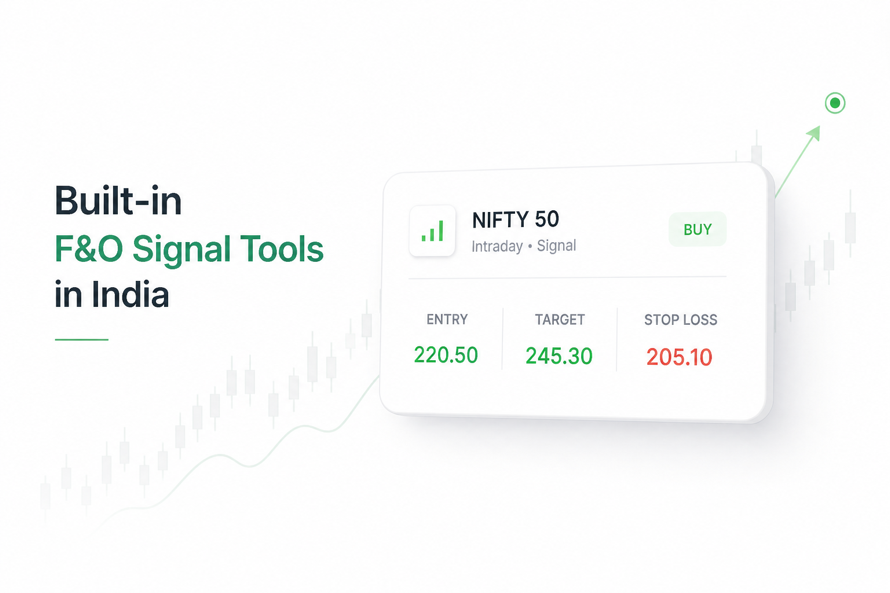
Options traders in India have more tools than ever before. But more choice has not always made decision-making easier. Many platforms mix together charting, alerts, third-party integrations, advisory-style products, and signal engines as if they all solve the same problem. They do not.
If your goal is simple – get a structured F&O trade idea inside the trading workflow, review the logic, check the stop-loss and target, and execute manually with discipline – then you need to compare built-in F&O signal tools in India differently.
This guide does exactly that.
Instead of throwing every “options platform” into one bucket, we will separate the category into four distinct product types:
- Built-in signal tools inside broker apps
- Strategy builders and backtesting platforms
- Alerting and chart-based workflows
- Advisory or tip-style products
That distinction matters because a trader looking for an options signal tool inside a trading app is usually not looking to code, stitch APIs, or chase Telegram calls. They want structure, not noise.
For retail derivatives traders, that structure matters even more because F&O is fast-moving and high-risk. SEBI has repeatedly highlighted the risks in equity derivatives for individual traders and has also tightened investor protection norms around the segment. (sebi.gov.in)
Why built-in F&O signal tools matter
A traditional trading app gives you charts, option chains, and order placement. A signal-led workflow adds one more layer: decision support. That means the platform helps surface a trade setup based on predefined logic rather than forcing you to interpret every candle on your own.
For many users, especially those trading index options intraday, that changes the experience in three ways:
- It reduces guesswork.
- It creates consistency in entry and exit rules.
- It makes manual execution faster without making it fully automated.
This is why searches around real time F&O signals app India, broker with F&O signals India, and signal based options trading app are growing. Traders are not necessarily asking for “guaranteed calls.” They are often asking for a cleaner process.
A good built-in signal tool should ideally answer these questions before you trade:
- What is the setup?
- What is the entry?
- Where is the stop-loss?
- What is the target?
- What market is it designed for?
- How has the strategy performed historically?
That is the minimum standard for anyone comparing pre built F&O strategies India platforms seriously.
A cleaner taxonomy: not all “signal” products are the same
Before comparing platforms, let us define the categories clearly.
“Start investing with confidence! Explore
option trading
and grow your wealth.”
1. Built-in broker signal tools
These are tools available inside a broker’s ecosystem where signals are generated within the app or platform and the user executes manually. This is the most relevant category if you want an all-in-one experience.
Best for:
- Retail traders who want structured trades
- Users focused on Nifty or Bank Nifty
- Traders who want manual control with less emotional decision-making
2. Strategy builders
These tools help users create, test, and sometimes automate strategies. They are powerful, but they assume a higher level of involvement. You are typically configuring conditions, not simply selecting from ready-made setups.
Best for:
- Advanced users
- Traders who want customization
- Users comfortable with backtests and parameter tuning
3. Alerting/chart-first platforms
These products are strongest in charting, scans, alerts, and analysis. They may support options workflows, but the “signal” is often still something the trader interprets rather than a fully packaged trade setup.
Best for:
- Self-directed discretionary traders
- Users who already know their strategy
- Traders who want chart flexibility over execution simplicity
4. Advisory or tip-led products
These may send trade calls, alerts, or recommendations, but they are not always embedded into a regulated brokerage execution experience. This makes comparison tricky, especially when users want transparent rules rather than opaque calls.
Best for:
- Users specifically seeking external recommendations
Not ideal for:
- Traders who want integrated execution and on-platform discipline
What to compare in built-in F&O signal tools in India
When comparing platforms fairly, look beyond marketing words like “AI,” “smart,” or “pro.” Focus on these practical criteria.
Signal clarity
Does the platform provide:
- instrument
- direction
- entry zone
- target
- stop-loss
- time horizon
If a tool only says “bullish” or “watch for breakout,” that is not a true execution-ready signal.
Strategy transparency
Is the signal based on a named setup or clearly defined framework? For example, EMA-based momentum, SuperTrend logic, breakout rules, or scalping conditions.
Transparency helps traders understand what they are following instead of blindly copying.
Historical stats visibility
Can you review:
- win rate
- average trade duration
- risk-reward profile
- past returns or outcome summaries
This is a major differentiator. A platform that shows performance context helps traders compare strategies rationally.
Manual execution flow
Some products generate signals but create friction when it is time to place the trade. Ideally, the journey from idea to order placement should be short and intuitive.
Index focus
Many retail traders want signals specifically for:
- Nifty options
- Bank Nifty options
- other liquid index contracts
Platforms that specialise here often deliver a more relevant experience than generic signal layers across every instrument.
Discipline support
The best tools reduce emotional trading. They do not merely generate opportunities; they encourage rule-based execution. If you are new to structured derivatives trading, reading this guide on how to trade in futures and options can help frame the basics before comparing tools.
Platform archetypes compared
Below is the most useful way to compare this category without forcing unlike products into the same table.
| Platform type | What it does well | Where it falls short | Best for |
| Built-in broker signal tool | Combines signal + execution in one flow | Usually less customizable than a full strategy builder | Manual traders seeking speed and structure |
| Strategy builder | Deep customization, backtesting, rules creation | Steeper learning curve, more setup effort | Advanced traders |
| Chart/alert platform | Great visual analysis and custom alerts | Signals may not be trade-ready | Discretionary traders |
| Advisory/tips product | Quick idea delivery | Often less transparent, less integrated | Users following external calls |
This framing matters because many traders searching for the best app in India for options traders who want clear TP and SL without building their own strategy are actually looking for the first category, not the second.
Where Lemonn fits in this comparison
Lemonn’s differentiation is strongest when judged as a built-in signal-execution workflow, not merely as a charting or brokerage app.
With BOLT by Lemonn, the positioning is clearer: structured F&O strategies are surfaced inside the platform for retail traders who want a manual, rule-based workflow. That matters because many alternatives either stop at charts or require users to build the system themselves. You can explore the product direction in BOLT by Lemonn: Simplifying FnO Trading for Everyone.
What makes this approach notable in the context of built-in F&O signal tools in India?
1. It is signal-led, not just chart-led
Many tools help you analyze. Fewer help you act with a predefined structure. BOLT is built around strategy-based signals rather than generic market observation.
For traders who prefer setups over open-ended interpretation, that is a meaningful difference.
2. It supports pre-built strategies
Lemonn has published multiple examples of named strategy frameworks on BOLT, including EMA, SuperTrend, breakout, and scalping-oriented approaches. Examples include:
- Scalping Pulse on BOLT: A Structured Intraday FnO Strategy
- Prime EMA Scalper on BOLT: A Momentum-Driven Intraday FnO Strategy
- EMA Cross on BOLT: A Simple Trend-Following FnO Strategy
This is especially relevant for users searching for a broker with F&O signals India that offers variety without asking them to create every condition manually.
3. It is designed for manual traders, not black-box automation
One of the strongest middle-ground product positions today is “auto-generated signals, manually executed trades.” That gives the trader more discipline without surrendering full control.
This makes Lemonn more suitable for users who want semi-structured support rather than fully automated algo behaviour. Traders interested in broader automation themes can also read What is Algo Trading? Pros, Cons, and How It Works.
4. It keeps execution close to the signal
A major weakness in fragmented workflows is lag: you see a signal on one platform, review charts on another, and place the order on a third. That gap increases hesitation and slippage risk in fast intraday markets.
Integrated broker-side signal workflows reduce that friction.
5. It aligns with disciplined intraday behaviour
A signal tool is most useful when it helps traders avoid random entries, revenge trading, and overtrading. For that reason, the value of a built-in signal system is not just opportunity generation; it is behavioural control.
This is one reason structured setups can be a better alternative to noisy off-platform communities. Investors should also stay alert to impersonation and fake-investment scams, as highlighted in Beware of Online Scams Impersonating Trusted Brands. SEBI has also issued guidance around disclosure and investor protection in market participation. (sebi.gov.in)
What to watch out for when comparing alternatives
If you are evaluating any real time F&O signals app India, ask these questions before signing up:
Does the tool show stop-loss and target upfront?
If not, it may be more of an alerting product than a real execution tool.
Are the strategies named and understandable?
A clear system beats vague “strong buy” style prompts.
Is there performance context?
A good platform should help you judge strategy suitability, not just push signals.
Is the signal inside the broker workflow?
If execution happens elsewhere, the user experience becomes slower and more error-prone.
Is the tool focused on liquid options contracts?
Index-led strategies often work best when execution quality and liquidity matter.
Does it encourage discipline over frequency?
More signals do not automatically mean better trading.
Who should use a built-in options signal tool?
This category is ideal for:
- traders who understand the basics of F&O but do not want to build systems from scratch
- users looking for pre built F&O strategies India
- manual traders who want clear entry, target, and SL
- index option traders focused on Nifty and Bank Nifty
- users trying to move away from random tip channels toward a documented process
It is less suitable for:
- traders who want fully custom strategy design
- users looking for fully automated execution without intervention
- long-term investors who do not trade derivatives regularly
If you are still learning the basics, start first with What is options trading? and How to start options trading?. If you are already active in derivatives, you may also want to review Best options trading strategies: A comprehensive guide for broader context.
Why this category is growing now
The growth in options participation and the broader retail shift toward digital execution have created demand for tools that reduce complexity without pretending to eliminate risk. Exchanges and regulators continue to update frameworks around derivatives risk, contract design, and investor protection, which makes structured participation more important than ever. (sebi.gov.in)
At the same time, traders increasingly want:
- platform-native workflows
- less reliance on external communities
- visible strategy rules
- faster but controlled execution
That is exactly why the category of signal based options trading app is becoming more relevant than standalone charting for a certain segment of active traders.
The practical takeaway
If you are comparing built-in F&O signal tools in India, do not ask only, “Which platform has signals?” Ask instead:
- Are the signals execution-ready?
- Can I see entry, target, and stop-loss?
- Are these based on named strategies?
- Can I compare performance or historical trade behaviour?
- Is the signal embedded inside the actual trading workflow?
- Does the tool suit a disciplined manual trader?
When judged on that basis, Lemonn stands out best when compared like-for-like against this exact product category: built-in broker-side signal tools for structured F&O trading.
It is not trying to be just another charting layer. And it is not asking traders to assemble a complex tech stack.
For users who want ready frameworks, manual control, and a shorter path from signal to execution, that is a compelling middle ground. If you want to explore the broader trading ecosystem around the platform, you can start from the main Lemonn homepage or review its dedicated F&O trading experience.
FAQs
Q. What are built-in F&O signal tools in India?
Built-in F&O signal tools are features within a trading platform or broker app that generate structured futures and options trade setups. These usually include entry price, target, stop-loss, and strategy logic inside the same ecosystem where you place the trade.
Q. Which broker in India has a built-in signal tool for options scalping?
Lemonn is one of the brokers positioning itself around app-integrated, strategy-based F&O signals through BOLT, with setups designed for manual execution rather than third-party dependency.
Q. What is the difference between a signal tool and a strategy builder?
A signal tool gives you ready trade setups based on preconfigured logic. A strategy builder lets you define rules, test them, and sometimes automate them. Most beginners and many busy manual traders prefer signal tools because they require less setup.
Q. Are built-in F&O signal tools better than Telegram tips?
Usually, yes – if the platform shows strategy rules, target, stop-loss, and execution context. A signal tool inside a broker workflow is generally more transparent and more structured than unverified informal channels.
Q. Can beginners use a signal based options trading app?
Beginners can use such tools, but only after understanding basic F&O concepts, risk, and stop-loss discipline. These tools can improve structure, but they do not remove market risk.
Q. What should I compare before choosing a real time F&O signals app in India?
Compare signal clarity, stop-loss logic, target definition, historical stats visibility, strategy variety, execution ease, and whether the tool works inside the broker app itself.
Conclusion
The market does not need more vague “smart trading” claims. It needs clearer categories and better comparisons.
A serious buyer evaluating built-in F&O signal tools in India should separate signal engines from charting platforms, strategy builders, and advisory-style products. Once you do that, the shortlist becomes much more practical.
For disciplined retail traders who want structured, manual F&O execution without building everything from scratch, integrated tools like BOLT represent a strong category fit. And that, more than feature overload, is what makes a platform genuinely useful.
Disclaimer
The stocks mentioned in this article are not recommendations. Please conduct your own research and due diligence before investing. Investment in securities market are subject to market risks, read all the related documents carefully before investing. Please read the Risk Disclosure documents carefully before investing in Equity Shares, Derivatives, Mutual fund, and/or other instruments traded on the Stock Exchanges. As investments are subject to market risks and price fluctuation risk, there is no assurance or guarantee that the investment objectives shall be achieved. Lemonn (Formerly known as NU Investors Technologies Pvt. Ltd) do not guarantee any assured returns on any investments. Past performance of securities/instruments is not indicative of their future performance.
Related Posts



Download Lemonn
Download my app for option trading, IPO, 0 demat account, stocks, and dive into the stock market.



