Intraday Trading Risk Management and Stop-Loss Strategies
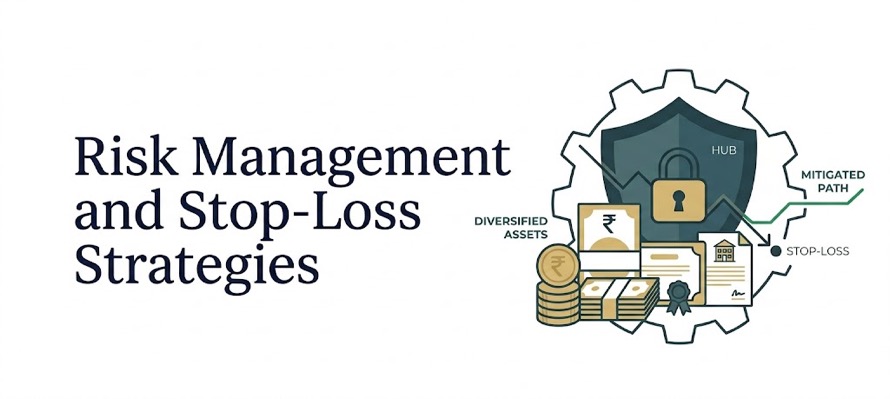
Risk management is not optional in intraday trading: it is the foundation. More traders are destroyed by poor risk management than by bad strategy. Master these principles before you trade.
The 1% Rule
Never risk more than 1% of your total capital on any single trade. If your trading capital is Rs.50,000, your maximum loss per trade is Rs.500. This ensures that even 10 consecutive losing trades only reduces your capital by 10%, recoverable. Without this rule, one bad trade can wipe out weeks of gains.
Position Sizing Formula
Position Size = Risk Amount / Distance to Stop Loss in %. Example: Capital Rs.50,000. Max risk per trade Rs.500 (1%). Stop-loss set 2% below entry price. Position size = Rs.500 / 2% = Rs.25,000 worth of stock.
“Start investing with confidence! Explore
option trading
and grow your wealth.”
Types of Stop Losses
| Stop Type | How to Set | Best For | Key Limitation |
|---|---|---|---|
| Fixed Percentage | 1 to 2% below entry price | Beginners, simple management | Ignores actual chart structure |
| Technical (Chart-based) | Below key support or previous candle low | Intermediate traders | Sometimes wider than comfort zone |
| ATR-based | 1 to 1.5x Average True Range below entry | Professional traders | Requires ATR calculation |
| Time-based | Exit if trade does not move in X minutes | When opportunity cost is high | Can exit valid setups early |
The Risk-to-Reward Ratio
Always aim for a minimum 1:2 risk-reward ratio. If you risk Rs.500 (stop-loss), your target should be at least Rs.1,000. Why this matters: even with a 40% win rate, a 1:2 R:R ratio is profitable over time.
| Win Rate | Risk-Reward Ratio | Expected P&L per 100 Trades (Risk=1) |
|---|---|---|
| 30% | 1:2 | 30×2 – 70×1 = -10 (loss) |
| 40% | 1:2 | 40×2 – 60×1 = +20 (profit) |
| 50% | 1:1.5 | 50×1.5 – 50×1 = +25 (profit) |
| 60% | 1:1 | 60×1 – 40×1 = +20 (profit) |
Daily Loss Limit
Set a hard daily loss limit of 3 to 5% of your capital. If you hit this limit, stop trading for the day; no exceptions. Revenge trading after hitting a daily loss limit is the most common way small losses become catastrophic ones.
The Psychology of Stop Losses
The biggest challenge is not knowing where to place stop-losses; it is not moving them when the trade goes against you. Moving a stop-loss to avoid being stopped out is a guarantee of a larger loss. Commit to your stop-loss before entering the trade. Treat it as sacred.
Common Risk Management Mistakes
- No stop-loss: hoping the trade will recover (it often does not)
- Stop-loss too tight: placed within normal price noise, gets hit by random fluctuations
- Position size too large: risking 10%+ of capital on one trade
- Averaging down on losing trades: adding to a losing position hoping for recovery
- Revenge trading after a loss: overtrading to recover, making the hole deeper
FAQs
What is a good stop-loss percentage for intraday?
Typically 0.5% to 1.5% depending on the stock’s volatility. Low-volatility large-caps: 0.5 to 0.75%. High-beta mid-caps: 1 to 1.5%.
Should I use market or limit stop-loss orders?
Use limit stop-loss orders for stocks. Market stop-loss can execute at a worse price in fast-moving markets, especially for less liquid stocks.
What is a trailing stop-loss?
A trailing stop-loss moves up as the stock price rises, locking in profits. For example, a 1% trailing stop on a stock that rises from Rs.100 to Rs.110 moves the stop from Rs.99 to Rs.108.90.
How do I avoid emotional stop-loss decisions?
Set your stop-loss as an actual order in the system before entering the trade. Do not watch the screen every minute. Pre-committing removes the emotion from the decision.
Should I use the same risk per trade every day?
Yes. Consistent position sizing is key to long-term survival. Only increase your position size after sustained profitability over at least 3 months.
Disclaimer
The stocks mentioned in this article are not recommendations. Please conduct your own research and due diligence before investing. Investment in securities market are subject to market risks, read all the related documents carefully before investing. Please read the Risk Disclosure documents carefully before investing in Equity Shares, Derivatives, Mutual fund, and/or other instruments traded on the Stock Exchanges. As investments are subject to market risks and price fluctuation risk, there is no assurance or guarantee that the investment objectives shall be achieved. Lemonn (Formerly known as NU Investors Technologies Pvt. Ltd) do not guarantee any assured returns on any investments. Past performance of securities/instruments is not indicative of their future performance.
Related Posts


Download Lemonn
Download my app for option trading, IPO, 0 demat account, stocks, and dive into the stock market.