
Power of Compounding: How ₹5,000 Can Grow Big
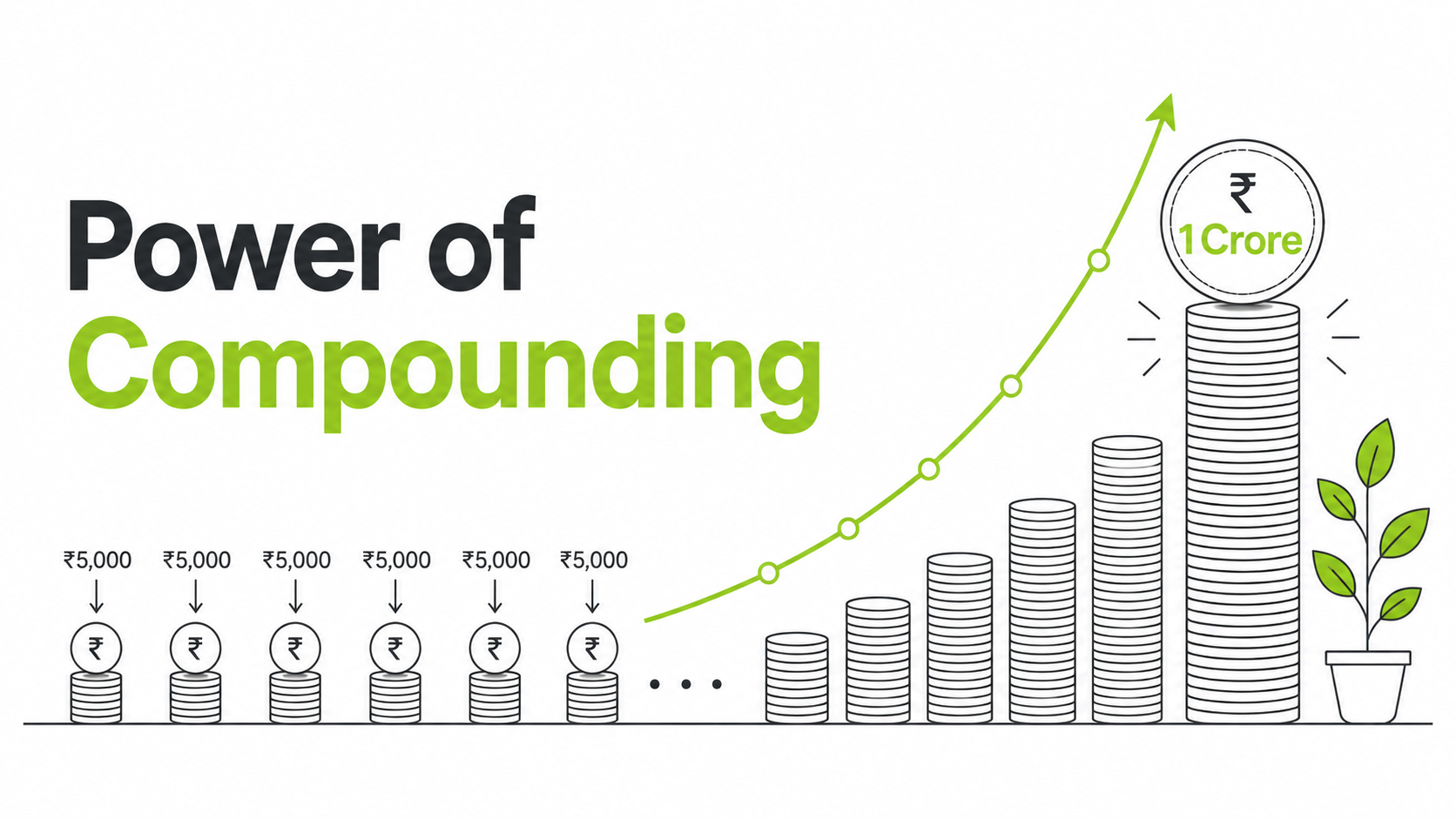
The power of compounding means your investment can earn returns on both your original money and the returns accumulated earlier. Over long periods, that can make even a modest monthly contribution grow into a substantial corpus.
For example, a ₹5,000 monthly investment earning an illustrative 12% annualised return can cross approximately ₹1 crore after around 26 years. The 12% figure is only an assumption, not a guaranteed market return.
What Is Compounding?
Suppose you invest ₹1 lakh and earn 10%.
After one year:
₹1,00,000 becomes ₹1,10,000
If the full ₹1,10,000 remains invested and earns another 10%:
₹1,10,000 becomes ₹1,21,000
Your second year’s gain is ₹11,000 rather than ₹10,000 because your first year’s return also participated in the second year’s growth.
That is the core idea of compounding.
What Is the Compound Interest Formula?
For a lump sum:
Future Value = Present Value × (1 + rate)^time
With monthly investments, the calculation is different because every contribution is invested for a different number of months.
The first ₹5,000 contribution gets decades to grow.
The contribution made near the end gets much less time.
“Start investing with confidence! Explore
0 demat account
and grow your wealth.”
How Can ₹5,000 Per Month Become ₹1 Crore?
Assume:
- Monthly investment: ₹5,000
- Illustrative annualised return: 12%
- Contributions continue regularly
- Returns remain invested
Approximate results can look like:
| Investment period | Total invested | Approximate value |
|---|---|---|
| 10 years | ₹6 lakh | About ₹11.6 lakh |
| 15 years | ₹9 lakh | About ₹25 lakh |
| 20 years | ₹12 lakh | About ₹49.5 lakh |
| 25 years | ₹15 lakh | About ₹95 lakh |
| Around 26 years | ₹15.6 lakh | Around ₹1 crore+ |
These are illustrations, not promises.
Actual values depend on the sequence and level of investment returns.
Why Does the Last Decade Matter So Much?
Compounding starts slowly because the investment base is small.
Later, you have:
- All previous contributions
- Accumulated investment gains
- New monthly contributions
working at the same time.
That is why the increase between years 20 and 25 can be much larger than the increase between years 1 and 5.
What Happens at 8% Instead of 12%?
Return assumptions matter enormously.
If the investment earns a lower annualised return, reaching ₹1 crore takes longer.
This is why financial plans should not be built on aggressive return assumptions simply to make the numbers look attractive.
A safer strategy is often to:
- Start early
- Invest more
- Increase contributions
- Remain consistent
rather than assume unusually high returns.
Why Starting Early Matters
Consider two investors.
Investor A
Starts at age 25.
Investor B
Starts at age 35.
Even if both invest the same monthly amount, Investor A’s earliest contributions receive ten extra years of compounding.
Time can be more valuable than trying to find the perfect investment.
What Is a Step-Up SIP?
A step-up SIP increases the monthly contribution periodically.
Suppose you start with ₹5,000 and raise it by 10% every year.
Your monthly contribution becomes:
- Year 1: ₹5,000
- Year 2: ₹5,500
- Year 3: ₹6,050
- Year 4: ₹6,655
- Year 5: ₹7,321 approximately
As your salary grows, this approach can increase your eventual corpus dramatically.
Why Increasing SIP Can Beat Chasing Returns
You cannot control the stock market.
You can control:
- Savings rate
- Contribution amount
- Investment period
- Costs
- Behaviour
Suppose your plan requires 18% returns every year to work.
That plan may be fragile.
Increasing monthly investment from ₹5,000 to ₹8,000 over time may be more realistic than trying to find a magical investment delivering exceptionally high returns.
Does Compounding Work in Mutual Funds?
Yes, conceptually.
If gains remain invested, the growing value can participate in future market movements.
However, mutual funds do not deliver a fixed compounding rate.
A fund might return:
- +20% one year
- -12% another
- +8% the next
The long-term annualised return emerges from the actual sequence of market performance.
Does Compounding Work in PPF?
Yes.
PPF interest is added according to the scheme’s rules, and the accumulated balance can continue earning interest.
The rate is periodically notified by the government, so you should not assume one fixed rate for the entire term.
Does Compounding Work in Fixed Deposits?
Cumulative fixed deposits can reinvest interest according to the deposit terms.
However, taxation and the chosen payout structure can affect the effective compound return.
What Is Negative Compounding?
Compounding can work against you too.
High-interest debt is a classic example.
If credit-card balances remain unpaid, interest can accumulate on an increasingly large balance.
This is why eliminating expensive debt can sometimes be financially more urgent than increasing investments.
Does Inflation Also Compound?
Yes.
If inflation averages 6%, prices do not rise by only a single 6% over ten years.
The cost base itself keeps increasing.
This means a ₹1 crore goal 25 years from now does not have the same purchasing power as ₹1 crore today.
Long-term goals should account for inflation.
How Much Will ₹1 Crore Be Worth in the Future?
The answer depends on inflation.
At sustained inflation, future purchasing power declines.
This is why investors should define goals in future-value terms rather than picking a psychologically attractive round number.
Your retirement plan should answer:
What future corpus may support the lifestyle I want?
not simply:
How do I reach ₹1 crore?
How Can Fees Reduce Compounding?
Investment costs also compound.
Suppose one investment earns 12% before costs and another strategy loses more each year to fees.
A small annual cost difference can translate into a large gap over 20 or 30 years.
This is one reason investors should understand mutual fund expense ratios and other recurring charges.
What Interrupts Compounding?
Stopping Too Early
Time is a major ingredient.
Frequent Withdrawals
Removing money reduces the amount available to participate in future growth.
Panic Selling
Selling after market declines can lock in losses.
Excessive Costs
High recurring costs reduce net returns.
Poor Asset Selection
Compounding cannot rescue an investment that permanently destroys capital.
Is 12% a Realistic Return?
No fixed market return should be treated as guaranteed.
A 12% assumption is commonly used for illustrations involving long-term equity-style investing, but actual returns can be lower or higher.
Financial planning should test multiple scenarios.
For example:
- Conservative case: 8%
- Moderate case: 10%
- Higher-return illustration: 12%
If your plan fails completely at the lower assumptions, increase contributions or adjust goals.
How Can Beginners Use Compounding Practically?
Follow these steps:
- Build an emergency fund.
- Clear high-cost debt.
- Identify long-term goals.
- Start investing early.
- Automate contributions.
- Increase investments with salary growth.
- Keep costs reasonable.
- Review periodically.
- Avoid unnecessary withdrawals.
Common Compounding Myths
“Compounding Makes Everyone Rich”
Only if you contribute enough, earn suitable returns, and give the investment time.
“12% Is Guaranteed”
It is not.
“Starting With ₹500 Means I Never Need to Increase It”
Starting small is useful, but your contribution should ideally grow with income.
“Compounding Removes Risk”
It does not.
A poor investment can lose value over long periods.
FAQs
Can ₹5,000 per month really become ₹1 crore?
Yes, mathematically, with sufficient time and returns. At an illustrative 12% annualised return, it can take roughly 26 years. Actual returns are not guaranteed.
How can I reach ₹1 crore faster?
You can increase the monthly investment, use a step-up strategy, start earlier, or potentially earn higher returns by accepting appropriate risk. Higher returns cannot be guaranteed.
Is compounding only for stocks?
No. The principle can apply to many investments where returns remain invested.
What is more important, return or time?
Both matter, but starting earlier gives compounding more time to work and is something the investor can control.
Does inflation reduce compound wealth?
Yes. Inflation reduces future purchasing power and should be included in long-term goal planning.
Key Takeaways
- Compounding means earning returns on accumulated value.
- Time has an outsized impact on long-term growth.
- ₹5,000 monthly can potentially reach ₹1 crore over decades, but returns are not guaranteed.
- Increasing your contribution can be more controllable than chasing higher returns.
- Fees and inflation also compound.
- Start early, invest consistently, and review your assumptions periodically.
Disclaimer
The stocks mentioned in this article are not recommendations. Please conduct your own research and due diligence before investing. Investment in securities market are subject to market risks, read all the related documents carefully before investing. Please read the Risk Disclosure documents carefully before investing in Equity Shares, Derivatives, Mutual fund, and/or other instruments traded on the Stock Exchanges. As investments are subject to market risks and price fluctuation risk, there is no assurance or guarantee that the investment objectives shall be achieved. Lemonn (Formerly known as NU Investors Technologies Pvt. Ltd) do not guarantee any assured returns on any investments. Past performance of securities/instruments is not indicative of their future performance.
Related Posts



Download Lemonn
Download my app for share market trading, ipo investment, trading account, and all your investment needs.



