
India Q1 GDP Growth Hits 7.8%, Beating RBI Forecast
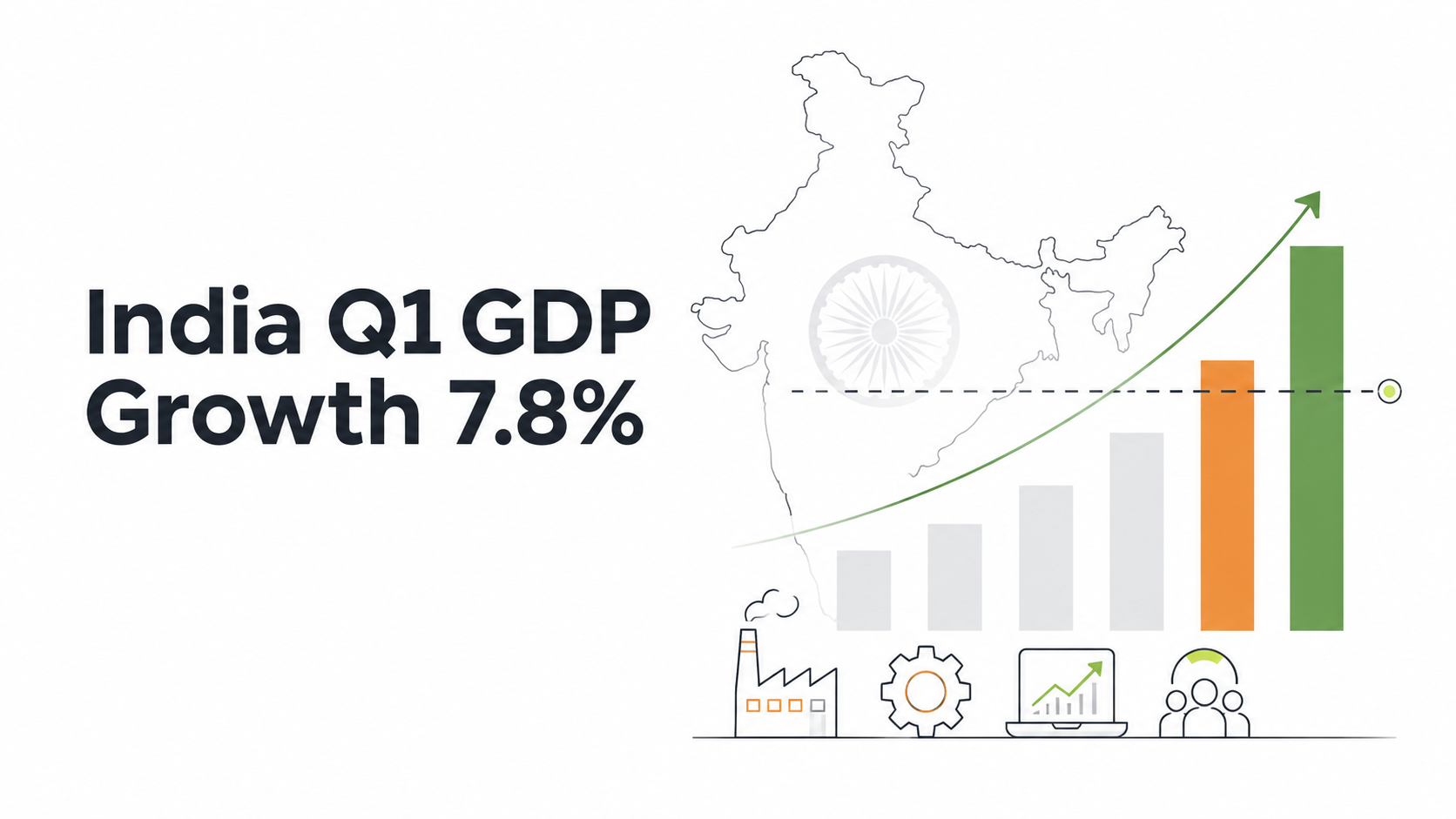
India’s economy grew 7.8% year-on-year in real terms during the April to June 2026 quarter, beating the Reserve Bank of India’s forecast of around 7%.
The stronger-than-expected Q1 FY27 GDP number suggests that domestic economic activity remained resilient despite risks from energy prices, geopolitical uncertainty and global demand.
For investors, the number matters because economic growth influences corporate earnings, credit demand, employment, government finances and monetary policy.
What was India’s Q1 FY27 GDP growth?
India recorded real GDP growth of 7.8% during the April to June 2026 quarter.
This exceeded the RBI’s projection of around 7% for the quarter.
The result was stronger than many forecasters expected.
What does 7.8% GDP growth mean?
GDP stands for gross domestic product.
It measures the economic value of goods and services produced in the country.
When real GDP rises by 7.8%, it means inflation-adjusted economic output was approximately 7.8% higher than in the corresponding period a year earlier.
The word real is important.
Nominal GDP includes the impact of price changes.
Real GDP attempts to measure changes in actual economic activity after adjusting for inflation.
“Start investing with confidence! Explore
0 demat account
and grow your wealth.”
What drove India’s growth?
Recent reporting around the Q1 data points to strength across several parts of the economy.
Manufacturing, construction, government spending, private consumption and services contributed to economic activity, although investors should use official sector tables for detailed comparisons.
India continues to benefit from a large domestic market alongside public and private investment.
Why did GDP beat the RBI forecast?
Economic forecasts use assumptions about:
- consumption,
- investment,
- government spending,
- exports,
- inflation,
- industrial activity,
- agriculture.
Actual data can differ substantially.
Q1 activity proved stronger than the RBI had expected.
That does not mean future quarters will automatically grow at the same pace.
The RBI’s full-year growth outlook remained lower than the first-quarter headline rate, reflecting expectations of some moderation later in FY27.
Is 7.8% GDP growth strong?
For a large economy, 7.8% real growth is a strong pace.
If sustained, high growth can support:
- higher household incomes,
- employment creation,
- business investment,
- corporate revenues,
- tax collections,
- credit demand,
- infrastructure spending.
However, GDP growth does not tell us how evenly income gains are distributed across households or sectors.
The quality and composition of growth matter too.
What does GDP growth mean for RBI interest rates?
Strong growth can reduce the urgency for immediate monetary-policy support.
If economic activity is already expanding rapidly while inflation risks remain, the RBI may have less reason to aggressively cut rates.
However, GDP does not determine policy by itself.
The RBI will also consider:
- CPI inflation,
- food prices,
- crude oil,
- currency movements,
- global rates,
- liquidity,
- inflation expectations,
- future growth risks.
Therefore, a 7.8% GDP print does not automatically mean rates will remain unchanged.
Why are oil prices important for India?
India imports a large portion of the crude oil it consumes.
A sustained rise in oil prices can affect:
- inflation,
- transport costs,
- household budgets,
- corporate margins,
- current-account balances,
- government finances.
An energy shock can therefore weaken some of the benefits of strong domestic growth.
This remains a significant risk given geopolitical uncertainty.
What does stronger GDP mean for the stock market?
Strong economic growth is generally supportive for corporate earnings.
But not every stock benefits equally.
Banks
Higher economic activity can increase demand for loans.
Infrastructure
Capital expenditure can benefit construction, engineering and industrial companies.
Consumer companies
Higher income and employment can support consumption.
Automobiles
Demand can improve if consumer confidence and financing remain healthy.
Real estate
Strong income and employment can support housing and office demand.
IT
Indian IT companies depend heavily on international demand, so domestic GDP is only one factor.
Does 7.8% GDP growth guarantee stock-market gains?
No.
Stock prices are forward-looking.
The market may already have priced in strong economic growth.
Equity returns also depend on:
- company earnings,
- valuations,
- interest rates,
- foreign flows,
- global markets,
- currency movements.
A strong economy can therefore coexist with weak stock returns if valuations are too high.
What does GDP growth mean for businesses?
Companies focused on domestic demand may see opportunities to:
- expand production,
- hire workers,
- invest in factories,
- open stores,
- increase capacity.
However, sector-specific demand is more relevant to individual businesses than national GDP alone.
A strong GDP print does not mean every industry is expanding equally.
What does GDP growth mean for households?
Economic growth can influence households through:
- jobs,
- wages,
- borrowing costs,
- government spending,
- business expansion.
However, GDP is not the same as household income growth.
If growth is concentrated in capital-intensive industries, employment creation may be more limited.
Broad-based consumption and labour-intensive growth can have a larger direct impact on households.
What could slow India’s economy?
High oil prices
They can increase inflation and import costs.
Global slowdown
Weak international demand can hurt exporters.
Higher interest rates
Expensive borrowing can slow consumption and investment.
Weak agricultural conditions
Rural incomes remain sensitive to agriculture and weather.
Geopolitical disruptions
Conflict can affect commodity prices and supply chains.
Persistent inflation
High prices reduce household purchasing power.
Can India sustain 7% plus growth?
India has several structural growth drivers:
- a large domestic market,
- infrastructure investment,
- digitalisation,
- financial formalisation,
- manufacturing ambitions,
- urbanisation,
- a relatively young population.
Maintaining high growth will also depend on productivity, employment, education, private investment and policy execution.
One quarter should therefore not be treated as proof of a permanent growth rate.
FAQs
What was India’s GDP growth in Q1 FY27?
Real GDP grew 7.8% year-on-year in April to June 2026.
What had the RBI forecast?
The RBI had expected around 7% growth for the quarter.
Is 7.8% GDP growth good?
For a large economy, it represents a strong pace of real economic expansion.
Will the RBI stop cutting rates because of GDP?
Not necessarily. Inflation and future economic conditions remain critical to RBI decisions.
Does strong GDP mean the stock market will rise?
No. Valuations, earnings, liquidity and global conditions also affect share prices.
Can India’s Q1 GDP number be revised?
Yes. GDP estimates can be revised when more complete economic data becomes available.
Key takeaways
- India grew 7.8% in real terms in Q1 FY27.
- Growth beat the RBI’s forecast of around 7%.
- Strong GDP indicates resilient domestic economic activity.
- Banks, consumer companies and infrastructure businesses can benefit from stronger growth.
- GDP alone does not guarantee stock-market gains.
- Oil prices and inflation remain key risks.
- RBI policy will depend on inflation and the broader outlook, not one GDP number.
Disclaimer
The stocks mentioned in this article are not recommendations. Please conduct your own research and due diligence before investing. Investment in securities market are subject to market risks, read all the related documents carefully before investing. Please read the Risk Disclosure documents carefully before investing in Equity Shares, Derivatives, Mutual fund, and/or other instruments traded on the Stock Exchanges. As investments are subject to market risks and price fluctuation risk, there is no assurance or guarantee that the investment objectives shall be achieved. Lemonn (Formerly known as NU Investors Technologies Pvt. Ltd) do not guarantee any assured returns on any investments. Past performance of securities/instruments is not indicative of their future performance.
Related Posts

Download Lemonn
Download my app for share market trading, ipo investment, trading account, and all your investment needs.



