Manipal Health Shares Jump 11% on Debut, Hits $9B Value
 Written by Kumar Ashutosh
 Reviewed by Gaurav Garg, SEBI-registered Research Analyst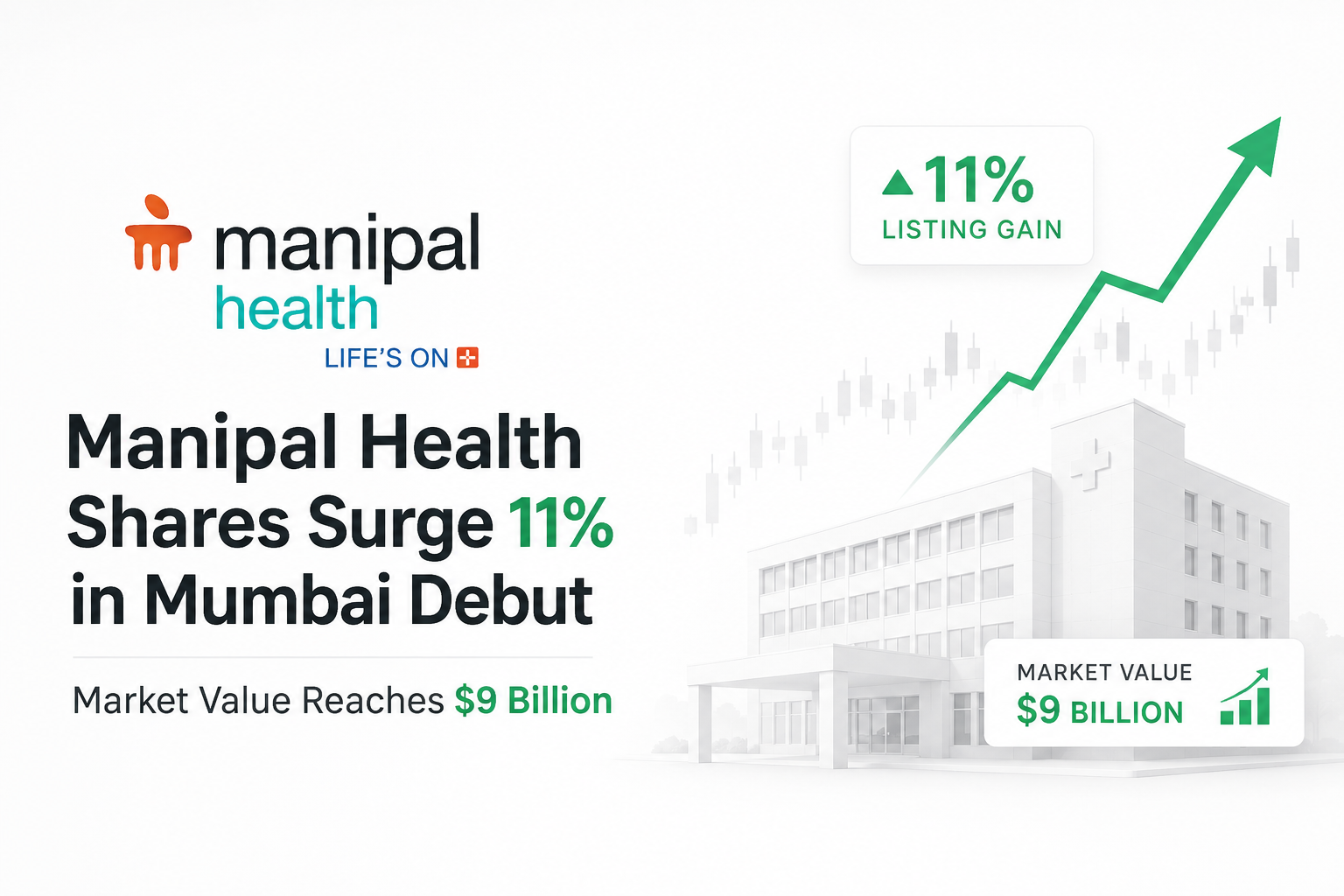
Manipal Health Enterprises made an impressive stock market debut on Wednesday, with its shares rising 11% above the IPO price, giving the hospital chain a market capitalization of nearly $9 billion. The strong listing surprised many market participants, especially after grey market premiums (GMPs) had indicated only a modest premium ahead of the listing.
The listing marks one of the biggest milestones for India’s healthcare sector, reinforcing investor confidence in hospital businesses that continue to benefit from rising healthcare demand, expanding insurance coverage, and increasing investments in advanced medical infrastructure.
Manipal Health’s Stock Market Debut at a Glance
| Metric | Details |
|---|---|
| IPO Price | ₹590 per share |
| BSE Listing Price | ₹655 |
| NSE Listing Price | ₹652 |
| Listing Gain | Approximately 11% |
| Market Capitalization | Around $9 billion |
| IPO Size | ₹9,275 crore |
The stock opened significantly above its issue price, outperforming grey market expectations that had suggested only a marginal premium before listing.
Why Did Manipal Health Shares Rise on Listing?
Several factors contributed to the strong market debut.
1. Strong Institutional Demand
Although retail participation was relatively moderate during the IPO, institutional investors showed robust interest.
The IPO was subscribed 4.92 times overall, with Qualified Institutional Buyers (QIBs) driving demand during the final day of bidding. The issue received bids for more than 44 crore shares against nearly 9 crore shares on offer.
2. India’s Healthcare Story Remains Strong
India’s private healthcare industry continues to benefit from multiple structural trends:
- Rising middle-class income
- Increasing health insurance penetration
- Growing demand for specialty care
- Expansion into Tier II and Tier III cities
- Higher spending on chronic disease management
These long-term trends have made hospital operators attractive investment opportunities.
3. Market Confidence in Manipal’s Business Model
Manipal Health is among India’s largest hospital networks, operating dozens of multi-specialty hospitals with over 13,000 licensed beds across the country. The company has built a diversified healthcare platform that spans tertiary care, quaternary care, oncology, cardiology, organ transplantation, and other specialized medical services.
IPO Details
Manipal Health launched one of India’s largest healthcare IPOs.
| IPO Feature | Information |
|---|---|
| Total Issue Size | ₹9,275 crore |
| Fresh Issue | ₹8,000 crore |
| Offer for Sale | ₹1,275 crore |
| Price Band | ₹560 to ₹590 |
| Listing Date | August 5, 2026 |
The IPO included a large fresh issue alongside an offer for sale by existing shareholders.
How Will Manipal Health Use the IPO Proceeds?
According to the company’s IPO plans, the proceeds from the fresh issue will primarily be used for:
- Debt repayment
- Hospital expansion
- Capacity addition
- Infrastructure upgrades
- Strategic acquisitions, including increasing its stake in Sahyadri Hospitals
- General corporate purposes
Reducing debt is expected to strengthen the balance sheet while supporting future expansion across India.
From IPO Pricing to a $9 Billion Company
Interestingly, Manipal Health had reportedly considered a significantly higher valuation during the early stages of its IPO planning before settling for a lower valuation range to improve investor participation. Reports suggested the company reduced its targeted valuation from earlier expectations of $10 billion to $12 billion to approximately $8.3 billion before pricing the issue. The strong listing has now lifted its valuation close to $9 billion.
Why the Strong Debut Was Unexpected
Before listing, the grey market premium had cooled considerably.
Some market observers even expected a flat or muted listing because:
- GMP had declined sharply in the final days before listing.
- The IPO size was among the largest in India’s healthcare sector.
- Retail subscription remained relatively soft during the initial days.
However, the actual listing significantly exceeded these expectations, highlighting that grey market premiums are not always reliable indicators of listing-day performance.
What Does This Mean for Investors?
For Existing Shareholders
Investors who received IPO allotments have already generated double-digit listing gains.
Their next decision depends on:
- Long-term investment horizon
- Portfolio allocation
- Expectations regarding hospital sector growth
- Company earnings over the coming quarters
For New Investors
Investors considering buying after listing should evaluate:
- Current valuation
- Future earnings growth
- Expansion execution
- Debt reduction progress
- Quarterly financial performance
Rather than focusing solely on listing gains, long-term investors may monitor how efficiently the company deploys IPO proceeds.
Growth Opportunities Ahead
India’s healthcare industry is expected to expand rapidly over the next decade.
Major growth drivers include:
- Aging population
- Lifestyle-related diseases
- Medical tourism
- Digital healthcare adoption
- Government healthcare initiatives
- Increased insurance penetration
Large hospital chains such as Manipal Health are well positioned to benefit if they continue expanding capacity while maintaining profitability.
Risks Investors Should Watch
Despite the strong debut, investors should remain aware of several risks:
- High valuation compared to peers
- Execution risks during expansion
- Regulatory changes
- Rising employee costs
- Competition from Apollo Hospitals, Max Healthcare, Narayana Health, and Fortis Healthcare
Long-term performance will ultimately depend on earnings growth rather than listing-day momentum.
How Manipal Health Compares With India’s Leading Hospital Chains
| Company | Focus Area |
|---|---|
| Manipal Health | Multi-specialty hospital network |
| Apollo Hospitals | Integrated healthcare ecosystem |
| Max Healthcare | Premium hospital services |
| Fortis Healthcare | Multi-city hospital chain |
| Narayana Health | Affordable tertiary care |
Each company operates with different expansion strategies, pricing models, and patient demographics.
The Bottom Line
Manipal Health’s 11% listing gain has delivered a strong start for one of India’s largest healthcare IPOs. The company’s market capitalization reaching nearly $9 billion reflects investor confidence in India’s growing healthcare sector and Manipal’s long-term expansion plans.
While the listing exceeded market expectations, investors should now focus on fundamentals such as earnings growth, debt reduction, hospital occupancy, and execution of expansion projects. These factors will determine whether the company can justify its premium valuation over the coming years.
Frequently Asked Questions
Q. Why did Manipal Health shares rise 11% on listing?
The stock benefited from strong institutional demand, positive sentiment toward India’s healthcare sector, and investor confidence in the company’s long-term growth prospects.
Q. What was Manipal Health’s IPO price?
The IPO was priced at ₹590 per share.
Q. At what price did Manipal Health list?
The shares listed at ₹655 on the BSE and ₹652 on the NSE, representing an 11% premium over the IPO price.
Q. How much did Manipal Health raise through its IPO?
The company raised approximately ₹9,275 crore through its public offering.
Q. What will Manipal Health use the IPO proceeds for?
The company plans to use the funds for debt repayment, expansion, acquisitions, infrastructure development, and general corporate purposes.
Key Takeaways
- Manipal Health shares debuted with an 11% premium over the IPO price.
- The listing lifted the company’s valuation to nearly $9 billion.
- The IPO raised ₹9,275 crore, making it one of India’s largest healthcare IPOs.
- Institutional investors drove strong subscription demand.
- IPO proceeds will support debt reduction, hospital expansion, and strategic acquisitions.
Disclaimer
The stocks mentioned in this article are not recommendations. Please conduct your own research and due diligence before investing. Investment in securities market are subject to market risks, read all the related documents carefully before investing. Please read the Risk Disclosure documents carefully before investing in Equity Shares, Derivatives, Mutual fund, and/or other instruments traded on the Stock Exchanges. As investments are subject to market risks and price fluctuation risk, there is no assurance or guarantee that the investment objectives shall be achieved. Lemonn (Formerly known as NU Investors Technologies Pvt. Ltd) do not guarantee any assured returns on any investments. Past performance of securities/instruments is not indicative of their future performance.