Multi-Leg Options Order in India: How It Works
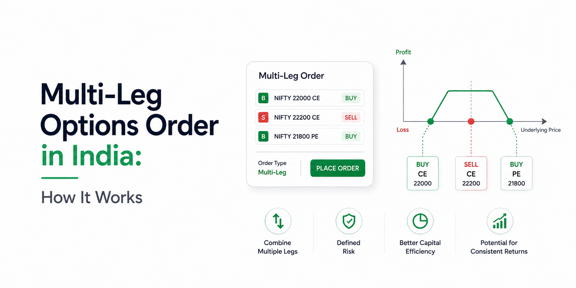
Most Indian traders learn options one leg at a time: buy a call, sell a put, square off before expiry. But many widely used F&O setups, straddles, strangles, spreads, iron condors, and hedged intraday structures, are not really “single orders” in practice. They are combinations of separate option legs that need to work together.
That is where a multi leg options order in India matters.
If you have ever tried to build a straddle by placing one order first and the second a few seconds later, you already know the problem. Price can move between legs. Margin can change. Your intended payoff can shift. On fast-moving days, especially weekly expiry, those few seconds matter.
This guide explains what is multi leg options order, how it differs from a normal basket, what happens when brokers send multiple legs for execution, where slippage enters the picture, and why single trade options execution in India matters more for some strategies than others.
If you are still building your foundation, it helps to first understand what options trading is, how options trading works, and the basics of how to trade in futures and options.
What is a multi-leg options order?
A multi-leg options order is an order structure where two or more option positions are created together as part of one strategy.
In plain English, instead of thinking “I am buying one call,” you think, “I am entering one strategy that contains multiple option contracts.”
Examples include:
- Long straddle: buy one ATM call and one ATM put
- Short straddle: sell one ATM call and one ATM put
- Bull call spread: buy one call and sell another call at a different strike
- Bear put spread: buy one put and sell another put
- Iron condor: combine four legs across calls and puts
- Hedged intraday option trade: one directional leg plus one protection leg
The National Stock Exchange’s educational material on option strategies explicitly covers structures such as bear put spreads, iron condors, and protective puts, which are all multi-leg in nature. (nsearchives.nseindia.com)
So, multi leg order meaning in options is simple: it is the coordinated execution of multiple option contracts that together form a strategy.
Why multi-leg execution matters in Indian F&O
The issue is not whether you can enter legs one by one. You usually can. The issue is whether doing so keeps the strategy close to what you intended.
Consider a Nifty ATM long straddle on expiry day:
- You want to buy the call and put at nearly the same spot reference.
- You are budgeting a certain total premium.
- Your payoff depends on the combined entry price, not just one leg.
If you buy the call first and the market moves sharply before you buy the put, your total cost changes. Your “strategy” may still exist, but it is no longer the same strategy you planned.
That is why traders care about execute all option legs together functionality. It cuts the gap between plan and execution.
This matters even more in setups where:
- spreads are tight and timing-sensitive,
- premium moves fast,
- expiry-day volatility is high,
- margin depends on the completed combination,
- or the hedge leg must exist immediately.
For related execution-focused reading, traders often compare tools used on fast markets such as expiry day trading apps and platforms with fast order execution for expiry day trades.
“Start investing with confidence! Explore
option trading
and grow your wealth.”
Multi-leg order vs basket order: not always the same thing
This is where many articles get vague.
A basket order usually means you group multiple orders together and send them in one workflow. But that does not automatically mean all legs are matched simultaneously in the market.
A true exchange-level multi-leg facility is more specific. BSE’s derivatives documentation describes multi-legged order entry as a facility that lets traders place a combination order across different futures and options contracts, with linked execution of the strategy legs. BSE’s FAQ also notes this can be used for strategy-based orders and allows up to four legs “at the same time,” while the orders are IOC in nature. (bseindia.com)
NSE circulars similarly describe a multi-leg order entry facility in derivatives through which members can place 2-leg and 3-leg combination orders via a single entry, with IOC matching. (nsearchives.nseindia.com)
That means:
Basket order
- You prepare multiple legs in one interface
- The system may still fire legs sequentially
- Final fills can happen one order at a time
- Temporary directional exposure may occur between legs
Multi-leg order entry facility
- Strategy is sent as a linked combination structure
- Exchange/broker routing logic is built around the full setup
- IOC behavior can reduce lingering partial exposure
- It is closer to “strategy execution” than “multiple manual orders”
In practice, many retail traders in India use the phrase options basket order India to mean any screen where multiple legs are placed together. But operationally, there is a big difference between:
- manual sequential execution,
- broker-side basket firing, and
- exchange-supported linked multi-leg execution.
That distinction affects slippage, fills, margin experience, and risk.
How execution actually works
Here it is in plain language.
1. You define the strategy
You select strikes, expiry, side, and quantity. For example:
- Sell 1 ATM Nifty call
- Sell 1 ATM Nifty put
That is a short straddle.
2. The system calculates the legs
The broker’s interface may show:
- net premium,
- leg-wise premium,
- required margin,
- and sometimes estimated payoff.
If you want to understand strategy construction better, best options trading strategies and what is options strategy are useful stepping stones.
3. The order is transmitted
Now the important part begins.
Depending on the platform, the trade may be sent as:
- separate order messages sent one after another,
- a broker-managed basket,
- or a linked multi-leg instruction supported by exchange workflow.
4. Matching happens in the market
Even if you clicked once, the market still has to find liquidity for each leg.
That means your fill quality depends on:
- bid-ask spread,
- market depth,
- order size,
- volatility,
- and how quickly the market is moving.
5. You either get completed structure, partial fills, or rejection
This is why execution quality matters.
A multi-leg strategy is only “complete” when the required legs are actually filled in a usable combination.
Sequential vs near-simultaneous execution
This is the heart of the issue.
When traders say they want single trade options execution India, they usually mean they want the system to reduce the delay and mismatch between legs as much as possible.
But in real market microstructure, “single trade” often means single workflow from the trader’s side, not one magical fill detached from market liquidity.
Here’s the practical spectrum:
Manual sequential
You place leg 1, then leg 2, then maybe leg 3.
Highest operational risk.
Broker basket, sequential firing
You click once, but the broker sends multiple child orders individually.
Faster than manual, but still exposed to fill mismatch.
Linked or exchange-supported multi-leg execution
The order is structured as a multi-leg combination with linked handling.
Usually better for strategy integrity, though not immune to execution constraints.
On fast sessions, especially expiry, this difference can be the gap between a defined spread and an unintended naked position. That is one reason active traders care about tools like built-in F&O signal tools, structured trades on BOLT, and execution-focused products such as Trade FnO Fast.
Slippage risk in multi-leg orders
Slippage is not only about one bad fill. In options strategies, it is often about net strategy slippage.
Suppose you want an iron condor:
- Sell OTM call
- Buy further OTM call
- Sell OTM put
- Buy further OTM put
If one short leg fills at a worse price while hedge legs lag, your intended credit changes. If volatility jumps during entry, the whole structure can look different by the time the final leg arrives.
This matters because the strategy’s risk-reward was based on:
- total credit or debit,
- strike distance,
- hedge placement,
- and margin efficiency.
So the hidden cost of a poor multi-leg workflow is not just inconvenience. It can be:
- worse entry pricing,
- temporary directional exposure,
- incomplete hedges,
- higher-than-expected margin usage,
- or a strategy that no longer fits your plan.
For traders working with expiry or fast intraday moves, instant exit versus auto square off and scalping in options are related operational topics.
Margin impact: why the order path changes the experience
Margin on option strategies can depend on whether the hedge leg is already present.
For example, a naked short option generally requires more margin than a hedged spread. If your short leg gets executed first and the protective long leg is delayed, you may temporarily see a larger margin block or even face failure if funds are insufficient for that intermediate state.
That is why strategy traders should not think only in terms of “final margin.” They should think about entry path risk.
Questions to ask:
- Does the broker block margin based on complete strategy logic?
- Can partial fills cause temporary excess margin demand?
- Is the structure recognized as hedged only after all legs go live?
- Can one leg fail and leave the rest exposed?
If leverage and margin are still new to you, these explainers on what margin in F&O means, what margin trading is, and exposure margin help build context.
Common strategies where multi-leg execution matters most
Not every trade needs advanced execution. But the more legs you add, the more coordination matters.
1. Straddles
Because both legs are near the money, premiums can move quickly together. Delays distort the total cost or credit.
2. Strangles
Wider strikes reduce some urgency, but execution still matters when volatility expands fast.
3. Vertical spreads
These often rely on tight pricing between bought and sold strikes. One weak fill can ruin the intended reward-to-risk.
4. Iron condors
Four legs mean more chances for mismatch. Good structure handling matters.
5. Hedged option selling
You may want short premium exposure only if the hedge is confirmed.
NSE’s own educational material includes complex strategies like iron condors and protective structures, reinforcing that multi-leg thinking is central to options strategy use, not an advanced afterthought. (nsearchives.nseindia.com)
What retail traders should check before using a multi-leg order feature
Before trusting any platform, ask these questions:
Does it support strategy-level entry or only grouped orders?
A visually neat basket is not enough.
Are legs sent sequentially or linked?
This directly affects slippage risk.
What happens if one leg fails?
You need to know whether remaining legs are cancelled, left open, or require manual action.
Is the order IOC or can it sit partially open?
Exchange-supported multi-leg facilities on NSE and BSE are described as IOC in the cited circulars and FAQs. (bseindia.com)
Does the platform show payoff before execution?
That helps verify whether the structure still matches your plan.
Does margin reflect the completed strategy?
Important for spreads, condors, and hedged short positions.
Is the workflow fast enough for active conditions?
Especially relevant for weekly expiry and intraday traders.
If you are evaluating a broker more broadly, how to choose a good stockbroker in India, SEBI registered brokers in India, and safe broker checklist are practical reads.
The risk side: multi-leg does not mean low-risk
A better execution workflow does not make an options strategy safe by default.
SEBI’s 2023 risk disclosure on equity F&O trading highlighted that most individual traders in this segment incurred net losses. That is the reminder here: execution quality can reduce avoidable mistakes, but it cannot remove market risk, volatility risk, or strategy risk. (sebi.gov.in)
So even with clean multi-leg entry, traders still need to manage:
- position sizing,
- stop-loss or exit logic,
- event risk,
- expiry behavior,
- implied volatility shifts,
- and max loss awareness.
If you are newer to risk frameworks, is F&O risky, what is option expiry, and weekly expiry trading for beginners are useful next reads.
Where Lemonn fits in the conversation
For Indian retail traders, the real value of a multi-leg workflow is not just convenience. It is reducing execution friction between idea and order placement.
When traders compare platforms, they are typically looking for:
- faster strategy deployment,
- fewer manual mistakes,
- cleaner execution during volatile sessions,
- and tools that support structured F&O decisions.
That is why the broader product experience matters too, including brokerage visibility, F&O trading tools, and a trading setup designed to help you trade F&O fast.
FAQs
What is a multi leg options order?
A multi leg options order is a strategy-based order that combines two or more option contracts, such as a straddle, spread, or iron condor, into one execution workflow.
What is the difference between a basket order and a multi-leg order in options?
A basket order groups multiple orders together, but the legs may still be fired one by one. A multi-leg order is more strategy-linked and may use exchange-supported handling for connected execution.
Can I execute all option legs together in India?
In many cases, brokers offer a one-click or one-workflow way to place multiple legs together. But the actual execution method may still vary between manual-style basket firing and linked multi-leg order handling.
Why does single trade options execution in India matter?
It matters because delays between legs can create slippage, margin issues, incomplete hedges, and strategy drift, especially on expiry day or during fast moves.
Are multi-leg options orders less risky?
No. They can reduce execution mistakes, but the market risk of the options strategy remains. SEBI’s risk disclosures on F&O still apply.
Which strategies commonly use multi-leg orders?
Common examples include straddles, strangles, bull call spreads, bear put spreads, iron condors, and hedged option-selling structures.
Conclusion
A multi leg options order in India is best understood as a strategy execution tool, not just a convenience feature.
The key idea is simple: many options strategies only make sense when their legs work together. If they are entered inefficiently, the structure can suffer from slippage, incomplete hedging, temporary margin stress, or plain execution error.
So when evaluating any platform, do not stop at “does it have basket orders?” Ask the more important question: how are the legs actually executed?
That is the difference between merely placing multiple options orders and truly trading a multi-leg strategy with intent.
Disclaimer
The stocks mentioned in this article are not recommendations. Please conduct your own research and due diligence before investing. Investment in securities market are subject to market risks, read all the related documents carefully before investing. Please read the Risk Disclosure documents carefully before investing in Equity Shares, Derivatives, Mutual fund, and/or other instruments traded on the Stock Exchanges. As investments are subject to market risks and price fluctuation risk, there is no assurance or guarantee that the investment objectives shall be achieved. Lemonn (Formerly known as NU Investors Technologies Pvt. Ltd) do not guarantee any assured returns on any investments. Past performance of securities/instruments is not indicative of their future performance.
Related Posts


Download Lemonn
Download my app for option trading, IPO, 0 demat account, stocks, and dive into the stock market.