
Infrastructure Investment Trust (InvIT): How It Works and How to Invest
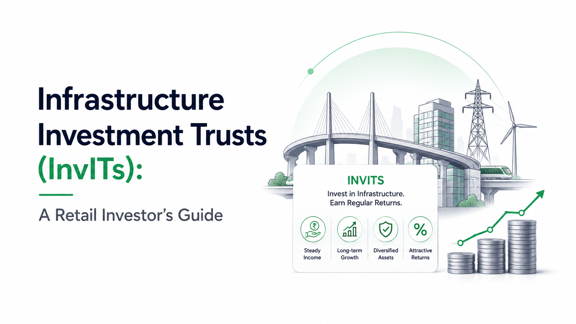
If you have ever driven on a toll road built through a public-private partnership, there is a good chance an infrastructure investment trust (InvIT) owns a piece of that asset. An InvIT lets you buy units on the stock exchange and earn a share of the toll or transmission income these projects generate, without funding an entire highway or power line yourself.
This guide covers what an InvIT is, how it is structured, how to actually buy one, which InvITs are currently listed in India, and how the income gets taxed.
What Is an Infrastructure Investment Trust (InvIT)?
An infrastructure investment trust (InvIT) is a SEBI-regulated pooled investment vehicle that owns and operates completed, revenue-generating infrastructure assets such as national highways, power transmission lines, gas pipelines, telecom towers, and renewable energy projects. It works much like a mutual fund: your money joins thousands of other investors’ money, and a professional manager uses the pool to hold income-producing assets and pass the earnings back to you.
InvITs were introduced through the SEBI (Infrastructure Investment Trusts) Regulations, 2014, specifically to provide infrastructure developers an alternative to bank loans for funding long-gestation projects. By law, an InvIT must pay out at least 90% of its net distributable cash flow to unit holders, usually every quarter or half-year. That single rule is why InvITs are often compared to fixed deposits or debt funds rather than growth stocks: the appeal is steady income, not rapid capital appreciation.
How Is an InvIT Structured?
Every InvIT is built around four parties, each with a defined role under SEBI rules:
| Entity | Role |
| Trustee | SEBI-registered debenture trustee that holds assets on behalf of unit holders and oversees compliance |
| Sponsor | The company or group that sets up the InvIT and transfers assets into it; must hold a minimum stake with a lock-in period |
| Investment Manager | Runs the InvIT day to day, decides on acquisitions, and manages the portfolio |
| Project Manager | Handles operations and maintenance of the underlying infrastructure assets |
In practice, the InvIT usually does not run the toll road or transmission line directly. It holds assets through Special Purpose Vehicles (SPVs), and cash flows from these SPVs, as interest, dividends, or loan repayments, get distributed to you.
Read More: Understanding Infrastructure Investment Trusts (InvITs)
“Start investing with confidence! Explore
0 demat account
and grow your wealth.”
Types of InvITs
InvITs in India fall into two broad categories:
- Publicly listed InvITs: These raise money through an IPO, list on the NSE or BSE, and trade freely like any stock. This is the route most retail investors use.
- Privately placed InvITs: These are offered to institutional and high-net-worth investors through private placement and are not available for retail purchase on an exchange.
As of late 2025, India had over 60 registered InvITs in total, combining public offerings and private placements, but only a handful trade on stock exchanges where retail investors can actually buy in.
How to Invest in an Infrastructure Investment Trust
This trips up most first-time investors, largely because of outdated information about lakh-rupee minimums. Here is what buying a listed InvIT actually looks like today:
- Open a demat and trading account. If you already trade stocks or ETFs, you already have what you need. Any SEBI-registered broker works.
- Search for the InvIT by its trading symbol on your broker’s app or website, for example, INDIGRID, PGINVIT, or IRBINVIT.
- Place a buy order just as you would for a stock, at market price or with a limit order.
- Hold units in your demat account. Distributions are credited directly to your linked bank account, usually quarterly or semi-annually.
- Sell anytime the market is open, subject to available trading volumes.
Worth flagging: SEBI cut the trading lot for listed InvITs to a single unit back in 2021. Before that, retail investors needed upwards of ₹1 lakh to get in. Today, with InvIT units typically priced between roughly ₹60 and ₹180 depending on the trust, you can start with just one unit and build your position gradually, the same way you would with any listed stock.
You can also enter through a new InvIT’s IPO or add units via a rights issue if you already hold units in that trust. A few broking apps now let you set up recurring SIP-style purchases into an InvIT.
Top InvITs Listed in India
Note: this is informational, not a buy recommendation. Any “best” InvIT depends on your risk appetite, income needs, and comfort with the underlying sector, since toll roads behave differently from power transmission. Always check the latest distribution history, leverage, and asset quality before investing. Here are the InvITs currently listed on Indian exchanges, roughly in order of scale:
| InvIT | Sector | Sponsor | Notable |
| IndiGrid Infrastructure Trust | Power transmission and solar | KKR affiliate and Sterlite Power | India’s first listed power-sector InvIT; largest by market cap among InvITs. Rating |
| PowerGrid Infrastructure Investment Trust | Power transmission | Power Grid Corporation of India (PSU) | First InvIT in India to list; government-sponsor backing. Rating |
| IRB InvIT Fund | Toll roads | IRB Infrastructure Developers | India’s very first listed InvIT of any kind |
| Capital Infra Trust | Roads (HAM projects) | Gawar Construction | Listed January 2025 |
| Indus Infra Trust (formerly Bharat Highways InvIT) | Roads (HAM projects) | Aadharshila Infratech / GR Highways | Listed March 2024 |
| National Highways Infra Trust (NHIT) | Toll roads | NHAI (government-backed) | Only InvIT directly sponsored by NHAI |
Between them, these trusts cover the sectors that dominate India’s InvIT landscape today: highways, power transmission, and renewables, with telecom-tower InvITs also emerging. Distribution yields have historically ranged from roughly 8% to 16%, but yield alone should never be the only filter, since a high yield can also reflect the market pricing in traffic, tariff, or refinancing risk.
Advantages of Investing in InvITs
- Regular, predictable income: the 90% mandatory payout rule makes InvITs one of the more dependable income instruments for retail investors.
- Lower entry barrier: you get exposure to assets like national highways or power grids that would otherwise be out of reach.
- Professional management: the investment and project managers handle acquisitions, operations, and compliance.
- Diversification: many InvITs hold assets across several states and sub-sectors, spreading out project-specific risk.
- Reasonable liquidity: since the 2021 SEBI reforms, listed units trade on the exchange during market hours, unlike a physical asset.
Risks Worth Weighing
- Revenue risk: toll-road InvITs depend on traffic volumes; power InvITs depend on availability-based tariffs, and a slowdown in either can dent distributions.
- Interest rate sensitivity: unit prices tend to move inversely with interest rates, since InvITs are valued partly like yield instruments.
- Leverage and refinancing risk: InvITs carry debt at the SPV level, and refinancing at unfavourable rates can squeeze payouts.
- Regulatory and concession risk: changes to toll policy or concession terms can affect cash flows, especially for government-linked assets.
- Lower trading volumes than large-cap stocks, which can make it harder to enter or exit large positions without moving the price.
How Are InvIT Distributions Taxed?
InvIT income can arrive in your account as interest, dividend, return of capital, or a mix of all three, and each is taxed differently:
| Type of income | Tax treatment for resident individuals |
| Interest | Taxed at your income slab rate; InvIT deducts 10% TDS |
| Dividend | Exempt if the SPV has not opted for the concessional 115BAA corporate tax rate; taxed at slab rate with 10% TDS if it has |
| Return of capital | Not taxed on receipt, but reduces your cost of acquisition; any amount above your original cost is taxed as income from other sources |
| Capital gains on sale of units | Held over 12 months: 12.5% long-term capital gains tax (with a ₹1.25 lakh annual exemption). Held 12 months or less: 20% short-term capital gains tax, provided STT was paid |
Each InvIT issues an annual statement (Form 64B/77) breaking down exactly how much of your distribution falls into each category, so you are not left guessing at tax time.
InvITs vs REITs, in Brief
Both are SEBI-regulated, pass-through vehicles taxed in largely the same way, and both distribute most of their cash flow to unit holders. The core difference is the underlying asset: InvITs hold infrastructure like roads and transmission lines, whose income depends on usage or availability-based tariffs, while REITs hold leased commercial real estate, whose income depends on rental agreements. REIT cash flows tend to be steadier over shorter horizons, while InvIT cash flows can be more sensitive to traffic patterns or tariff resets.
Read More: REITs vs InvITs in India: Key Differences and Which Is Better?
Who Should Consider Investing in InvITs?
InvITs generally suit investors who want steady, bond-like income with some inflation protection, have a horizon of three years or more, and are comfortable with somewhat lower liquidity than large-cap stocks. They suit income seekers more than investors chasing rapid capital growth.
Key Takeaways
- An InvIT pools investor money to own income-generating infrastructure and must distribute at least 90% of its cash flow.
- Buying one is as simple as placing a buy order through your demat account; the old lakh-rupee minimum is gone.
- Listed InvITs span power transmission (IndiGrid, PowerGrid InvIT) and toll roads (IRB InvIT, NHIT, Capital Infra Trust, Indus Infra Trust).
- Distributions are taxed differently as interest, dividends, or return of capital, so check the annual statement each InvIT issues.
- InvITs suit income-focused investors with a medium-to-long horizon, not those chasing quick capital gains.
Frequently Asked Questions (FAQs)
What is the minimum amount needed to invest in an InvIT?
Since SEBI cut the trading lot to a single unit in 2021, you can invest for the price of just one unit, typically ranging from around ₹60 to ₹180 depending on the trust.
Are InvITs safe investments?
InvITs carry lower risk than direct equity because of contracted, long-term cash flows, but they are not risk-free. Traffic, tariff, interest rate, and leverage risks all apply.
How is an InvIT different from an infrastructure mutual fund?
An InvIT directly owns and earns income from physical infrastructure. An infrastructure mutual fund instead invests in shares of infrastructure-related companies.
Can NRIs invest in Indian InvITs?
Yes, through eligible NRE or NRO demat accounts, subject to applicable FEMA regulations.
How often do InvITs pay out distributions?
SEBI requires at least once every six months, though most listed trusts pay out quarterly.
Disclaimer
The stocks mentioned in this article are not recommendations. Please conduct your own research and due diligence before investing. Investment in securities market are subject to market risks, read all the related documents carefully before investing. Please read the Risk Disclosure documents carefully before investing in Equity Shares, Derivatives, Mutual fund, and/or other instruments traded on the Stock Exchanges. As investments are subject to market risks and price fluctuation risk, there is no assurance or guarantee that the investment objectives shall be achieved. Lemonn (Formerly known as NU Investors Technologies Pvt. Ltd) do not guarantee any assured returns on any investments. Past performance of securities/instruments is not indicative of their future performance.
Related Posts

Download Lemonn
Download my app for share market trading, ipo investment, trading account, and all your investment needs.



