
Why Indian Households Are Rushing to Sell Their Old Gold Jewellery as Gold Prices Fall: All You Need to Know
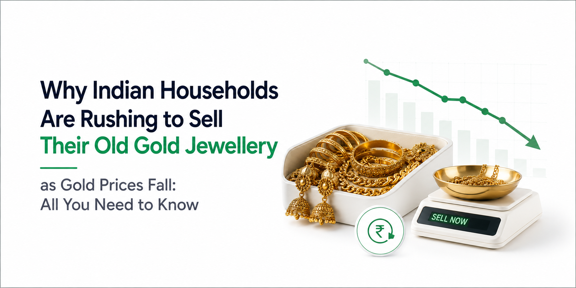
If you have old gold jewellery sitting in a locker, you are not alone in thinking about selling it right now. Indian households sold nearly 50 tonnes of old gold jewellery in the April to June 2026 quarter, a jump of 43% over the same period last year, according to data from the India Bullion & Jewellers Association (IBJA). This is happening even as gold prices have corrected from record highs, which sounds unusual since falling prices should normally discourage selling. But for Indian households, the math works differently, and this article breaks down exactly why.
What Is Actually Happening With Old Gold Right Now
Gold prices touched an all-time high of nearly Rs 1.8 lakh per 10 grams earlier in 2026 before correcting to around Rs 1.4 lakh. Even at this corrected level, prices remain far higher than what most households paid for their gold years or decades ago. This is the key reason old gold jewellery is being sold in such large quantities.
Instead of exchanging old jewellery for new ornaments at the local jeweller, as has been the traditional practice in India, many households are now choosing to sell it outright for cash. The IBJA data show this is not a small shift. A 43% year-on-year jump in volume during a single quarter points to a genuine change in household behaviour, not just a one-off event.
The World Gold Council’s India data for the January to March 2026 quarter tells a related story. Total gold demand rose 10% year on year to 151 tonnes, but the composition changed. Investment demand, meaning bars, coins, and gold ETFs, rose sharply, while jewellery demand stayed under pressure because of high prices. Indians are still buying gold, just in different, more price-conscious forms.
Why Gold Rate Is Going Down: The Real Reasons
Understanding why old gold selling is rising means understanding why gold prices have fallen. A few global and domestic factors are driving this correction.
A stronger US dollar. Gold is priced in US dollars globally. When the dollar strengthens, gold becomes more expensive for buyers using other currencies, which reduces demand and pulls prices down. Through much of 2026, the dollar has strengthened, adding pressure on gold.
Elevated US interest rate expectations. Gold pays no interest or dividend. When bond yields stay high, investors often prefer interest-bearing assets like bonds over non-yielding gold. Expectations that the US Federal Reserve will keep rates elevated for longer have weighed on gold through the year.
Profit booking after a sharp rally. Gold had rallied hard on global uncertainty, inflation worries, and heavy central bank buying before touching record levels. After such a steep rise, it is common for investors to book profits. This is not unique to physical gold either. Gold ETFs in India also saw outflows in May 2026, showing financial investors were booking gains alongside households selling physical jewellery.
Rupee movement. Since India imports most of its gold, the rupee-dollar exchange rate also affects how international price moves translate into domestic rates.
None of this means gold’s long-term story has changed. Most analysts still view gold as a useful hedge over the long run. What has changed is short-term sentiment, and Indian households are reacting to it in a practical way.
Read More: Gold Price Forecast India 2026-2030: Trends, Predictions & Investment Outlook
“Start investing with confidence! Explore
0 demat account
and grow your wealth.”
Why Households Are Selling Old Gold Instead of Holding On
There are three main reasons behind this rush to sell old gold jewellery, and they are worth understanding if you are weighing a similar decision.
- Old gold still looks profitable, even after the correction. If your gold was bought five, ten or twenty years ago, even today’s corrected price is likely to be well above your original purchase cost. Households are choosing to lock in this gain rather than wait and hope for prices to move even higher.
- Fear of a deeper price fall. With expectations that gold could correct further, some households are choosing to sell now rather than risk getting a lower price later. This is a classic case of loss aversion playing out at a national scale.
- A shift from jewellery to organised cash or investment. Selling old, unused jewellery and converting it into liquid cash, or reinvesting in more flexible formats like gold coins, bars or ETFs, is becoming more common. It reflects a broader trend of Indians treating gold more like a financial asset and less like a purely ornamental one.
Muthoot Exim, one of the organised players buying old gold from consumers, notes that people are increasingly turning to transparent, organised channels to convert idle gold into cash rather than relying only on informal jewellers, a meaningful change in how India’s gold ecosystem functions.
Where Is All This Old Gold Going
The old gold being sold does not disappear. It enters the gold recycling ecosystem. Companies such as Muthoot Exim and Augmont buy old and unused gold directly from households, refine it into 24-karat pure gold, and supply it back to jewellery and coin manufacturers.
This matters because of how heavily India depends on gold imports. In FY26, India’s gold import bill stood at close to 72.4 billion US dollars. Recycled gold contributed an estimated 125 to 150 tonnes in 2025, and this could rise to 200 to 250 tonnes in 2026 if the current trend continues.
Indian households are estimated to hold a massive stock of gold, much of it sitting idle in lockers and homes. Even a small share of this coming into organised recycling can meaningfully add to domestic supply and ease some pressure on the import bill. It will not remove India’s dependence on imports, but it will bring idle household wealth back into active use. Augmont, for instance, has scaled its gold monetisation network to over a hundred centres across several states, giving households more accessible ways to sell old gold.
What This Means for Different Stakeholders
For households considering selling old gold: This can be a reasonable way to unlock value from jewellery you no longer wear, especially pieces bought at much lower prices. Before selling, check the purity (karat), look for BIS hallmark verification, compare rates across two or three buyers, and confirm whether GST and making charges are deducted correctly from the payout.
For jewellery companies: Slower fresh jewellery demand combined with rising resale volumes means business models built purely around new jewellery sales may need to adapt, with more emphasis on exchange schemes and lightweight jewellery.
For gold loan companies: As more households choose to sell rather than pledge gold, this could influence loan book growth, though gold loans remain popular for those who want liquidity without giving up ownership.
For long-term investors: The current cycle is a reminder that gold, despite its safe-haven reputation, is not a one-way asset. It can rise sharply and correct meaningfully within the same year. Gold works best as one part of a diversified portfolio, and decisions to buy or sell should be based on your own goals and time horizon rather than short-term price swings.
Should You Sell Your Old Gold Right Now
There is no single right answer, since it depends on your financial situation.
- If the jewellery has been unused for years, converting it to cash or a more liquid gold format can make sense at current elevated prices.
- If you expect to need funds soon anyway, selling now while prices remain well above your original cost may be sensible.
- If you are reacting purely to fear of further price declines without any real need for cash, it may be worth pausing, since gold has historically recovered from corrections over multi-year periods.
- If you need liquidity but want to retain ownership, a gold loan is worth comparing against an outright sale.
Read More: Understanding Gold Investment: A Comprehensive Guide
Key Takeaways
- Indian households sold close to 50 tonnes of old gold jewellery in the April to June 2026 quarter, a 43% jump over last year, per IBJA data.
- Gold prices corrected from near Rs 1.8 lakh per 10 grams to around Rs 1.4 lakh, driven mainly by a stronger US dollar and elevated US interest rate expectations.
- Even after the correction, prices remain well above what most households originally paid, which is why selling still looks profitable.
- Recycled gold could rise from 125-150 tonnes in 2025 to 200-250 tonnes in 2026, easing some pressure on India’s import bill.
- Gold ETFs also saw outflows in May 2026, showing that households and financial investors are booking profits together.
- Whether to sell now depends on your liquidity needs and goals, not short-term price movement alone.
Read More: Top 10 Reasons to Invest in Gold
Frequently Asked Questions (FAQs)
Why are Indian households selling old gold jewellery in 2026?
Because current gold prices, even after correcting from record highs, remain well above what most households originally paid. Many also fear prices could fall further and want to lock in gains now.
Why is the gold rate going down in 2026?
Mainly due to a stronger US dollar, expectations that US interest rates will stay elevated for longer, and profit booking after a sharp earlier rally.
How much old gold have Indian households sold recently?
According to IBJA data, nearly 50 tonnes of old gold jewellery were sold in the April to June 2026 quarter, a 43% increase over the same quarter last year.
Is it a good time to sell old gold jewellery?
It depends on your situation. If the jewellery is unused and you need liquidity, selling at current elevated prices can make sense. If you are selling purely out of fear, consider whether you actually need the cash right now.
What happens to old gold after it is sold?
It typically enters the organised recycling system, where companies refine it into 24-karat pure gold and supply it to jewellery and coin manufacturers, reducing reliance on freshly imported gold.
Should I sell my old gold or take a gold loan instead?
A gold loan lets you retain ownership while accessing funds. If you no longer have use for the jewellery, an outright sale would be simpler, letting you benefit from the current elevated prices.
Disclaimer
The stocks mentioned in this article are not recommendations. Please conduct your own research and due diligence before investing. Investment in securities market are subject to market risks, read all the related documents carefully before investing. Please read the Risk Disclosure documents carefully before investing in Equity Shares, Derivatives, Mutual fund, and/or other instruments traded on the Stock Exchanges. As investments are subject to market risks and price fluctuation risk, there is no assurance or guarantee that the investment objectives shall be achieved. Lemonn (Formerly known as NU Investors Technologies Pvt. Ltd) do not guarantee any assured returns on any investments. Past performance of securities/instruments is not indicative of their future performance.
Related Posts


Download Lemonn
Download my app for share market trading, ipo investment, trading account, and all your investment needs.



