
Senior Citizen Savings Scheme Investment Returns 2026: What Indian Seniors Can Earn
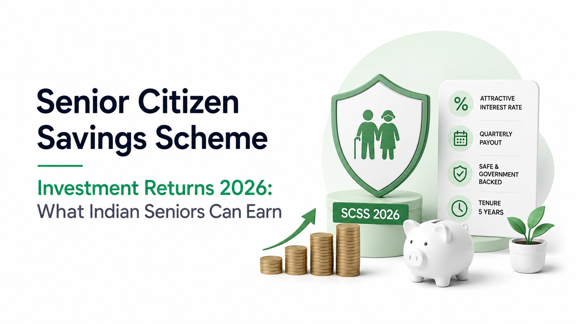
The Senior Citizen Savings Scheme remains one of the most trusted fixed-income options for Indian retirees in 2026. For the July to September 2026 quarter, SCSS continues to offer 8.2% per annum, with interest paid quarterly. The Department of Economic Affairs has kept small savings rates unchanged for Q2 FY 2026-27, and SCSS remains among the highest-paying government-backed savings schemes available to senior citizens in India.
For retirees who want predictable income without market-linked risk, SCSS is especially useful. A senior citizen investing ₹30 lakh, the maximum allowed, can earn about ₹2,46,000 per year, paid as ₹61,500 every quarter before tax. This works out to a monthly equivalent of about ₹20,500, though the actual payout is quarterly.
FY 2026 SCSS Investment Returns at a Glance
| Investment Amount | Annual Interest at 8.2% | Quarterly Payout |
| ₹1,00,000 | ₹8,200 | ₹2,050 |
| ₹5,00,000 | ₹41,000 | ₹10,250 |
| ₹10,00,000 | ₹82,000 | ₹20,500 |
| ₹15,00,000 | ₹1,23,000 | ₹30,750 |
| ₹30,00,000 | ₹2,46,000 | ₹61,500 |
These calculations assume the current SCSS rate of 8.2% per annum. Since SCSS interest is paid out quarterly, it is better viewed as a retirement income product than a wealth-compounding product.
What Is the Senior Citizen Savings Scheme?
The Senior Citizen Savings Scheme is a Government of India small savings scheme designed for older citizens who want a stable post-retirement income. It is available through post offices and authorised banks across India. The National Savings Institute lists SCSS as a scheme with a minimum deposit of ₹1,000 and a maximum deposit of ₹30 lakh.
The scheme is mainly meant for:
- Individuals aged 60 years or above
- Retired civilian employees aged 55 to below 60, subject to conditions
- Retired defence personnel aged 50 or above, subject to specified conditions
- Individuals opening the account singly or jointly with a spouse
For many Indian households, SCSS works well after retirement, VRS, sale of property, receipt of PF, gratuity, or maturity of other fixed-income investments.
“Start investing with confidence! Explore
0 demat account
and grow your wealth.”
SCSS Interest Rate in 2026
For Q2 FY 2026-27, covering 1 July 2026 to 30 September 2026, the SCSS interest rate remains unchanged from the previous quarter. The latest notified return is 8.2% per annum.
This matters because small savings rates are reviewed every quarter. However, once you open an SCSS account, the interest rate applicable at the time of account opening gets locked in and remains fixed for the account tenure.
In simple terms, if an eligible senior opens SCSS while the rate is 8.2%, the payout is planned around that rate for the five-year term.
How SCSS Returns Are Paid
SCSS interest is not paid monthly. It is paid on the first working day of April, July, October, and January. The National Savings Institute states that interest is payable for the relevant quarter on the first working day of these months.
This quarterly payout structure suits retirees who can plan expenses in three-month blocks. For example, the quarterly interest may help cover:
- Medicines and routine healthcare
- Household bills
- Insurance premiums
- Groceries
- Utility payments
- Support for a spouse or dependent family member
A practical tip for Indian retirees is to keep one savings account linked to SCSS and use that account only for regular household withdrawals. This makes it easier to track retirement income and avoid mixing it with emergency funds.
SCSS Maturity and Extension Rules
The SCSS account matures after five years from the date of opening. The depositor may extend the account for a further period of three years, and premature closure is allowed subject to conditions.
This five-year tenure is useful for retirees who want medium-term certainty. It is long enough to lock in a stable income stream, but not as long as some retirement products that require a decade or more of commitment.
Before extending the account, seniors should compare the then-current SCSS rate with bank FD rates, RBI floating rate bonds, annuity options, and their cash-flow needs.
Is SCSS Better Than Bank FDs in 2026?
For many Indian senior citizens, SCSS is attractive because it combines sovereign backing, a strong interest rate, and fixed quarterly payouts. In June 2026, some five-year senior citizen bank FDs were reported at around 8.05%, while SCSS continues at 8.2% for the July to September 2026 quarter.
That said, SCSS and FDs serve slightly different needs.
SCSS is better when you want:
- Government-backed safety
- Quarterly income
- A fixed five-year retirement income plan
- Section 80C benefit on eligible deposits
- A clear maximum allocation limit
Bank FDs may be better when you want:
- Flexible tenure choices
- Monthly, quarterly, or cumulative interest options
- Higher liquidity
- No SCSS-style age eligibility rule
- Ability to invest beyond the SCSS cap
A balanced retiree portfolio may include both. SCSS can form a stable income base, while FDs can handle liquidity and short-term needs.
Read More: Fixed Deposit Interest Rates: All Banks Compared (2026)
Tax Treatment of SCSS Returns
SCSS deposits qualify for deduction under Section 80C of the Income Tax Act, as noted by the National Savings Institute. However, the interest earned from SCSS is taxable as income. Senior citizens may also be able to claim a deduction under Section 80TTB on eligible interest income, subject to the applicable tax regime and limits. Section 80TTB allows senior citizens to claim up to a ₹50,000 deduction on eligible interest income from deposits with banks, post offices, and co-operative societies.
This is important because the headline SCSS return is not always the same as the post-tax return.
For example, a ₹30 lakh SCSS deposit at 8.2% earns ₹2,46,000 per year before tax. The actual amount you keep depends on your total taxable income, deductions, chosen tax regime, and TDS position.
Seniors should review SCSS along with pension income, rent, FDs, mutual fund withdrawals, and medical insurance deductions before finalising tax planning.
Who Should Consider SCSS in 2026?
The Senior Citizen Savings Scheme is suitable for Indian retirees who want safety and a reliable income stream. It is especially useful for people who do not want exposure to equity market volatility for their essential monthly expenses.
SCSS may suit you if:
- You are 60 or older and want a stable income.
- You have retirement proceeds sitting in a savings account.
- You want better returns than many traditional low-risk deposits.
- You prefer government-backed instruments.
- You can manage with quarterly payouts.
- You do not need the full amount immediately.
SCSS may not be ideal if you need high liquidity, want monthly income only, or need to invest more than ₹30 lakh in one person’s name.
Common Mistakes Indian Investors Should Avoid
The first mistake is assuming SCSS interest is tax-free. It is not. The deposit may offer tax benefits under Section 80C, but the interest is taxable.
The second mistake is putting all retirement money into one product. SCSS is strong, but retirees still need emergency funds, medical reserves, and some liquidity.
The third mistake is ignoring the payout cycle. Since SCSS pays quarterly, seniors who need monthly cash flow should keep part of the payout in a savings account and withdraw it month by month.
The fourth mistake is delaying investment when rates are attractive. Small savings rates are reviewed quarterly, so retirees planning to invest should check the current rate before opening the account.
Final Verdict: Is SCSS Worth It in 2026?
Yes, SCSS remains one of the strongest low-risk income options for Indian senior citizens in 2026. At 8.2% per annum for the July to September 2026 quarter, it offers predictable quarterly income, government backing, a five-year tenure, and tax benefit eligibility on deposits.
For a retiree seeking safety over aggressive growth, SCSS can form the core of a retirement income plan. The best approach is to combine it with a savings buffer, a medical emergency fund, and other fixed-income options based on your family’s monthly expenses.
Read More: Best Investment Options For Senior Citizens In India
Frequently Asked Questions (FAQs)
What is the SCSS interest rate in 2026?
The SCSS interest rate for July to September 2026 is 8.2% per annum. The rate has been kept unchanged for Q2 FY 2026-27.
How much return will I get on ₹30 lakh in SCSS?
At 8.2% per annum, ₹30 lakh in SCSS can earn ₹2,46,000 per year before tax. This is paid as ₹61,500 every quarter.
Is SCSS interest paid monthly?
No. SCSS interest is paid quarterly, on the first working day of April, July, October, and January.
What is the maximum investment in SCSS?
The maximum deposit allowed in SCSS is ₹30 lakh, while the minimum deposit is ₹1,000.
Is SCSS safe for Indian senior citizens?
SCSS is a Government of India small savings scheme, which makes it one of the safer fixed-income options for eligible senior citizens.
Can SCSS be extended after maturity?
Yes. SCSS matures after five years, and the depositor may extend the account for a further period of three years.
Disclaimer
The stocks mentioned in this article are not recommendations. Please conduct your own research and due diligence before investing. Investment in securities market are subject to market risks, read all the related documents carefully before investing. Please read the Risk Disclosure documents carefully before investing in Equity Shares, Derivatives, Mutual fund, and/or other instruments traded on the Stock Exchanges. As investments are subject to market risks and price fluctuation risk, there is no assurance or guarantee that the investment objectives shall be achieved. Lemonn (Formerly known as NU Investors Technologies Pvt. Ltd) do not guarantee any assured returns on any investments. Past performance of securities/instruments is not indicative of their future performance.
Related Posts

Download Lemonn
Download my app for share market trading, ipo investment, trading account, and all your investment needs.



