Investment Scam Checklist: 12 Red Flags Every Indian Investor Must Know
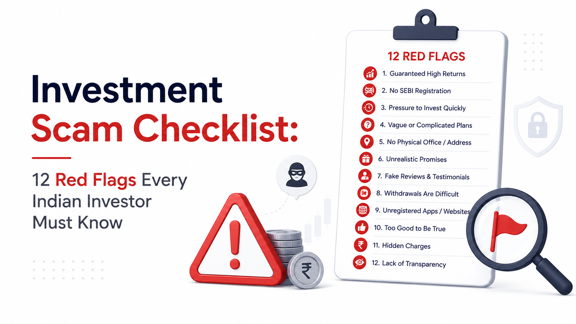
Scamsters rarely begin with an obvious lie. More often, they begin with confidence, urgency, and polished language that sounds official. They may pose as brokers, “relationship managers,” research analysts, Telegram tip providers, or app support staff. By the time an investor realizes something is wrong, money may already be transferred, trades may already be placed, or sensitive details may already be shared.
That is why a practical investment scam checklist India investors can actually use matters more than generic warnings. If you are evaluating a broker, trading app, tipster, WhatsApp group, Telegram channel, or “guaranteed return” offer, this guide will help you slow down, verify facts, and spot danger early.
SEBI’s investor education portal explicitly warns investors to be suspicious of assured returns, unregistered entities, and unclear documentation. It also emphasizes that securities-market investments carry risk and that investors should verify whether the offering entity is regulated. SEBI Investor: How to Spot a Scam, SEBI Investor: Staying Away from Investment Frauds
If you are new to markets, it also helps to understand the basics of how accounts and brokers work before you trust anyone with money. Start with Demat Account Explained (2026 Guide): Meaning, Benefits, Charges & How It Works in India and How To Choose A Good Stockbroker In India: A Guide.
Why investment scams are so effective
Investment fraud does not always look like fraud. In India, scams increasingly appear through:
- fake broker onboarding calls
- cloned apps and spoofed websites
- Telegram and WhatsApp tip groups
- fake “research” or “insider” access
- relationship managers asking for remote access or OTPs
- hidden plans that lock your money in
- withdrawal-delay tricks after profits appear on screen
NSE has repeatedly issued investor cautions about entities and channels on social media offering trading tips and assured returns, including Telegram and Instagram-based setups. These advisories show that the playbook is not hypothetical; it is recurring and operational. NSE investor caution, July 2024, NSE investor caution, August 2024
This is also why investors should treat every new offer as something to verify, not something to trust by default.
The investment scam checklist India investors should use
Use the 12 red flags below before you:
- transfer money
- open an account through an agent
- join a paid trading group
- share KYC documents
- give app access permissions
- follow buy/sell instructions from strangers
“Start investing with confidence! Explore
0 demat account
and grow your wealth.”
1. They promise guaranteed, fixed, or “risk-free” returns
This is one of the clearest guaranteed returns scam warning signs.
If someone says:
- “12% monthly guaranteed”
- “sure-shot options strategy”
- “no-loss trades”
- “capital protection with daily profits”
- “100% accuracy signals”
stop immediately.
SEBI warns investors to be suspicious of anyone who guarantees assured or near-certain returns in securities markets. Legitimate investing and trading always involve risk. SEBI Investor: How to Spot a Scam
A genuine broker can explain products, risks, charges, margins, and processes. A scammer sells certainty.
2. They avoid clear registration and regulatory details
A major fake broker scam India pattern is simple: the person sounds legitimate but avoids verifiable registration details.
If the caller or website cannot clearly tell you:
- the legal entity name
- whether they are SEBI regulated, where relevant
- their exchange membership or registration details, where applicable
- official support channels
- grievance redressal paths
that is a problem.
Before acting, verify basics through official sources. You can review SEBI’s investor portal for scam awareness and check DP information through CDSL’s “Know your Depository Participant” database. SEBI Investor, CDSL Know your DP
For added context on market oversight, see Who regulates stock market in India? and What Is SEBI And Its Role In India?.
3. The communication happens only on Telegram, WhatsApp, or personal numbers
A serious telegram trading scam india marker is when all communication happens via disappearing chat groups, personal numbers, or unverifiable handles.
Scammers often use:
- “VIP” Telegram channels
- paid WhatsApp groups
- fake support accounts
- rotating mobile numbers
- anonymous admins with no corporate email trail
NSE advisories specifically mention social media channels offering securities-market tips and assured returns. That should tell you something important: platform presence is not proof of legitimacy. NSE caution, June 2024, NSE caution, July 2024
If the only proof they offer is screenshots of profits, member testimonials, or “last call to join,” assume risk is high.
For more on brand impersonation and fake trading groups, read Beware of Online Scams Impersonating Trusted Brands and Impersonation & Investment Fraud: Don’t Let Scammers Trade on Your Trust.
4. They pressure you to act immediately
Urgency is emotional leverage.
Common lines include:
- “This IPO slot closes in 10 minutes”
- “Next candle move is guaranteed”
- “Complete transfer now to unlock your account”
- “If you delay, you will miss the operator move”
- “Last chance to recover previous losses”
Pressure exists because scrutiny is the scammer’s enemy.
A legitimate financial service may have time-sensitive market conditions, but it will still allow you to verify details, charges, terms, and risk disclosures properly. If they want money before verification, walk away.
5. They ask you to transfer money to a personal bank account or UPI ID
This is one of the strongest online trading scam red flags.
Never ignore it if you are asked to send money to:
- an individual’s savings account
- a random UPI ID
- a QR code shared on chat
- a “temporary collection account”
- a “manager’s account” for activation or margin top-up
A genuine platform should have established payment flows, not improvised payment instructions from an individual rep.
If payment instructions seem unusual, do not proceed until you verify them through official app or website channels. You can also review Regulatory and Other Information when assessing a platform’s operational transparency.
6. They ask for OTPs, TPINs, passwords, or screen-sharing access
No trustworthy platform representative should ask for your confidential credentials in a casual support chat.
Huge warning signs include requests for:
- OTPs
- passwords
- PINs
- TPINs
- remote device control
- screen-sharing to “help place orders”
Once that access is granted, the fraud may move beyond persuasion into account compromise.
If you trade actively, you should already know where your account permissions matter. Understanding account and order flows can reduce panic-based mistakes; relevant basics are covered in How to trade stocks in India and How to Open a Demat Account: A Beginner’s Guide.
7. The fees, plans, or brokerage structure are vague
Some scams do not steal through one dramatic transfer. They trap investors with hidden deductions, fake upgrade plans, or invented compliance charges.
Examples:
- “Refundable security deposit”
- “Premium signal unlock fee”
- “Withdrawal processing charge”
- “Tax clearance amount”
- “Broker activation amount”
- “Recovery margin fee” after a losing trade
If charges are not transparently documented, pause.
Real brokers should disclose brokerage, statutory charges, and product terms clearly. To understand how transparent fee communication should look, compare with A Detailed Look at Lemonn Brokerage Charges and Fees and use the Brokerage Calculator to see how cost estimation should work in practice.
8. Your withdrawal is delayed again and again
Withdrawal friction is a classic scam stage.
It often happens after the victim sees fake profits in a dashboard or screenshot-based account statement. The scammer then says withdrawal is blocked due to:
- account upgrade pending
- tax due
- conversion fee
- anti-money laundering hold
- analyst clearance
- margin normalization
Then they ask for one more payment.
This is not how trustworthy investing should feel. Repeated excuse-based delays are often the point where a suspicious setup becomes an obvious fraud.
If a platform experience starts looking inconsistent, stop adding funds and move immediately to official support and escalation routes.
9. They show only winning screenshots, never risk disclosures
Any service selling trading or investing without balanced risk communication deserves skepticism.
Be careful when a page or group shows:
- only profit screenshots
- highly edited P&L images
- “student turned crorepati” stories
- impossible win rates
- no downside examples
- no product suitability discussion
In India, regulated market participation comes with disclosures, documentation, and process discipline. If the seller markets only upside and hides risk, that alone is enough to downgrade trust sharply.
For example, if you are exploring leveraged products or derivatives, understanding the risks matters more than the pitch. See Risks of Margin Trading Facility (MTF) in India and Risk Disclosure Derivatives.
10. The app, website, or support identity looks slightly “off”
Many frauds succeed not because the victim ignores all warning signs, but because the fake brand asset looks almost real.
Check carefully for:
- misspelled domain names
- low-quality logos or copied branding
- app pages that differ from official branding
- unofficial support numbers
- strange email domains
- inconsistent language across screens
A trust check should always include confirming the official site, official app, and official help channels. Start from the company’s main website rather than from a forwarded link. For Lemonn’s official ecosystem, begin at Invest in Stocks, Mutual Funds, F&Os & IPOs. and then navigate from there instead of clicking links dropped in random chats.
11. They claim secret access, insider information, or “operator” certainty
Scams often rely on exclusivity theatre:
- “operator-backed move”
- “inside upper circuit stock”
- “private institutional flow”
- “foreign desk access”
- “HNI dealer room tips”
The goal is to make you feel chosen.
But if a pitch relies on hidden access rather than clear process, disclosures, and verifiable records, it is not a trust signal. It is usually a manipulation tactic.
If you want structured market participation, focus on transparent tools, documented strategies, and regulated workflows instead of secret groups. For example, investors looking at rules-based investing can explore educational content like What is Algo Trading? Pros, Cons, and How It Works and What is algo trading? rather than trusting anonymous “AI trading bot” pitches.
12. There is no clear complaint or escalation path
A real financial business should not disappear the moment something goes wrong.
Before you trust any platform or intermediary, ask:
- Where do I raise a support ticket?
- Where is the grievance page?
- Is there a regulator-facing escalation path?
- Is there an investor complaint mechanism?
- Are terms and disclosures visible?
If none of this is visible, that is a major structural red flag.
In India, investors can escalate cyber-fraud and suspicious digital activity through the National Cyber Crime Reporting Portal, which also offers suspect-search and suspect-report features for identifiers such as phone numbers, URLs, WhatsApp numbers, and Telegram handles. National Cyber Crime Reporting Portal, NCRP suspect repository and reporting
What to do if you spot multiple red flags
If two or more of the above signs appear together, do not “test with a small amount.” That is how many scams begin.
Instead:
- Stop all transfers immediately.
- Do not share OTPs, PAN copies, or login permissions.
- Save evidence: screenshots, chats, bank reference IDs, URLs, app names, numbers, handles.
- Contact your bank or payment provider quickly if a transfer was just made.
- Report the fraud or suspicious identifier on the National Cyber Crime Reporting Portal. NCRP official portal
- Raise the issue through your broker’s official support and grievance channels if the fraud involved impersonation of a real platform.
- Escalate as needed through SEBI’s investor ecosystem, including SCORES access from the SEBI investor portal. SEBI Investor
If you are evaluating whether a broker itself looks credible, it also helps to review public-facing operating information and investor grievance pathways such as Investor Grievance and Escalation Matrix and Investor Charter.
A simple 30-second trust test before you invest
Before sending money anywhere, ask yourself:
- Is the return claim realistic?
- Can I verify the entity independently?
- Am I being pushed to act urgently?
- Are they avoiding official channels?
- Are they asking for credentials or personal transfers?
- Are fees and withdrawal rules documented clearly?
- Is there a visible grievance process?
If the answer to even one of these feels uncomfortable, pause. If several are true, exit immediately.
That is the real purpose of an investment scam checklist India investors can reuse: not to create fear, but to create friction before bad decisions.
Conclusion
The most dangerous scams are not always the loudest. They are the ones that sound plausible, use market jargon, mimic trusted brands, and exploit urgency, greed, or embarrassment.
A solid defense starts with pattern recognition. If you remember nothing else, remember this: guaranteed returns, hidden charges, personal payment requests, Telegram-only communication, withdrawal delays, and credential requests are not small issues. They are scam signals.
The safest investors are not the ones who know every stock tip. They are the ones who know when to verify, when to refuse, and when to report.
If you want to build market confidence the right way, focus on basics, regulated processes, transparent charges, and trusted learning resources instead of shortcuts. A good place to continue is Stock Market Basics for Beginners in India (2026) and the broader Frequently Asked Questions.
FAQs
What is the biggest investment scam red flag in India?
The clearest red flag is a promise of guaranteed or risk-free returns. In securities markets, returns are never assured. If someone guarantees profits, treat it as a warning sign immediately.
How do I identify a fake broker scam in India?
Check whether the entity can be verified independently through official channels, whether communication happens through official support, and whether payment is being asked via personal bank account or UPI. Vague registration details and pressure tactics are major warning signs.
Are Telegram trading groups safe in India?
Not by default. Many telegram trading scam india cases rely on anonymous admins, fake profit screenshots, and paid “VIP” groups offering assured returns. Platform presence is not proof of legitimacy.
What should I do if I sent money to an investment scammer?
Act fast: contact your bank, preserve screenshots and transaction records, report the incident on the National Cyber Crime Reporting Portal, and raise a complaint with the official broker or platform if impersonation was involved.
How can beginners avoid online trading scams?
Beginners should use a simple rule: verify before you trust. Learn the basics, use official apps and websites, avoid guaranteed-return offers, never share OTPs, and stick to platforms with transparent fees, disclosures, and grievance channels.
Where can I learn how to identify investment fraud better?
Start with official investor education resources and beginner-friendly explainers. SEBI’s investor portal is useful for scam awareness, and educational guides on broker selection, demat accounts, and fee transparency can help you spot what genuine processes look like.
Disclaimer
The stocks mentioned in this article are not recommendations. Please conduct your own research and due diligence before investing. Investment in securities market are subject to market risks, read all the related documents carefully before investing. Please read the Risk Disclosure documents carefully before investing in Equity Shares, Derivatives, Mutual fund, and/or other instruments traded on the Stock Exchanges. As investments are subject to market risks and price fluctuation risk, there is no assurance or guarantee that the investment objectives shall be achieved. Lemonn (Formerly known as NU Investors Technologies Pvt. Ltd) do not guarantee any assured returns on any investments. Past performance of securities/instruments is not indicative of their future performance.
Related Posts


Download Lemonn
Download my app for share market trading, ipo investment, trading account, and all your investment needs.