Best Time to Trade Stocks in India: Hourly Breakdown of NSE/BSE Hours (2026)
 Written by Supratim Choudhury
 Reviewed by Gaurav Garg, SEBI-registered Research Analyst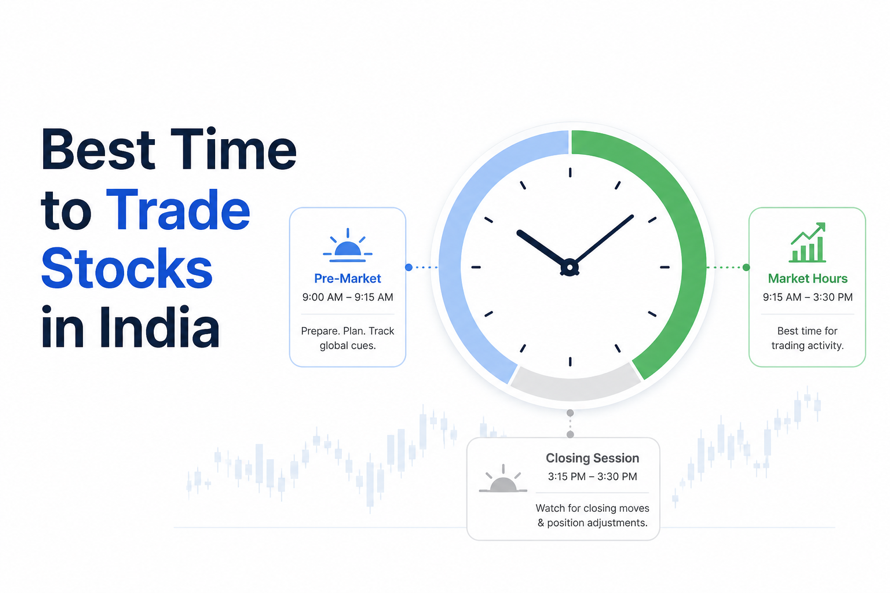
A common myth among new Indian traders is that “you can trade any time between 9:15 AM and 3:30 PM equally well.” In reality, the Indian stock market behaves very differently across the day, and choosing the right hour can be the difference between a manageable setup and a string of avoidable mistakes.
This guide breaks down the best time to trade stocks in India hour by hour, plus expiry dynamics, earnings-season timing, and what long-term investors should know about market timing.
Standard NSE & BSE timings in 2026
The National Stock Exchange (NSE) and BSE no longer have one simple closing timetable for every security. A Closing Auction Session (CAS) was introduced in 2026 for eligible cash-market stocks.
| Session | Time (IST) | What it means |
| Pre-open | 9:00 AM–9:15 AM | Opening-price discovery. Order entry runs to about 9:10 AM with a random close in the final two minutes, followed by matching and a buffer. |
| Cash market, CAS-eligible stocks | Continuous trading 9:15 AM–3:15 PM; CAS 3:15 PM–3:35 PM | The closing auction replaces the old end-of-day continuous-trading process for eligible shares. |
| Cash market, other equities | 9:15 AM–3:30 PM | Normal continuous trading. |
| Post-close session | 3:50 PM–4:00 PM | Eligible cash-market orders can trade at the closing price under exchange rules. |
| Equity derivatives | 9:15 AM–3:40 PM | Futures and options continue beyond the cash-market auction. |
| After-market orders | Broker-specific | After-Market Orders (AMOs) are held by the broker and sent to the exchange for the next session. Acceptance windows vary by broker. |
NSE and BSE are closed on Saturdays, Sundays, and notified trading holidays, apart from announced special sessions such as Muhurat trading.
Outside this guide, Multi Commodity Exchange (MCX) timings vary by contract. Internationally referenceable non-agricultural commodities generally trade from 9:00 AM to 11:30 PM, extending to 11:55 PM during part of the year. Major rupee currency derivatives on NSE generally trade from 9:00 AM to 5:00 PM.
The hourly map: when is the best time to trade?
Each part of the day has its own personality. Trading activity and volatility can vary materially through the session, with the opening and closing periods often seeing heavier activity than the middle of the day. That makes time of day relevant to execution, but it does not mean one fixed hour is always the most profitable.
“Start investing with confidence! Explore
0 demat account
and grow your wealth.”
9:00 AM–9:15 AM: Pre-open, use it for price discovery
The pre-open is a call auction, not ordinary continuous trading. It is designed to discover the opening price by matching buy and sell interest.
Best use: Check GIFT Nifty, overnight global markets, company announcements, and the pre-open indicative price. If you do not understand auction mechanics, observing is usually more sensible than sending an aggressive market order.
9:15 AM–9:45 AM: Opening volatility, higher risk
The first 30 minutes often absorb overnight orders, gap-ups, gap-downs, and fresh news. Trading activity can be especially intense around the market open.
- Pros: Strong price discovery, high activity, and potential momentum
- Cons: Fast reversals, wider spreads in some stocks, and slippage risk
- Best for: Traders whose tested strategy is specifically designed for the opening period
Beginners may find it easier to observe the first few candles before taking a trade. There is no rule that 9:45 AM is automatically safe.
9:45 AM–11:00 AM: A practical post-opening window
This is a useful window for many intraday traders because the initial gap and opening reaction are visible while liquid stocks generally still have healthy participation.
Opening-range breakout, pullback, and momentum strategies are often assessed here. But “best time” depends on the stock, market regime, and strategy.
11:00 AM–1:00 PM: Mid-day, often quieter
Trading activity often eases after the opening rush. That can mean fewer clean momentum moves, although major news can change the pattern immediately.
For swing traders, this can be a useful period to review charts and planned entries.
1:00 PM–2:30 PM: Reassess the day’s trend
By early afternoon, traders can judge whether the morning move is holding, reversing, or turning into a range. Trend-continuation trades can appear, but there is no robust basis for calling this the “second-best” window every day.
2:30 PM onward: Closing activity, with new 2026 mechanics
Activity often rises into the close, but the 2026 market structure matters.
For CAS-eligible cash stocks, continuous trading ends at 3:15 PM, followed by the closing auction until 3:35 PM. Other cash equities continue normally until 3:30 PM. Equity derivatives on NSE trade until 3:40 PM.
Broker risk-management cut-offs also matter. Brokers, not NSE or BSE, set intraday auto square-off times, which can vary by segment. Do not assume every broker will square off a Margin Intraday Square-off (MIS) position at 3:20 PM.
Best day of the week to trade in India
There is no reliably “best” weekday for profits. The useful calendar distinction in 2026 is expiry risk.
| Day | What matters in 2026 |
| Monday | Weekend news can create opening gaps, but direction is not predetermined. |
| Tuesday | NSE expiry day. Nifty 50 weekly options expire on Tuesday, and NSE monthly equity-derivative contracts expire on the last Tuesday. |
| Wednesday | No fixed exchange-wide expiry edge. Treat it as a normal session unless an event changes conditions. |
| Thursday | BSE expiry day. Sensex weekly options expire on Thursday, and BSE monthly equity-derivative contracts expire on the last Thursday. |
| Friday | A normal session structurally, but overnight positions carry weekend gap risk. |
Expiry can increase short-term activity and option sensitivity, but it does not make one direction more likely. Short-dated options can lose value quickly as time decays.
Monthly patterns: focus on expiry mechanics, not calendar folklore
The original “last Thursday of every month” rule is no longer valid across Indian exchanges.
On NSE, monthly equity derivatives expire on the last Tuesday of the month. On BSE, they expire on the last Thursday. If the scheduled expiry is a trading holiday, the contract expires on the preceding trading day.
Rollover and hedging activity can affect derivatives and related cash stocks near expiry, but there is no dependable rule that the first week of every month brings fresh institutional buying or that mid-quarter weeks are automatically quieter.
Earnings season: know the filing deadlines
Results can trigger sharp gaps and volatility, so the company’s announced result date matters more than a generic “earnings season” window.
For most listed companies, Securities and Exchange Board of India (SEBI) rules set these outer deadlines:
| Period ended | Typical regulatory deadline |
| 30 June | By 14 August |
| 30 September | By 14 November |
| 31 December | By 14 February |
| 31 March | Annual and last-quarter results by 30 May |
Companies can report earlier. Check the exchange announcement before taking a large short-term position. Options can also lose value after results if implied volatility falls sharply.
Best time of year for long-term investors
For long-term investors using a systematic investment plan (SIP) or staggered buying, the calendar month is a weak basis for a decision. Claims that March–April or September–October reliably offer better entry points are not dependable enough to treat as a strategy.
A consistent SIP removes the need to guess the best day or month. For a lump sum, valuation, diversification, time horizon, and risk tolerance matter more.
Can you trade after 3:30 PM?
The old answer, “No, equities stop at 3:30 PM,” is now too simple.
- CAS-eligible cash stocks can continue through the closing auction until 3:35 PM.
- Equity derivatives trade until 3:40 PM.
- The cash-market post-close session runs from 3:50 PM to 4:00 PM for eligible orders at the closing price.
- AMOs can be placed after hours, but the broker only queues them for the next session. They do not execute immediately after market close.
- MCX commodity trading can continue later in the evening, depending on the contract.
If you use AMOs, check your broker’s acceptance window and consider a limit price when opening gaps are a concern.
A simple daily routine for Indian retail traders
- 8:30–9:00 AM: Check GIFT Nifty, overnight markets, corporate announcements, and scheduled events.
- 9:00–9:15 AM: Watch the pre-open and note the indicative opening range.
- 9:15–9:45 AM: Observe the opening reaction unless your strategy is built for this period.
- 9:45–11:00 AM: Take only planned setups that meet your rules.
- 11:00 AM–1:00 PM: Manage positions, review charts, and avoid manufacturing trades out of boredom.
- 1:00–2:30 PM: Reassess trend, liquidity, and news.
- 2:30–3:15 PM: Manage exits carefully and know whether the stock is CAS-eligible.
- After 3:15 PM: Follow the correct closing mechanism for the security and your broker’s square-off rules.
- After the session: Journal the trade, including execution quality and whether timing helped or hurt the setup.
Final Thoughts
The Indian stock market does not behave the same way at 9:15 AM as it does at 11:30 AM or near the close. Trading activity, volatility, and execution conditions can change meaningfully through the session, so understanding that rhythm can help traders choose when to act, when to manage an existing position, and when to stay on the sidelines.
For many retail traders, the quieter mid-day period can be better used to review charts, journal trades, and plan the next setup rather than forcing a trade. Expiry sessions and the closing period also deserve extra attention because market mechanics and short-term activity can change.
Timing can improve execution discipline, but it cannot turn a weak strategy into a profitable one. SEBI found that seven out of ten individual intraday traders in the equity cash segment made losses, which makes risk management just as important as choosing when to trade.
Lemonn offers TradingView-integrated charts and one-tap Exit Now / Exit All controls for F&O positions. These tools can make monitoring and exiting positions more convenient, but they do not remove market risk or guarantee better trading outcomes.
Frequently Asked Questions (FAQs)
Q: What is the best time to buy stocks for intraday in India?
A: There is no universal best time. For many retail traders, roughly 9:45 AM–11:00 AM is a practical window because the opening reaction is visible and liquidity is usually still healthy in actively traded stocks. Test any time-based rule against your own strategy.
Q: Should beginners avoid trading at market open?
A: The opening minutes are often among the most volatile. Beginners may prefer to observe first, but 9:45 AM is not a guaranteed safety line. Use position sizing, stop-loss rules, and a tested setup.
Q: What time does the Indian stock market close in 2026?
A: It depends on the security. Non-CAS cash equities trade normally until 3:30 PM. CAS-eligible cash stocks enter the closing-auction process from 3:15 PM to 3:35 PM, equity derivatives trade until 3:40 PM, and the cash post-close session runs from 3:50 PM to 4:00 PM.
Q: Which day is weekly F&O expiry in India?
A: Futures and options (F&O) expiry depends on the exchange. Nifty 50 weekly options on NSE expire on Tuesday, while Sensex weekly options on BSE expire on Thursday. Other index and stock derivatives are generally monthly rather than weekly.
Q: Is Thursday a good day to trade in India?
A: Thursday is BSE’s expiry day in 2026, not NSE’s. That can affect short-dated Sensex options, but it does not make Thursday inherently better or worse for trading.
Q: Can I place stock orders after 3:30 PM?
A: Yes, depending on the mechanism. Eligible cash stocks may still be in the closing auction, the post-close session is available later, and brokers can accept AMOs for the next trading day. Check the security and your broker’s rules.
Disclaimer
The stocks mentioned in this article are not recommendations. Please conduct your own research and due diligence before investing. Investment in securities market are subject to market risks, read all the related documents carefully before investing. Please read the Risk Disclosure documents carefully before investing in Equity Shares, Derivatives, Mutual fund, and/or other instruments traded on the Stock Exchanges. As investments are subject to market risks and price fluctuation risk, there is no assurance or guarantee that the investment objectives shall be achieved. Lemonn (Formerly known as NU Investors Technologies Pvt. Ltd) do not guarantee any assured returns on any investments. Past performance of securities/instruments is not indicative of their future performance.
Related Posts


Download Lemonn
Download my app for share market trading, ipo investment, trading account, and all your investment needs.