How to Start Trading with ₹100 or ₹500 in India: A Beginner’s Step-by-Step Guide
 Written by Supratim Choudhury
 Reviewed by Gaurav Garg, SEBI-registered Research Analyst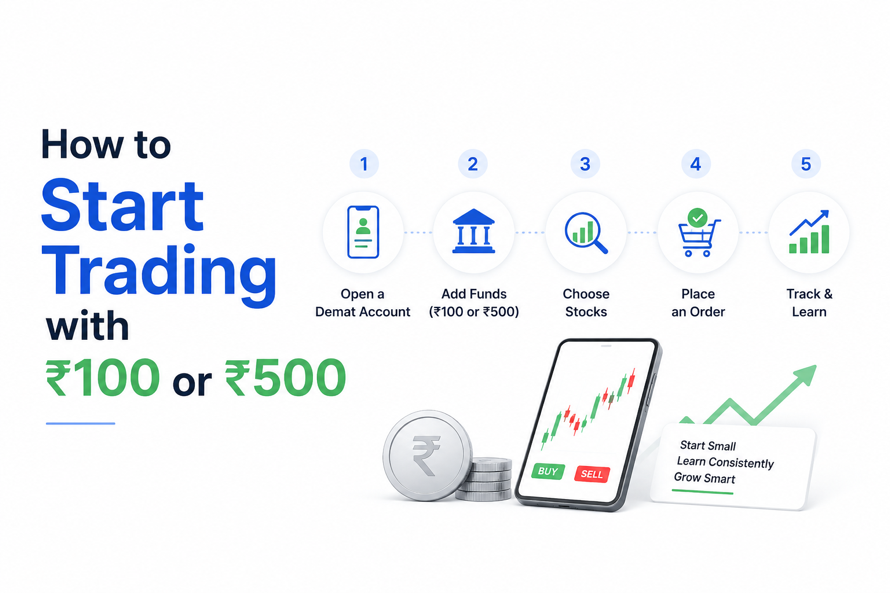
“Do I need lakhs of rupees to start trading in India?” No. You can enter the market with ₹100 or ₹500. However, with such a small amount, long-term investing is usually more practical than active trading because transaction costs, spreads, and repeated turnover can take a large bite out of your capital.
The better question is how to start in a way that teaches you useful habits without pushing you into unnecessary risk.
This guide shows what ₹100 or ₹500 can realistically buy, what the charges can look like, what to avoid, and how to scale up gradually.
Can you really trade stocks with ₹100 or ₹500?
Yes, although your choices are limited.
- Buy one listed share or one exchange-traded fund (ETF) unit if its market price fits your budget. On the National Stock Exchange (NSE), shares in compulsory dematerialised form generally have a normal-market lot size of one.
- Start a systematic investment plan (SIP) in a mutual fund. Minimums vary by scheme. Some funds accept ₹100 SIPs, while the Association of Mutual Funds in India (AMFI) says a SIP can be as small as ₹500 a month, or ₹250 under Chhoti SIP.
- Save the money until you can make a more useful purchase. You do not have to place a trade simply because cash is available.
The Securities and Exchange Board of India (SEBI) says no minimum balance is required in a demat account. In practice, you simply need enough money for the security you want to buy and the applicable charges.
Digital gold is another low-ticket option on some apps, but do not treat it as equivalent to a regulated gold ETF. SEBI warned in November 2025 that many digital gold and e-gold products offered by online platforms fall outside its regulatory framework and do not receive securities-market investor protections.
Step 1: Open a demat and trading account
To buy listed shares and ETFs, you generally need a demat account to hold the securities and a trading account to place orders. A demat account is not compulsory for most ordinary mutual fund investments unless you choose to hold the units in demat form or buy an ETF.
For online onboarding, keep these ready:
- Permanent Account Number (PAN)
- Aadhaar and the mobile number linked to it, if you use Aadhaar-based onboarding
- Bank account details
- Mobile number and email address
- Any additional financial documents the broker asks for when enabling derivatives
Account-opening charges, account maintenance charges (AMC), brokerage, and depository participant (DP) charges vary by broker. Do not assume every “discount broker” is free on every line item. You should check the latest brokerage, DP charges, and other applicable fees before opening an account.
“Start investing with confidence! Explore
0 demat account
and grow your wealth.”
Step 2: Decide what ₹100 or ₹500 should buy
With micro-capital, the goal should be to learn the process and build a repeatable habit, not force a trade.
Realistic options with ₹100
- A mutual fund SIP of ₹100, if the chosen scheme permits
- One listed share priced below ₹100, after checking the business and the total transaction cost
- Saving the ₹100 and combining it with future contributions
A low share price does not make a stock “cheap” or good value. Avoid choosing a company merely because its share trades in double digits.
Realistic options with ₹500
- One or more shares whose total purchase value is below ₹500
- One unit of a broad-market ETF, if its traded price is below ₹500
- A ₹500 SIP in an eligible index mutual fund
- Holding the money until the next contribution if doing so gives you a better choice
A broad-market ETF can reduce the risk of relying on one company, but it still carries market, tracking, liquidity, and price risks.
Step 3: Understand the costs before you trade
The idea that every ₹500 delivery trade costs about ₹1.50, while every ₹500 intraday trade costs about ₹22, is too simplistic. Broker pricing differs, and some costs appear only in certain situations.
| Cost | Equity delivery | Equity intraday |
| Brokerage | Broker-specific; some brokers charge ₹0 | Broker-specific |
| Securities transaction tax (STT) | 0.1% on buy and sell | 0.025% on sell |
| Stamp duty | 0.015% on buy | 0.003% on buy |
| Exchange, SEBI, and Goods and Services Tax (GST) charges | Apply as relevant | Apply as relevant |
| DP charge | Commonly applies when securities are sold from demat | Generally not an intraday demat debit |
Brokerage structures differ across platforms. Some brokers charge ₹0 brokerage on equity delivery, while intraday brokerage may be calculated as a percentage of the order value or capped at a maximum amount per executed order. A ₹500 intraday order, therefore, does not automatically attract the maximum advertised brokerage.
On the other hand, selling shares held in demat can attract a DP charge, depending on the broker and depository arrangement. Because this is often a fixed per-scrip charge, it can represent a meaningful percentage of a ₹500 position. Check your broker’s current tariff before selling.
The lesson is simple: small capital and frequent trading are a poor combination. Use your broker’s current charges page or calculator before placing an order.
Step 4: Build the habit, not the profit
With ₹100 or ₹500, the first few months are about learning how markets, orders, and your own behaviour work.
Aim to:
- Place one carefully considered buy order
- Review the investment periodically instead of reacting to every price move
- Add ₹500 a month if your budget allows
- Learn about market and limit orders, settlement, charges, and how contract notes work
Twelve monthly contributions of ₹500 add up to ₹6,000 before returns.
Treat your first ₹500 as real money, not “play money.” But do not use emergency funds, borrowed money, or money needed for near-term expenses.
Step 5: Pick a strategy that suits small capital
Strategy A: Accumulate a broad-market ETF
If one ETF unit fits your monthly budget, buying periodically can give you diversified market exposure without choosing an individual stock every month. Check the traded price, bid-ask spread, tracking difference, expense ratio, and liquidity.
Strategy B: Use an index mutual fund SIP
A mutual fund is often easier for very small monthly amounts because you invest a rupee amount rather than buying whole exchange units.
Compare the total expense ratio (TER), tracking difference, minimum SIP, exit load, and plan type. Do not assume that every direct index fund has a TER below 0.20%. Current direct-plan TERs can be higher.
Strategy C: Buy individual stocks slowly
If you are keen to learn stock selection, buy only when a company meets your criteria and the price fits your budget. Do not force yourself to buy one stock every month merely to follow a schedule. A portfolio of one or two shares is not diversified.
Avoid using leverage to make a small account feel larger. Margin trade funding (MTF), futures and options (F&O), and other leveraged products can magnify losses as well as gains.
What not to do with ₹100 or ₹500
- Do not confuse a low share price with a bargain. Business quality, valuation, liquidity, and governance matter more than the rupee price of one share.
- Do not make intraday trading your default. SEBI reported in July 2024 that seven out of ten individual intraday traders in the equity cash segment made losses.
- Do not jump into F&O because the upfront amount looks small. SEBI reported that nearly 91% of individual traders in equity derivatives incurred net losses in FY2025.
- Do not rely on unsolicited Telegram or WhatsApp tips. SEBI specifically warns investors about pump-and-dump scams and misleading stock recommendations on such channels.
- Do not borrow to invest. Lemonn’s Power SIP, for example, is not an ordinary stock SIP. Lemonn describes it as a leveraged product using MTF at 12.99% a year.
Step 6: Scale up gradually
A simple progression could look like this:
- Months 1 to 3: Put a small amount into one chosen core investment and learn the process.
- Months 4 to 6: Keep contributing consistently rather than adding products merely for variety.
- Months 7 to 12: Increase your monthly amount only if your budget allows.
- Year 2 onwards: Consider adding new strategies only after you understand costs, diversification, taxation, and risk.
A simple core portfolio can be enough. Complexity is not a requirement for progress.
A simple ₹500-a-month example
Suppose you invest ₹500 at the end of every month and earn an illustrative 12% annual return, with the monthly rate derived from that annual rate.
| Period | Total invested | Illustrative value |
| 5 years | ₹30,000 | ~₹40,200 |
| 10 years | ₹60,000 | ~₹1.11 lakh |
| 20 years | ₹1.20 lakh | ~₹4.56 lakh |
| 30 years | ₹1.80 lakh | ~₹15.26 lakh |
These figures are illustrations, not a forecast. Actual market returns vary, and fees, taxes, tracking difference, and the timing of investments can change the outcome.
Conclusion
You do not need ₹50,000 or ₹5 lakh to begin participating in India’s securities market. With ₹100 or ₹500, a small mutual fund SIP, an affordable broad-market ETF unit, or a carefully researched share can be enough to learn the mechanics.
Start small, understand every charge, avoid leverage and tip channels, and raise your contribution as your finances allow. If you are comparing brokers, check the latest account-opening, AMC, brokerage, and DP charges rather than choosing on a “zero brokerage” headline alone.
Frequently asked questions (FAQs)
Q: Can I buy stocks with just ₹100 in India?
A: Yes, you can buy stocks in India with just ₹100 if a listed share trades below that amount, and you have enough funds to cover the purchase price and any applicable charges. You can also use ₹100 for a mutual fund SIP if the chosen scheme permits that minimum. A low share price, however, is not evidence that the stock is good value.
Q: Is investing ₹100 or ₹500 a month worth it?
A: It can be useful for building the habit of regular investing and learning how the market works. The amount is small, so focus on consistency, costs, and risk rather than expecting large short-term profits.
Q: Which trading app is best for a beginner with ₹500?
A: There is no single best app for every beginner. Compare account-opening fees, AMC, delivery and intraday brokerage, DP charges, mutual fund access, order tools, and customer support. Recheck the latest tariff before choosing.
Q: Can I do intraday trading with ₹500?
A: It may be technically possible for some low-priced shares, but ₹500 leaves little room for costs, price movement, and mistakes. SEBI’s loss data also shows that intraday trading is a difficult activity for individual traders, so it is not a sensible default for a beginner.
Q: What is the minimum amount for a mutual fund SIP in India?
A: It depends on the scheme. Some funds currently allow SIPs from ₹100. AMFI says SIP instalments can be as small as ₹500 a month, or ₹250 under Chhoti SIP. Always check the latest scheme terms before investing.
Disclaimer
The stocks mentioned in this article are not recommendations. Please conduct your own research and due diligence before investing. Investment in securities market are subject to market risks, read all the related documents carefully before investing. Please read the Risk Disclosure documents carefully before investing in Equity Shares, Derivatives, Mutual fund, and/or other instruments traded on the Stock Exchanges. As investments are subject to market risks and price fluctuation risk, there is no assurance or guarantee that the investment objectives shall be achieved. Lemonn (Formerly known as NU Investors Technologies Pvt. Ltd) do not guarantee any assured returns on any investments. Past performance of securities/instruments is not indicative of their future performance.
Related Posts



Download Lemonn
Download my app for share market trading, ipo investment, trading account, and all your investment needs.