What is Power SIP? Lemonn’s Leveraged SIP Explained
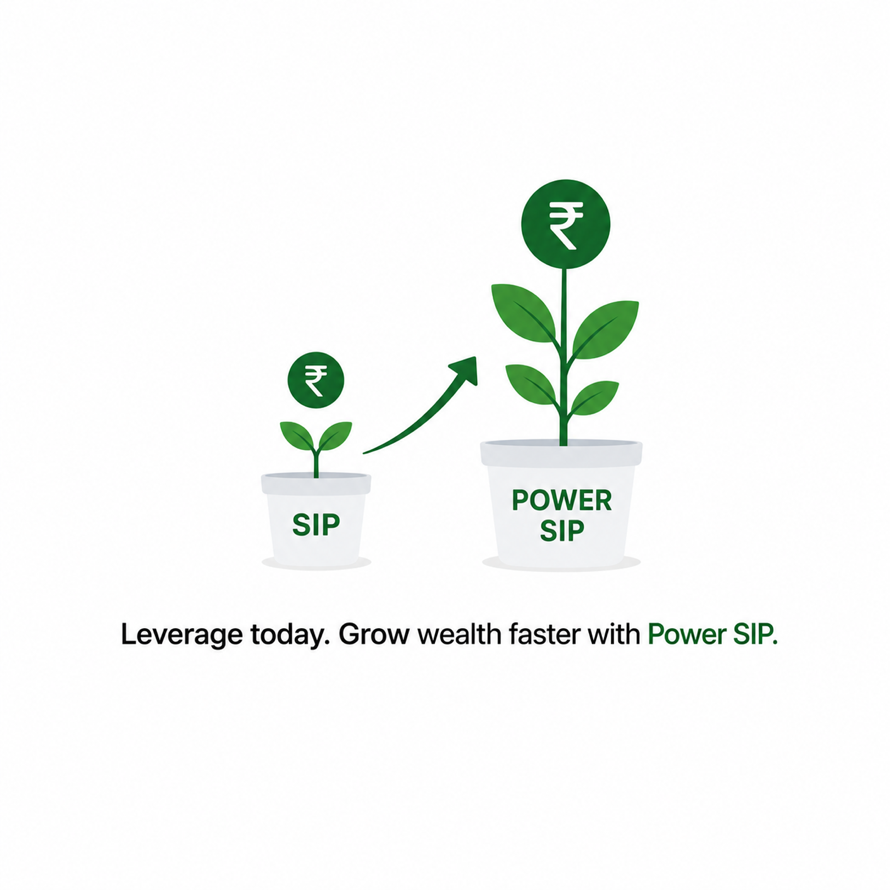
The Problem Power SIP Solves
Regular SIP investors accumulate wealth slowly by investing a fixed monthly amount. But what if you could invest more than you have, using borrowed funds at a low rate, to accelerate wealth creation? Power SIP by Lemonn combines the discipline of SIP with the capital efficiency of Margin Trade Funding (MTF).
What is Power SIP?
Power SIP is Lemonn’s product that allows you to invest a multiple of your regular SIP amount in equity mutual funds or stocks by borrowing the additional capital through MTF at 12.99% per annum. You commit your regular SIP amount; Lemonn lends additional capital as margin.
| Parameter | Regular SIP | Power SIP |
| Monthly Commitment | ₹10,000 | ₹10,000 (your contribution) |
| Actual Investment | ₹10,000 | ₹25,000–₹50,000 |
| Leverage Ratio | 1x | 2.5x–5x |
| Interest on Borrowed Amount | Nil | 12.99% p.a. on MTF portion |
| Potential Return Amplification | Market return | Higher (before interest cost) |
| Risk | Market risk only | Market risk + leverage risk |
“Start investing with confidence! Explore
0 demat account
and grow your wealth.”
How Power SIP Works: Step-by-Step
- Set your SIP amount, say ₹10,000/month
- Choose your Power SIP multiplier (e.g., 3x = ₹30,000 total investment)
- Lemonn provides ₹20,000 via MTF at 12.99% p.a.
- The full ₹30,000 is invested in your chosen equity fund/stocks on SIP date
- Interest accrues on the borrowed ₹20,000 daily
- Over time, as your portfolio grows, you can repay principal at your pace
The Math: When Power SIP Works in Your Favour
Power SIP creates positive leverage when your investment return exceeds the cost of borrowing (12.99% p.a.). Historically, Nifty 50 has delivered ~12% CAGR over 10-year periods, marginally above the MTF rate. However, volatility means short-term periods can be painful.
| Annual Market Return | 3x Power SIP Return (after 12.99% cost) | Regular SIP Return |
|---|---|---|
| 15% | ~22.1% (net of interest) | 15% |
| 12% | ~16.3% (net of interest) | 12% |
| 10% | ~12.1% (near breakeven) | 10% |
| 8% | ~7.0% (below breakeven) | 8% |
| 0% | -7.3% (interest drag) | 0% |
Who Should Use Power SIP?
- Investors with 7–10 year horizon who can withstand short-term portfolio swings
- Those confident in long-term equity returns exceeding 11%
- Investors with stable income to sustain SIP payments through market downturns
- Not suitable for: Near-retirement investors, low risk tolerance, or those who panic-sell
Key Risks to Understand
Margin Call Risk
If your portfolio falls sharply and the LTV (loan-to-value) ratio breaches limits, Lemonn may require you to top up or reduce positions. Unlike regular SIP, Power SIP can require action during market crashes, exactly when you least want to sell.
Interest Cost Compounding
At 12.99% p.a., interest on the borrowed amount accumulates. In flat or down markets, this erodes your returns significantly. Calculate total interest cost over your intended horizon before committing.
Power SIP vs Other Leveraged Products
| Product | Leverage Mechanism | Rate | Suitability |
|---|---|---|---|
| Power SIP | MTF on equity portfolio | 12.99% p.a. | Long-term equity investors |
| Futures SIP | F&O contracts | Implicit in pricing | Experienced traders only |
| Leveraged ETFs | Daily reset derivatives | Built into product | Short-term tactical only |
| Home Equity Investment | Loan against property | 8–12% p.a. | Real estate investors |
Disclaimer
The stocks mentioned in this article are not recommendations. Please conduct your own research and due diligence before investing. Investment in securities market are subject to market risks, read all the related documents carefully before investing. Please read the Risk Disclosure documents carefully before investing in Equity Shares, Derivatives, Mutual fund, and/or other instruments traded on the Stock Exchanges. As investments are subject to market risks and price fluctuation risk, there is no assurance or guarantee that the investment objectives shall be achieved. Lemonn (Formerly known as NU Investors Technologies Pvt. Ltd) do not guarantee any assured returns on any investments. Past performance of securities/instruments is not indicative of their future performance.
Related Posts


Download Lemonn
Download my app for share market trading, ipo investment, trading account, and all your investment needs.