
Demat Account Comparison India 2026: Best by Usage Type (Investor, Trader, F&O, Student)
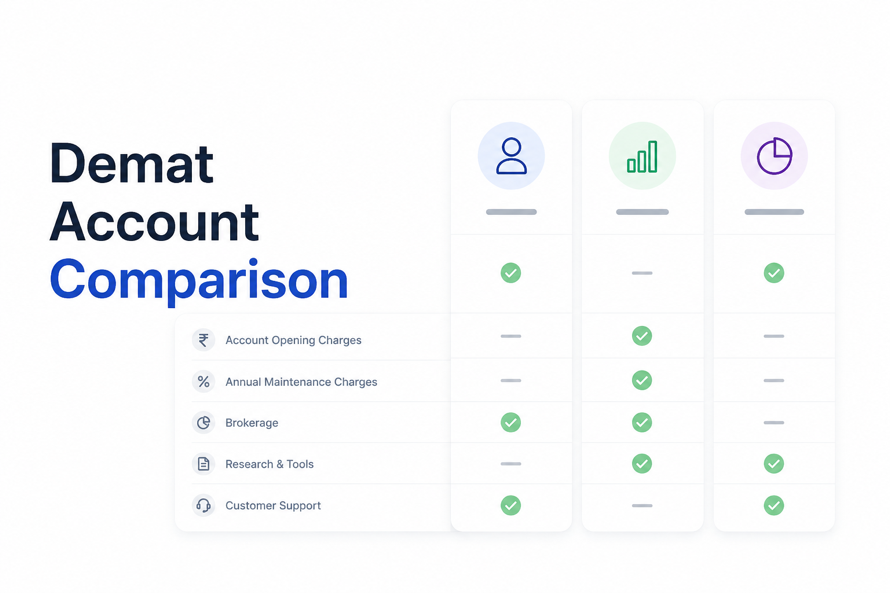
Every broker advertises “₹0 Demat opening” and “lowest brokerage” – but the best Demat account for a long-term mutual-fund investor is very different from the best one for an active F&O trader. Choosing wrong means paying for features you do not use, or losing money to hidden charges.
This guide compares Indian Demat accounts not by broker, but by usage type – so you can pick the right one for how you will actually use it.
What a Demat account is (and is not)
A Demat account holds your shares, ETFs, and bonds in electronic form. A trading account, usually opened with the same broker, places buy/sell orders on NSE/BSE. The two are almost always opened together as a 2-in-1 account.
Brokers in India are regulated by SEBI and registered as Depository Participants (DPs) with NSDL or CDSL. The depository charges are passed through to you, but each broker layers its own pricing on top.
Three charge categories matter:
- Account opening and AMC (Annual Maintenance Charge) – fixed
- Brokerage – per trade, varies by segment
- Hidden charges – DP charges, call & trade fees, auto square-off, GST, STT, exchange transaction charges
Quick comparison: Demat accounts by usage type
| Usage Type | Best-Fit Broker Profile | Why |
| Long-term investor (buy & hold) | Zero-AMC discount broker with clean app | Almost no trades, costs matter only on rare buys |
| Active intraday trader | Discount broker with low flat brokerage | High order volume – flat ₹20 saves a lot |
| F&O trader | Broker with strong trading platform + low option brokerage | Charts, fast execution, hedging margin benefit |
| Mutual fund investor | Direct MF platform or zero-AMC broker | No regular interaction with equity desk needed |
| Student / first-time | Zero opening + zero AMC + simple app | Low capital, easy onboarding |
| Housewife / passive investor | Simple UI, joint nomination flow, SIP support | Minimal screen time, set-and-forget |
| NRI | Broker offering NRE/NRO Demat + PIS account | Currency, repatriation, and RBI compliance |
Below we break down each profile.
“Start investing with confidence! Explore
0 demat account
and grow your wealth.”
1. For the long-term investor (buy & hold)
If you plan to buy a few stocks or ETFs and hold for years, you do not need a trading-heavy platform. Look for:
- ₹0 account opening, ₹0 or low AMC (some brokers waive AMC entirely)
- ₹0 delivery brokerage (many brokers offer this)
- DP charges of ₹13–₹20 per scrip on sell – unavoidable, but compare
- Clean app with portfolio tracking and dividend statements
Common mistake: Going for a broker only because of zero opening, then paying ₹300/year AMC. Over 20 years that is ₹6,000 – enough to add another ETF.
2. For the active intraday trader
Intraday traders place 5–20 orders a day. Brokerage costs compound rapidly.
What to optimize:
- Flat ₹20 per executed order (industry standard) or lower
- Fast order execution and stable platform – slippage on a frozen app is more expensive than brokerage
- MIS leverage as per SEBI (4x–5x)
- Bracket and cover orders for built-in stop-losses
- Free TradingView or in-house charts (Lemonn, Zerodha Kite, Upstox Pro, Fyers)
A 10-trade day at ₹20/trade = ₹200, plus STT, exchange fees, GST, SEBI charges. For ~200 trading days, that is ₹40,000+ in brokerage alone. Switching from ₹20 to ₹10 saves you ₹20,000/year.
Broker apps like Lemonn build features specifically for active traders – Instant Exit to flatten positions in volatile moves, Instant Pledge of holdings to unlock margin, and TradingView charts inside the app. See our best intraday broker guide for a deeper breakdown.
3. For the F&O trader
F&O traders need very different tools.
- Low brokerage on options – most brokers charge ₹20 or 0.03%, whichever is lower
- Margin benefits on hedged positions (spreads, iron condors)
- Strong options chain and Greeks in the trading app
- Bracket orders and basket orders for multi-leg strategies
- Real-time SEBI loss disclosure – mandatory and useful
Specialist platforms like Sensibull (often integrated) help with strategy building. Lemonn, Zerodha, Upstox, and Lemonn all offer solid F&O tools – Lemonn’s Basket Orders are particularly useful for executing iron condors, spreads, and other multi-leg strategies in a single click instead of one leg at a time.
Avoid free brokers that lack option chain depth – slippage on illiquid contracts can be brutal.
4. For the mutual fund investor
If your investing is mostly SIPs in equity mutual funds, you do not need a full Demat-trading account at all.
Two cheaper paths:
- Direct mutual fund platforms like Lemonn, Zerodha Coin, Kuvera, and INDmoney offer direct plans with no commission – saving 1%–1.5% per year in expense ratio
- AMC websites (HDFC AMC, SBI Mutual Fund, etc.) directly
If you do want a Demat to also hold a few ETFs or stocks, choose a broker that supports both – Lemonn, Zerodha + Coin, Groww, or INDmoney work well.
Why direct over regular? Over 20 years of SIPs, a 1.2% lower expense ratio compounded can mean 30%+ more corpus.
5. For students (first-time users)
Students typically have low capital, no income source, and need a simple interface. Priorities:
- ₹0 account opening and ₹0 AMC (or AMC waived for first year)
- Simple onboarding – Aadhaar e-KYC, no in-person visits
- PAN required; age must be 18+
- Educational content built into the app
- Small SIP options in mutual funds (some start at ₹100/month)
We cover the full process in our Stock Trading for Students guide.
If you are under 18, a guardian Demat account is the only legal route – it is a separate, more involved application.
6. For housewives and homemakers
Set-and-forget investors who manage a household budget need calm, low-friction platforms.
- Joint holding option with spouse and nominee mandatory
- SIP in equity mutual funds as the core, plus optional gold ETFs
- Easy KYC – some banks let you open Demat at your branch
- Simple statement and tax document downloads at year-end
- Bank-linked brokers (HDFC, ICICI, SBI) can be reassuring even if slightly costlier
Read our homemaker investing guide for SIP allocations and goal planning.
7. For NRIs
Non-Resident Indians cannot use a regular Indian Demat account. You need:
- An NRE or NRO bank account (Non-Resident External / Ordinary)
- A PIS (Portfolio Investment Scheme) account approved by RBI for stock trading
- A Demat account marked as NRI by the broker
Documentation is heavier – passport, visa, overseas address proof, FATCA declaration. F&O is restricted for NRIs in most cases.
Hidden charges every Demat user must know
Even “zero brokerage” accounts have these:
- STT (Securities Transaction Tax) – 0.1% on delivery both sides; 0.025% on intraday sell
- Exchange transaction charges – small percentage by NSE/BSE
- SEBI turnover charges – ₹10 per crore
- GST 18% on brokerage + exchange charges
- Stamp duty – 0.015% on buy
- DP charges – ₹13–₹20 per scrip on sell, charged by depository (not avoidable)
- Call & trade – ₹50 if you place order via phone
- Auto square-off – ₹50 if your intraday position is squared off by the system
A 100-share intraday trade looks “free” but easily costs ₹50–₹100 in stacked fees. Read the brokerage calculator on the broker’s site before opening an account.
How to decide in 3 steps
- Define your usage clearly. Are you investing ₹5,000/month in SIPs, or planning 10 intraday trades a day? They need different brokers.
- Check the published rate card for that segment specifically. Ignore marketing claims.
- Open a free trial account in 1–2 brokers and try the apps. The platform you actually enjoy using is the one you will stick with.
FAQs
Q. Which Demat account is best for beginners in India?
For most beginners, a zero-opening, zero-AMC discount broker like Lemonn, Zerodha, Groww, or Upstox is ideal. They have simple apps and free educational content built in.
Q. Can I have multiple Demat accounts?
Yes. You can hold multiple Demat accounts across different DPs (NSDL/CDSL), but you must declare all of them while filing tax. Most retail investors only need one or two.
Q. What is the difference between a Demat and a trading account?
A Demat account stores your securities electronically. A trading account places buy/sell orders. They are usually opened together as a 2-in-1 account.
Q. Is there any Demat account with zero AMC for life?
Several discount brokers offer zero AMC for Basic Service Demat Accounts (BSDA) – applicable when holdings stay below ₹10 lakh as per SEBI rules. Confirm with the broker before opening.
Q. Can students open a Demat account in India?
Yes, students 18 years and older can open a Demat with PAN and Aadhaar. Those under 18 need a guardian Demat account opened by a parent.
Conclusion
The “best Demat account” question is the wrong question. The right question is: best Demat account for what? A long-term ETF investor, an intraday trader, and an NRI all need fundamentally different setups. Match the account to your actual usage, check the full brokerage calculator (not the headline rate), and start with the simplest option you can.If you are still deciding, you can open a zero-AMC Demat with 100% digital KYC at Lemonn in a few minutes and explore stocks, mutual funds, IPOs, and F&O from a single app. Already know what kind of trader or investor you are? Compare brokers head-to-head in our Best Demat accounts in India roundup.
Disclaimer
The stocks mentioned in this article are not recommendations. Please conduct your own research and due diligence before investing. Investment in securities market are subject to market risks, read all the related documents carefully before investing. Please read the Risk Disclosure documents carefully before investing in Equity Shares, Derivatives, Mutual fund, and/or other instruments traded on the Stock Exchanges. As investments are subject to market risks and price fluctuation risk, there is no assurance or guarantee that the investment objectives shall be achieved. Lemonn (Formerly known as NU Investors Technologies Pvt. Ltd) do not guarantee any assured returns on any investments. Past performance of securities/instruments is not indicative of their future performance.
Related Posts


Download Lemonn
Download my app for share market trading, ipo investment, trading account, and all your investment needs.



