How Economic Indicators Influence Stock Market Movements
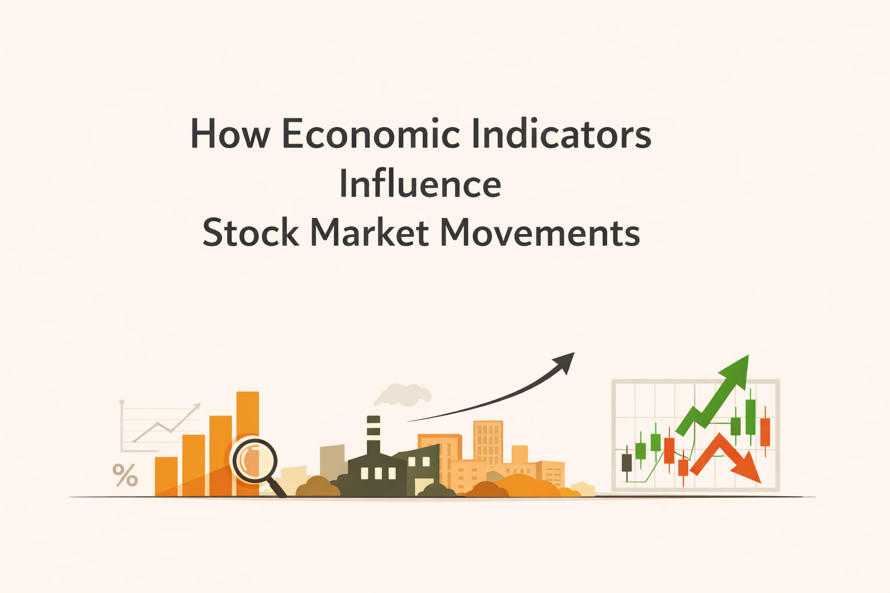
Markets rarely react to numbers. They react to what numbers threaten or promise.
Economic indicators are very important for the market’s reaction cycle. They can impact the market’s positioning and movement. But these reactions depend on the context, liquidity, and the market’s expectations.
A strong GDP print does not automatically produce a rally. A soft inflation reading does not always trigger buying. What matters is how those numbers compare to consensus, how they interact with RBI policy direction, and how investors interpret forward implications.
Economic indicators are less about today’s economy and more about tomorrow’s capital allocation.
When that future changes, markets adjust fast.
What Are Economic Indicators?
Economic indicators are measurable data points that track the state of India’s economy – GDP, inflation, unemployment, consumption, and fiscal deficit. On paper, they appear objective and predictable. In markets, they behave strategically.
They fall into three conventional categories, though the real world rarely respects clean boundaries.
Leading indicators attempt to show where momentum is heading. PMI is one such example. It captures business sentiment before official output data confirms expansion or slowdown. When export orders soften in PMI surveys, traders begin adjusting cyclical exposure long before GDP reflects it.
Lagging indicators are often used to determine the current trends. For example, unemployment goes down once growth stabilizes. By the time the labor market strengthens meaningfully, equity markets may already have priced in optimism.
Coincident indicators move alongside current economic conditions. GDP often plays that validating role, reinforcing whether existing optimism or caution is justified.
In India, these figures are released by institutions such as the NSO, RBI, and Ministry of Finance. However, markets rarely wait passively. Bloomberg consensus surveys shape expectations. Brokerage houses circulate projections. Options markets embed implied volatility ahead of release dates.
When actual data diverges from expectation, repricing becomes immediate.
Strong data may lift indices through earnings optimism. Weak data may pressure valuations. Yet the reaction often depends on what policymakers might do next. Soft inflation can drive rallies because it increases rate-cut probability. Strong inflation can restrain enthusiasm even if growth remains intact.
Economic indicators influence two critical pillars simultaneously: earnings outlook and liquidity direction.
Equity markets price both.
Which Major Indicators Affect the Stock Market?
Several Indian macro indicators consistently move markets because they intersect directly with valuation models and capital flows.
- GDP defines growth trajectory and corporate revenue potential.
- Inflation and interest rates influence discount factors and borrowing costs.
- GST collections reveal consumption depth and fiscal strength.
- Employment shapes spending power and demand resilience.
- PMI captures business momentum ahead of official output.
- Retail trends validate whether consumption narratives hold.
These indicators also trigger sector rotation. Elevated GST collections typically support FMCG and auto counters. Cooling PMI readings often pressure industrials and capital goods. Stable inflation supports financials and cyclicals. Rising inflation shifts flows toward defensives.
Markets rarely respond to these data points independently. They process them collectively.
Strong GDP combined with moderate inflation supports risk appetite. Strong GDP combined with accelerating inflation introduces valuation tension. Elevated GST collections paired with stable employment reinforce consumer confidence. Weak PMI alongside tariff pressure creates caution.
Economic indicators create interplay.
Interplay creates volatility.
“Start investing with confidence! Explore
0 demat account
and grow your wealth.”
Gross Domestic Product (GDP)
GDP measures India’s total output of goods and services. It is the broadest economic barometer.
India’s Q2 FY26 GDP surged 8.2%, exceeding forecasts and pushing Nifty toward 26,200 despite FII outflows. That detail matters. It showed domestic growth conviction was strong enough to offset foreign selling pressure.
Full-year FY26 growth is now eyed at 7.5%, while Goldman Sachs projects 6.9% growth for 2026 amid global trade headwinds. These numbers coexist. One reflects near-term strength. The other reflects external caution.
Markets interpret the gap.
When GDP accelerates sharply, earnings estimates expand. Corporate revenue projections strengthen. Operating leverage improves. Yet robust growth may also reduce urgency for RBI rate cuts if inflation risks reappear.
If GDP slows unexpectedly, equities may initially correct on profit-taking concerns but recover later if stimulus becomes more likely.
GDP influences both profitability expectations and monetary flexibility.
Markets constantly weigh which effect dominates.
Inflation & Interest Rates
Inflation defines how much room policymakers have.
The RBI targets 4% (±2%) as a stability anchor. December 2025 CPI at 4.2% sat near that comfort zone, allowing a neutral stance.
Then, FY26 inflation forecasts were revised down to 2.6% following GST slab adjustments. That revision subtly altered equity assumptions. Lower projected inflation implies potential rate relief. Lower rates reduce discount factors applied to future earnings. Reduced discount factors support higher valuations.
When inflation accelerates meaningfully, repo hikes follow. Borrowing costs increase. Leveraged sectors feel the strain first. Autos, real estate, and capital-intensive industries react quickly. Financial conditions tighten.
Interest rates and equities often move inversely over extended cycles. However, context shapes intensity. Moderate inflation during expansion can coexist with rising markets. Accelerating inflation in a fragile recovery constrains sentiment.
Inflation does not move markets alone. It moves markets through the channel of policy expectation.
Liquidity drives valuation.
Goods and Services Tax (GST) Collection
GST collections are a strong economic indicator that can explain market consumption and overall stability.
In January 2026, this collection reached Rs 1.93 lakh crore. This was 6.2% YoY growth. Net collections stood at Rs 1.71 lakh crore, up 7.6%. The best part? Cumulative April–January FY26 collections reached Rs 18.43 lakh crore, a good sign of an expanding economy.
These figures reinforced demand resilience.
Then the reforms that unlocked Rs 48,000 crore in relief pushed the Sensex up 900 points. It’s a clear example of how GST numbers can impact the market.
Strong GST collections typically support the consumer discretionary, FMCG, and auto sectors. Weak collections signal caution around demand sustainability.
GST acts as a bridge between fiscal data and earnings forecasts.
When the bridge strengthens, equity confidence expands.
Employment and Consumer Spending
Employment stability sustains consumption momentum.
The unemployment rate fell to 3.2% in 2023-24. In January 2026, the unemployment rate was at 5%, slightly up from 4.8% in December. And when the quarter ends, it’s expected to rise to 5.1%.
Now, coming to the consumer spending, it’s more than 60% of the GDP. So this makes the employment data very important.
When employment remains stable, discretionary demand holds. Retail and services earnings projections remain supported. When unemployment trends upward persistently, consumption narratives weaken.
Markets rarely overreact to marginal labor fluctuations. They respond when trends solidify.
Employment influences medium-term conviction.
Conviction defines market direction.
Purchasing Managers’ Index (PMI)
PMI surveys capture forward sentiment.
Readings above 50 indicate expansion. In November 2025, manufacturing PMI eased to 56.6, marking a 13-month low amid softer export orders. The composite PMI remained above the 54.2 average, suggesting resilience despite tariff concerns.
December data signaled slower momentum but continued expansion.
PMI influences industrial and capital goods counters because it previews earnings direction. Sustained expansion supports cyclical positioning. Sub-50 readings typically prompt risk reduction.
PMI shapes early narrative shifts before GDP confirms them.
Markets respect early signals.
Retail Sales
Retail activity, reflected through FMCG and auto volume proxies, confirms consumption strength.
Strong post-GST-cut sales supported Nifty Consumer names. BSE retail deliverables track participation intensity.
When sales growth aligns with stable inventory levels, earnings visibility improves. Rising inventories alongside soft demand pressure margins.
Retail trends validate macro assumptions.
Validation sustains rallies.
How Markets Respond in Real Time
Markets price expectations first. Reality adjusts them.
The 8.2% GDP print exceeded consensus and opened Nifty higher. January 2026 GST at Rs 1.93 lakh crore reinforced bullish sentiment. PMI at 56.6 moderated gains amid tariff concerns.
Algorithms amplify surprise-driven moves, often generating 1–2% intraday swings. FII flows intensify volatility when positioning shifts rapidly.
RBI and NSO calendars create participation spikes. Data days carry heavier volume. Traders anticipate deviation magnitude. Long-term investors focus on trend persistence.
Economic indicators can impact the entire market’s narrative and direction. That’s the reason why a lot of investors and analysts pay key attention to them.
FAQs:
Q. How do economic indicators affect the stock market?
Economic indicators reset expectations. A GDP beat lifts earnings forecasts. A softer CPI raises rate-cut probability. Strong GST collections reinforce demand confidence. Markets react to what the data implies for growth, liquidity, and policy – and prices adjust within seconds.
Q. How do economic factors affect the stock market?
Economic factors influence the overall revenue outlook and borrowing costs. It also gives an idea about the traders’ and investors’ risk appetite. If inflation rises, valuations often fall.
Q. Which economic indicator tells how the stock market is doing?
No single indicator tracks the market directly. However, GDP reflects growth momentum, inflation signals policy direction, and PMI captures early business sentiment. Together, they shape equity performance trends.
Q. What is the impact of economic indicators?
Economic indicators can trigger sector rotation and even influence the RBI’s monetary policies. When you look at it as a whole, you might notice that economic indicators can make or break the market.
Disclaimer
The stocks mentioned in this article are not recommendations. Please conduct your own research and due diligence before investing. Investment in securities market are subject to market risks, read all the related documents carefully before investing. Please read the Risk Disclosure documents carefully before investing in Equity Shares, Derivatives, Mutual fund, and/or other instruments traded on the Stock Exchanges. As investments are subject to market risks and price fluctuation risk, there is no assurance or guarantee that the investment objectives shall be achieved. Lemonn (Formerly known as NU Investors Technologies Pvt. Ltd) do not guarantee any assured returns on any investments. Past performance of securities/instruments is not indicative of their future performance.
Related Posts

Download Lemonn
Download my app for share market trading, ipo investment, trading account, and all your investment needs.