
REIT Dividend Yield India 2026: Passive Income Comparison
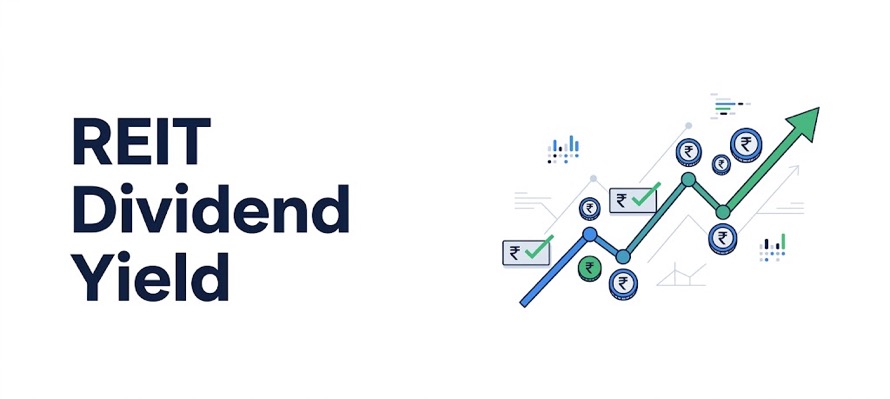
REITs and InvITs are among India’s most compelling passive income instruments , combining regular quarterly distributions with long-term capital appreciation potential. Here is a comprehensive comparison of current yields and how to build a passive income portfolio using REITs.
Current REIT and InvIT Distribution Yields 2026
| Instrument | NSE Symbol | Type | Approx. Annual Yield | Quarterly Distribution | Key Asset |
|---|---|---|---|---|---|
| Embassy Office Parks | EMBASSY | Office REIT | 6.5 to 7% | Rs.5.50 to Rs.6.00 per unit | Grade-A office parks |
| Mindspace Business Parks | MINDSPACE | Office REIT | 7 to 7.5% | Rs.5.80 to Rs.6.20 per unit | Office parks, primarily Hyderabad |
| Brookfield India Real Estate | BIRET | Office REIT | 7.5 to 8% | Rs.6.00 to Rs.7.00 per unit | Office parks, Gurugram/Mumbai/Noida |
| Nexus Select Trust | NEXUSSELECT | Retail REIT | 5.5 to 6% | Rs.4.50 to Rs.5.00 per unit | Shopping malls, 14 Indian cities |
| India Grid Trust | INDIGRID | Power InvIT | 11 to 12% | Rs.3.50 to Rs.4.00 per unit | Power transmission lines |
| IRB InvIT | IRB INVIT | Highway InvIT | 9 to 11% | Variable | Toll road concessions |
| PowerGrid InvIT | POWERINVIT | Power InvIT | 10 to 11% | Rs.3.00 to Rs.4.00 per unit | PGCIL transmission assets |
REIT Yield vs Other Passive Income Assets
| Asset | Typical Yield | Risk Level | Liquidity | Capital Appreciation |
|---|---|---|---|---|
| Bank Fixed Deposit | 7 to 7.5% | Very Low | Low (locked in) | None |
| Office REIT | 6.5 to 8% | Low to Medium | High (exchange-traded) | Moderate (3 to 5% per year) |
| Power InvIT (IndiGrid) | 11 to 12% | Medium | Medium | Low (concession assets depreciate) |
| Sovereign Gold Bonds | 2.5% + gold price return | Low | Medium | Gold price appreciation |
| High-dividend stocks | 2 to 5% | Medium to High | High | High potential |
| Liquid Mutual Funds | 7 to 7.5% | Very Low | Very High (1-day) | None |
| PPF | 7.1% | Very Low | Very Low (15-year lock) | None |
“Start investing with confidence! Explore
0 demat account
and grow your wealth.”
How to Build a Rs.1 Lakh Annual Income Portfolio Using REITs
To earn Rs.1,00,000 per year from REIT/InvIT distributions: at a blended yield of 8%, you need to invest Rs.12.5 lakh. A practical portfolio: Rs.5 lakh in office REITs (average 7% yield = Rs.35,000/year), Rs.4 lakh in InvITs at 11% (Rs.44,000/year), Rs.3.5 lakh in Nexus Select (6% = Rs.21,000/year). Total = Rs.1,00,000 per year.
Post-Tax Yield Calculation
REIT distributions are not fully taxable , they comprise interest income, dividend, and return of capital in varying proportions. For a taxpayer in the 30% bracket, the post-tax yield on an 8% gross yield REIT is approximately 5.8 to 6.5% depending on the component split. Still well above post-tax FD yields for high-bracket taxpayers.
REIT Distribution Growth: The Compounding Effect
Unlike FDs, good REITs grow their distributions over time. Embassy Office Parks grew its distribution per unit from Rs.20.17 in FY2020 to Rs.23.08 in FY2024 , a 14.4% cumulative growth. If this growth continues, your effective yield on your original purchase price increases year after year (yield-on-cost), compounding your passive income.
FAQs
Are REIT yields guaranteed like FD interest?
No. REIT distributions depend on actual rental income, occupancy, and expenses. They are mandatory (SEBI requires 90% distribution) but the amount can vary. FD interest is contractually fixed.
Which Indian REIT has the best track record of distribution growth?
Embassy Office Parks and Mindspace Business Parks have both shown consistent distribution per unit growth since their respective listing dates.
Can REIT yields fall?
Yes. If major tenants vacate, if rents reset lower at expiry, or if interest costs rise significantly, distributions can be reduced. Office REITs faced some headwinds post-COVID when work-from-home reduced office demand.
Is InvIT yield sustainable long-term?
InvIT yields (10 to 12%) are higher because assets have a finite life (concession expiry). Part of the ‘yield’ is essentially return of capital. True sustainable yield is lower , factor this in when comparing with perpetual assets like REITs.
How do I compare REIT yield with my FD renewal rate?
Compare post-tax yields. If you are in the 30% tax bracket: FD at 7.5% gives post-tax 5.25%. A REIT at 7% gross with 30% effective tax rate gives ~4.9 to 5.5% post-tax , comparable, with the REIT also offering capital appreciation upside.
Disclaimer
The stocks mentioned in this article are not recommendations. Please conduct your own research and due diligence before investing. Investment in securities market are subject to market risks, read all the related documents carefully before investing. Please read the Risk Disclosure documents carefully before investing in Equity Shares, Derivatives, Mutual fund, and/or other instruments traded on the Stock Exchanges. As investments are subject to market risks and price fluctuation risk, there is no assurance or guarantee that the investment objectives shall be achieved. Lemonn (Formerly known as NU Investors Technologies Pvt. Ltd) do not guarantee any assured returns on any investments. Past performance of securities/instruments is not indicative of their future performance.
Related Posts

Download Lemonn
Download my app for share market trading, ipo investment, trading account, and all your investment needs.



