What Is a Circuit Breaker in Trading? How Is It Triggered?
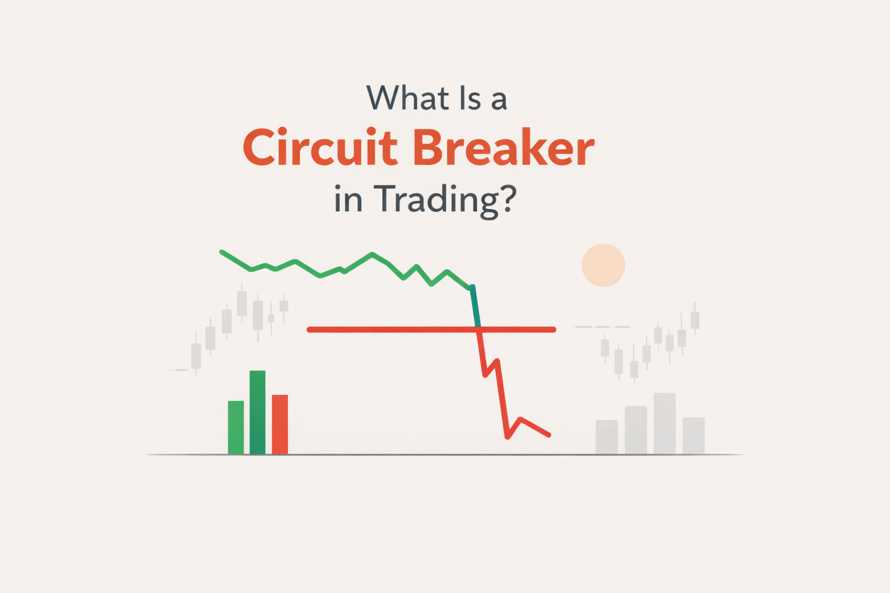
Markets move on emotion as much as logic. Fear compresses time. Greed stretches it. When panic spreads quickly, prices can spiral in minutes. That is where a circuit breaker enters the picture.
A circuit breaker acts as a temporary pause button. Exchanges trigger it when price movement crosses predefined thresholds. The goal is simple. Slow the market. Give participants time to absorb information. Prevent cascading selloffs driven purely by momentum.
Circuit breakers exist at two levels. One applies to the entire market. The other applies to individual stocks. Both operate under exchange rules and regulatory oversight. Both aim to stabilize volatility without freezing natural price discovery.
Market-Wide Circuit Breakers
A market-wide circuit breaker halts trading across the entire exchange when a benchmark index falls or rises sharply within a session. In India, exchanges such as the NSE and BSE use the Nifty 50 and Sensex as reference indices.
Thresholds typically trigger at 10 percent, 15 percent, and 20 percent movements. Each level results in a trading halt of defined duration. The timing of the breach determines the halt duration. If triggered early in the session, the halt lasts longer. If triggered near closing hours, the halt may remain shorter.
These pauses allow investors to reassess positions, evaluate news, and reduce impulsive selling. Clearing corporations also recalibrate risk exposures during halts.
Limit Up/Limit Down Circuit Breaker
Single-stock circuit breakers function differently. Exchanges define upper and lower price bands for individual securities. If a stock hits its upper circuit, trading halts because buying demand exceeds supply at the allowed price bands. If it hits the lower circuit, selling pressure dominates.
This mechanism is often referred to as the limit up/limit down system. It prevents extreme one-day price movements in illiquid stocks.
Price bands may range from 2 percent to 20 percent depending on stock category, liquidity, and volatility profile. Highly liquid stocks often trade within dynamic price bands that reset periodically during the day.
“Start investing with confidence! Explore
share market
and grow your wealth.”
History of Circuit Breakers
The modern circuit breaker system was the direct result of the devastating Black Monday crash in the United States market. On this day, sentimental actions triggered a massive selloff due to the absence of any pausing mechanism. So, regulators realized that even in the free market, there has to be some form of mechanism that can prevent such a selloff.
Only then is there a chance to control uninterrupted panic that can destabilize the entire financial system.
Subsequently, a lot of reforms were introduced in the market for market-wide halts in such extreme cases. Over time, exchanges refined their threshold levels. They also modified their halt durations and stock-specific price bands. In India, circuit breakers took shape after the 1990s. And then evolved till early 2000s.
Balancing Prevention and Restriction
A circuit breaker walks a thin line. It prevents runaway panic. It also interferes with natural trading flow. This balance creates debate.
Some traders argue that halts restore rationality. Others believe that halting delay is an inevitable price discovery. Both perspectives carry weight.
Let’s examine the tensions.
The Magnet Effect
The magnet effect introduces a strange tension near a circuit threshold. As prices drift closer to the trigger level, traders often accelerate activity instead of slowing down. They rush to execute before trading halts. That urgency can intensify the very volatility the rule attempts to contain. When participants know that a circuit breaker will activate at a defined percentage, that number begins to act like gravity. Sellers try to exit before the freeze. Buyers hesitate, and liquidity thins. Momentum feeds itself. The threshold stops behaving like a safety wall and starts acting like a psychological target.
Interference with Price Discovery
Markets function through continuous negotiation between buyers and sellers. A trading halt interrupts that negotiation mid-sentence. Some argue that prices should adjust organically, even during panic. When a circuit breaker pauses activity, an imbalance builds silently. Orders stack. Emotions compound. When trading resumes, the reopening print may jump sharply because suppressed demand or supply suddenly expresses itself. That gap can feel abrupt, even destabilizing.
Contagion Paradox
A halt in one market rarely stays isolated. Whenever any major exchange activates a circuit breaker, global investors take it into account right away. Their screens start flashing red, and commentary accelerates. This leads to anxiety that spreads quickly to other markets. Result? The trading halt at one exchange can lead to a selloff in the other markets.
Forward-Looking vs. Backward-Looking Design
Most circuit thresholds rely on historical volatility data. Markets, however, evolve in real time. Liquidity structures shift. Algorithmic participation expands. Critics question whether static percentage bands always reflect present conditions. Regulation adapts slowly. Trading technology adapts rapidly. This tension fuels ongoing debate.
Recent Market Volatility and the Circuit Breaker System
Recent years tested the entire circuit breaker framework in Indian markets. For example, pandemic-driven panic in 2020 was an exceptional event. Screens flashed red globally. In India, March 13, 2020, saw the Nifty 50 and Sensex fall more than 10 percent, triggering a 45-minute halt. Ten days later, on March 23, 2020, the Nifty and Sensex again breached the 10 percent threshold, forcing another 45-minute suspension. Fear moved faster than fundamentals.
The system responded exactly as designed. Trading stopped. Clearing corporations recalculated exposure. Liquidity paused, then slowly returned. Markets reopened in an environment where emotion had slightly cooled.
Crucially, circuit breakers did not erase losses. They slowed the momentum. That slowdown mattered. Speed, not just price, drives panic.
Modern markets run on algorithms. Automated systems execute at a millisecond scale. Momentum compounds quickly. A circuit breaker introduces friction into that high-speed loop. It interrupts cascading orders before they spiral uncontrollably.
The most recent reminder came from commodities. Silver futures on MCX hit a 6 percent upper circuit on January 12, 2026, as a buying frenzy froze trading during a global rally. On February 1, 2026, a 12 percent lower circuit followed a sharp global selloff in gold and silver. Earlier, on October 27, 2025, another lower circuit near 12 to 14 percent emerged as dollar strength triggered aggressive profit-taking. These events show that circuit mechanisms extend beyond equities. Metals, too, require speed control when momentum overwhelms restraint.
What Was in Place Before the Market-Wide Circuit Breakers?
Before structured market-wide circuit breaker systems existed, exchanges relied primarily on manual intervention and limited stock-level price bands.
During earlier decades, sudden crashes unfolded without systematic pause mechanisms. Liquidity vanished. Orders cascaded.
Regulators recognized the need for pre-defined rules rather than discretionary intervention. Structured thresholds replaced reactive decision-making.
When Is a Market-Wide Circuit Breaker Triggered?
In India, a market-wide circuit breaker triggers when benchmark indices breach specific percentage thresholds compared to the previous day’s closing level.
At 10 percent movement, trading halts temporarily.
At 15 percent movement, a longer halt may occur.
At 20 percent movement, trading may remain suspended for the rest of the session, depending on timing.
The exchange determines the halt duration based on the time of breach. Early-session triggers result in longer pauses. Late-session triggers may result in shorter suspensions.
Are the Rules the Same for Single-Stock Circuit Breakers?
Single-stock circuit rules differ from market-wide halts. Individual securities operate within predefined price bands. These bands reset periodically.
Highly liquid stocks may have dynamic bands. Less liquid stocks may operate under fixed daily limits. Certain derivatives-linked securities may follow separate frameworks.
Therefore, the circuit breaker mechanism varies by asset type and liquidity classification.
Are Options Markets Also Halted When a Circuit Breaker Is Triggered?
When a market-wide circuit breaker triggers, derivatives trading, including options, typically halts alongside cash markets. This synchronization prevents arbitrage imbalances between cash and derivative segments.
The Bottom Line
A circuit breaker does not eliminate volatility. It manages tempo. It creates a pause where panic accelerates.
Market-wide halts protect systemic stability. Single-stock limits control localized volatility. Both mechanisms reflect decades of market evolution.
Critics debate interference. Supporters emphasize stability. Reality sits somewhere in between.
Circuit breakers work best during extreme stress. During normal volatility, markets rarely approach thresholds.
Ultimately, a circuit breaker does one essential thing. It slows the clock. In moments of panic, slowing the clock changes outcomes.
That is the purpose of a circuit breaker.
FAQs:
Q. What does trading halted circuit breaker mean?
This means the circuit breaker got activated due to a very sharp price movement in any direction. The exchange stops the trading temporarily to control volatility and protect investors and traders from emotion-based trades.
Q. Why has trading been halted?
Trading halts when price movement crosses predefined limits. This may happen due to extreme volatility, regulatory announcements, or market-wide circuit breaker activation.
Q. What is a circuit filter in the stock market?
A circuit filter sets upper and lower price limits for a stock during a session. If price hits those limits, trading pauses to prevent excessive volatility.
Q. How long does a circuit breaker halt last?
Duration depends on trigger level and time of breach. In India, market-wide halts may last from 15 minutes to the rest of the session, based on percentage movement.
Disclaimer
The stocks mentioned in this article are not recommendations. Please conduct your own research and due diligence before investing. Investment in securities market are subject to market risks, read all the related documents carefully before investing. Please read the Risk Disclosure documents carefully before investing in Equity Shares, Derivatives, Mutual fund, and/or other instruments traded on the Stock Exchanges. As investments are subject to market risks and price fluctuation risk, there is no assurance or guarantee that the investment objectives shall be achieved. Lemonn (Formerly known as NU Investors Technologies Pvt. Ltd) do not guarantee any assured returns on any investments. Past performance of securities/instruments is not indicative of their future performance.
Related Posts



Download Lemonn
Download my trading app for SIP, demat account services—get a free demat account with our demat apps.