P/E Ratio Explained: How to Use It to Pick Stocks in India
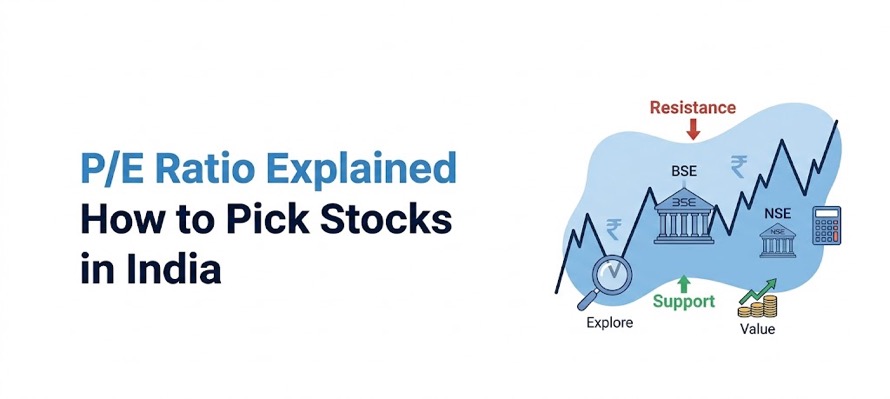
The Price-to-Earnings (P/E) ratio is the most widely used stock valuation metric in the world. It tells you how much investors are willing to pay for every rupee of a company’s annual earnings. Understanding P/E is fundamental to determining whether a stock is cheap, fairly priced, or expensive.
What Is the P/E Ratio?
P/E Ratio = Market Price per Share / Earnings per Share (EPS). Example: Infosys trades at Rs.1,500 per share. Its EPS (last 12 months) is Rs.60. P/E = 1500 / 60 = 25x. You are paying Rs.25 for every Rs.1 of annual profit. A lower P/E suggests cheaper valuation; a higher P/E suggests the market expects strong future growth.
What P/E Ratio Tells You
| P/E Range | What It Could Mean | Key Caution |
|---|---|---|
| Below 10 | Possibly undervalued or deep value situation | Check if earnings are declining or company has serious issues |
| 10 to 20 | Fair value for most sectors and stable businesses | Depends heavily on growth rate and industry norms |
| 20 to 35 | Premium valuation; growth expectations priced in | Growth must justify the premium; monitor quarterly results closely |
| Above 35 | High-growth expectations baked in | Very sensitive to earnings disappointment; high downside risk |
| Negative P/E | Company is loss-making; P/E not applicable | Focus on revenue trajectory, gross margin, and path to profitability |
“Start investing with confidence! Explore
share market
and grow your wealth.”
P/E Benchmarks by Sector in India
| Sector | Typical P/E Range | Why This Range |
|---|---|---|
| Banking and NBFC | 10 to 20x | Capital-intensive, regulated returns on equity |
| IT Services | 22 to 35x | High margins, dollar revenues, steady growth, low capital needs |
| FMCG | 40 to 65x | Premium brands, pricing power, very predictable earnings growth |
| Pharmaceuticals | 20 to 35x | R&D uncertainty balanced by defensiveness and global demand |
| Auto | 15 to 25x | Cyclical, capex-heavy, dependent on consumer sentiment |
| Infrastructure | 20 to 40x | Long-term revenue visibility via contracts; execution risk premium |
| Defence | 50 to 80x | Government order books create visibility; scarcity premium |
Trailing P/E vs Forward P/E
Trailing P/E (TTM) uses the last 12 months of actual earnings, reliable but backward-looking. Forward P/E uses analyst estimates for the next 12 months, more predictive but depends on forecast accuracy. When evaluating fast-growing companies, forward P/E is more meaningful. For stable companies, trailing P/E is preferred.
P/E vs PEG Ratio: Adding Growth to the Picture
PEG Ratio = P/E divided by EPS Growth Rate (%). A PEG below 1 suggests the stock may be undervalued relative to its growth. Example: A company with P/E of 30x and earnings growing at 35% CAGR has PEG = 30/35 = 0.86; suggesting it is reasonably priced despite the high absolute P/E. PEG is most useful for comparing growth stocks across a sector.
When P/E Is Misleading
- One-time extraordinary income (asset sale, write-back) inflates earnings, reducing P/E artificially
- Cyclical businesses at the top of the cycle appear cheap (low P/E) but earnings will normalise
- Companies using accounting tricks to inflate profits while cash flow remains weak
- Comparing P/E across different sectors or geographies without adjusting for growth rates
FAQs
Is a lower P/E always better?
No. A low P/E can indicate undervaluation, but it can also reflect structural problems, earnings decline, or poor management. Always look at the reason behind a low P/E.
What P/E ratio is considered good for Indian stocks?
There is no universal ‘good’ P/E; it depends on the sector, growth rate, and market cycle. Compare a stock’s P/E to its own historical range and its sector peers.
What is the Nifty 50’s average P/E?
The Nifty 50’s long-term average P/E is around 20 to 22x. Above 25x is generally considered expensive; below 17x is historically cheap.
Can I use P/E to evaluate bank stocks?
P/E is less reliable for banking stocks due to their leveraged nature. Use Price-to-Book (P/B) ratio and Return on Equity (ROE) instead for banks.
Where can I find P/E ratio for Indian stocks?
Screener.in, Lemonn app (stock detail page), NSE India website, and Moneycontrol all display current and historical P/E ratios.
Disclaimer
The stocks mentioned in this article are not recommendations. Please conduct your own research and due diligence before investing. Investment in securities market are subject to market risks, read all the related documents carefully before investing. Please read the Risk Disclosure documents carefully before investing in Equity Shares, Derivatives, Mutual fund, and/or other instruments traded on the Stock Exchanges. As investments are subject to market risks and price fluctuation risk, there is no assurance or guarantee that the investment objectives shall be achieved. Lemonn (Formerly known as NU Investors Technologies Pvt. Ltd) do not guarantee any assured returns on any investments. Past performance of securities/instruments is not indicative of their future performance.
Related Posts


Download Lemonn
Download my trading app for SIP, demat account services—get a free demat account with our demat apps.