
How to Read a Company Balance Sheet for Beginners
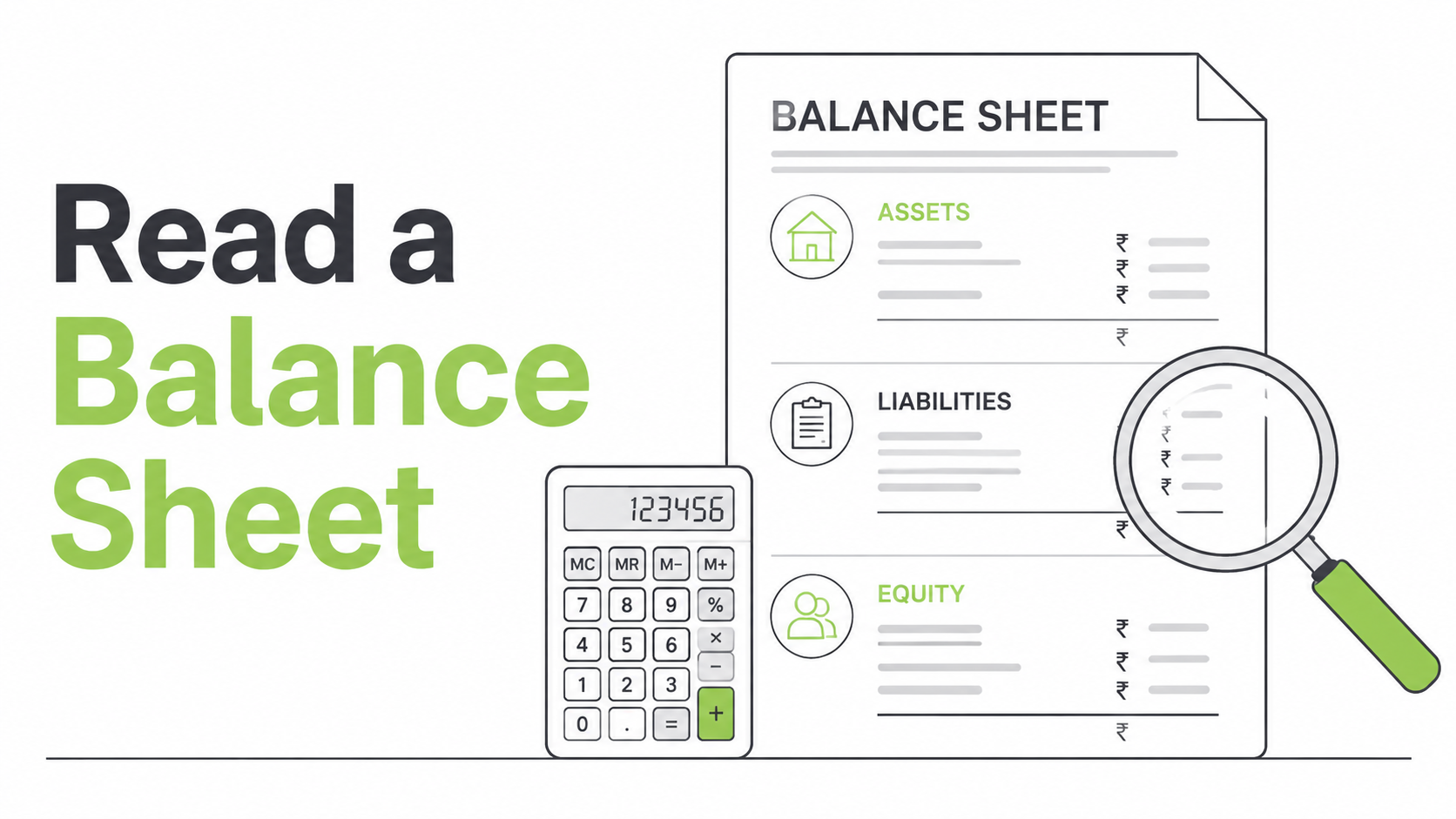
A balance sheet shows what a company owns, what it owes, and the residual value attributable to shareholders at a specific date.
For an investor, it can reveal whether a business is financially strong, heavily indebted, short of cash, dependent on customers paying later, or carrying assets whose quality deserves closer investigation.
What Is a Balance Sheet?
The balance sheet is one of the core financial statements.
The basic accounting equation is:
Assets = Liabilities + Shareholders’ Equity
Everything the company controls must be financed either by:
- Obligations to others
- Capital attributable to owners
Why Is It Called a Balance Sheet?
Because the accounting equation must balance.
Suppose a company has:
- Assets: ₹1,000 crore
- Liabilities: ₹600 crore
- Shareholders’ equity: ₹400 crore
Then:
₹1,000 crore = ₹600 crore + ₹400 crore
The equality does not mean the business is healthy.
It simply reflects accounting structure.
“Start investing with confidence! Explore
Lemonn
and grow your wealth.”
What Are Assets?
Assets are economic resources controlled by the company that can contribute to future benefits.
They are commonly grouped into:
- Current assets
- Non-current assets
What Are Current Assets?
Current assets are generally expected to be realised, sold, consumed, or converted within the relevant operating cycle or short-term period under accounting rules.
Examples include:
- Cash
- Bank balances
- Inventory
- Trade receivables
- Short-term investments
- Other current financial assets
Why Cash Matters
Cash provides financial flexibility.
A business with healthy cash reserves can:
- Pay suppliers
- Invest in growth
- Handle temporary downturns
- Repay debt
- Fund acquisitions
But excessive idle cash can also raise questions about capital allocation.
What Are Trade Receivables?
Receivables are amounts customers owe the company.
If revenue grows 10% but receivables grow 60%, investigate.
Possible explanations include:
- Longer credit periods
- Slower collection
- Weak customers
- Aggressive revenue recognition
Receivables are not automatically bad, but trends matter.
What Is Inventory?
Inventory includes goods a company intends to sell or use in production.
Rapidly rising inventory can mean:
- Preparing for growth
- Supply-chain planning
- Slowing demand
- Obsolete products
Context is critical.
A jewellery retailer and a software company naturally have very different inventory profiles.
What Are Non-Current Assets?
These are longer-term assets.
Examples can include:
- Property
- Plant and equipment
- Long-term investments
- Goodwill
- Intangible assets
- Long-term financial assets
What Is Property, Plant and Equipment?
PPE represents physical assets used to run the business.
For a manufacturer, this may include:
- Factories
- Machinery
- Equipment
Large capital expenditure can create future capacity, but investors should ask whether that capacity earns adequate returns.
What Is Goodwill?
Goodwill commonly arises when a company acquires another business for more than the identifiable net asset value recognised in the transaction.
Large goodwill is not automatically a problem.
But repeated acquisitions followed by impairment charges can indicate poor capital allocation.
What Are Liabilities?
Liabilities are obligations the company owes to others.
Examples include:
- Borrowings
- Trade payables
- Lease liabilities
- Tax liabilities
- Other financial obligations
What Are Current Liabilities?
Current liabilities are generally obligations expected to be settled within the applicable short-term period or operating cycle.
Examples include:
- Supplier payments
- Short-term borrowing
- Current debt maturities
- Accrued expenses
What Are Non-Current Liabilities?
These are longer-term obligations.
Examples include:
- Long-term loans
- Bonds
- Lease obligations
- Certain provisions
The amount and cost of debt deserve careful attention.
Is Debt Always Bad?
No.
Debt can improve returns when used productively.
A profitable business may borrow at 8% to fund a project generating a much higher return.
The problem occurs when:
- Debt grows faster than cash generation
- Interest costs become burdensome
- Refinancing becomes difficult
- Borrowed money funds poor acquisitions
What Is Shareholders’ Equity?
Equity represents the residual interest attributable to shareholders after liabilities.
It can include:
- Share capital
- Securities premium
- Retained earnings
- Reserves
- Other equity components
Growing equity can be positive, but understand the source.
What Are Retained Earnings?
Retained earnings broadly represent profits that were not distributed and remain within the business over time.
A good business may reinvest retained earnings at attractive returns.
A poor business can retain large profits and waste them.
Capital allocation matters.
What Is Book Value?
Book value relates to the accounting value of shareholders’ equity.
Book value per share is commonly calculated using equity divided by the relevant share count.
It is used in the P/B ratio.
However, book value can be more informative for some industries than others.
What Is Working Capital?
A simplified working-capital calculation is:
Current assets minus current liabilities
Working capital helps assess short-term operating funding.
But high working capital is not automatically good.
Too much inventory or overdue receivables can inflate current assets.
What Is the Current Ratio?
Current ratio = Current assets ÷ Current liabilities
A ratio above 1 means current assets exceed current liabilities.
But there is no universal ideal figure.
Business models differ.
What Is the Debt-to-Equity Ratio?
Debt-to-equity = Debt ÷ Shareholders’ equity
It shows the relationship between borrowed capital and shareholder capital.
Compare it with:
- Industry peers
- The company’s own history
- Interest coverage
- Cash flow
What Is Net Debt?
A common simplified concept is:
Net debt = Debt minus cash and cash equivalents
A company with ₹1,000 crore debt and ₹900 crore cash is different from one with ₹1,000 crore debt and ₹50 crore cash.
How Do You Read a Balance Sheet Step by Step?
Step 1: Check Cash
Is liquidity improving or deteriorating?
Step 2: Check Debt
Compare the current year with previous years.
Step 3: Examine Receivables
Are customers taking longer to pay?
Step 4: Review Inventory
Is stock growing faster than revenue?
Step 5: Check Equity
Is net worth increasing through genuine profits or repeated share issuance?
Step 6: Read Notes to Accounts
Many important details sit outside the headline table.
Why You Should Compare Five Years
One balance sheet is a photograph.
Five years provide a short movie.
You can see whether:
- Debt is rising
- Cash is shrinking
- Receivables are building
- Equity is being diluted
- Acquisitions are inflating goodwill
Trend analysis is more useful than isolated numbers.
Why Industry Comparison Matters
Banks naturally have enormous financial assets and liabilities.
Manufacturers carry inventory and plants.
Technology firms may have few physical assets.
A ratio that looks alarming in one industry can be normal in another.
Always compare relevant peers.
Balance Sheet Red Flags
Watch for:
- Debt rising faster than operating performance
- Receivables growing far faster than sales
- Persistent inventory build-up
- Large unexplained related-party balances
- Repeated equity dilution
- Weak cash balances
- Large goodwill after aggressive acquisitions
- Contingent liabilities that could become material
None proves fraud or failure by itself.
They are signals for deeper research.
Do Not Analyse the Balance Sheet Alone
Also read:
- Profit and loss statement
- Cash-flow statement
- Auditor’s report
- Notes to accounts
- Annual report
- Management commentary
A company can report profits while cash flow remains weak.
That difference is often where deeper analysis begins.
FAQs
What is the most important balance sheet number?
There is no single number. Cash, debt, receivables, inventory, and equity should be analysed together.
Is zero debt always good?
No. Productive and manageable debt can support growth.
What is a healthy current ratio?
It depends on the industry and business model. Peer and historical comparisons are more useful than a universal threshold.
Why are receivables important?
Rapidly growing receivables can signal slow collection or aggressive revenue recognition.
How many years should I compare?
Several years, commonly at least three to five, can reveal trends that one period hides.
Key Takeaways
- The balance sheet shows assets, liabilities, and equity.
- Cash quality matters.
- Rising debt should be compared with profits and cash flow.
- Receivables and inventory can reveal operational stress.
- Ratios are useful only in context.
- Compare several years and relevant competitors.
- Read the notes and other financial statements before investing.
Disclaimer
The stocks mentioned in this article are not recommendations. Please conduct your own research and due diligence before investing. Investment in securities market are subject to market risks, read all the related documents carefully before investing. Please read the Risk Disclosure documents carefully before investing in Equity Shares, Derivatives, Mutual fund, and/or other instruments traded on the Stock Exchanges. As investments are subject to market risks and price fluctuation risk, there is no assurance or guarantee that the investment objectives shall be achieved. Lemonn do not guarantee any assured returns on any investments. Past performance of securities/instruments is not indicative of their future performance.
To read the RA disclaimer
Research Analyst - Gaurav Garg
Related Posts


Download Lemonn
Download my share market app for stock trading—trade stocks effortlessly in the market.



