
Hexaware Technologies Shares Fall 4% After CEO Srikrishna Ramakarthikeyan Resigns
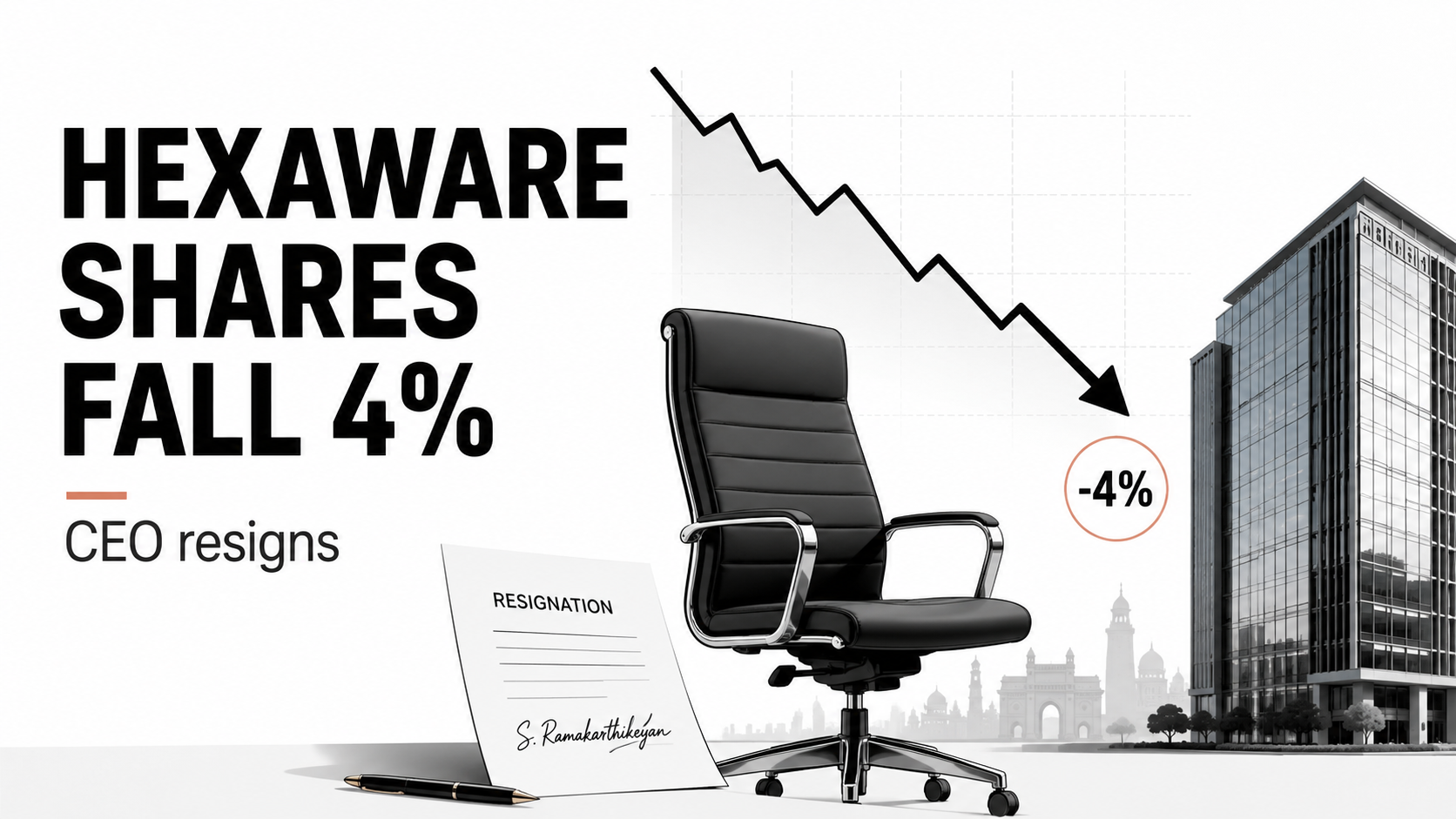
Hexaware Technologies shares fell around 4% on September 3, 2026, after the IT services company announced a major leadership transition involving long-serving CEO Srikrishna Ramakarthikeyan.
Ramakarthikeyan, widely known as Keech, will step down as chief executive and as a member of Hexaware’s board on October 28, 2026. EXL veteran Vivek Jetley has been named CEO-designate and will take charge on the same date.
The stock declined as investors assessed what the leadership change could mean for strategy, client relationships and Hexaware’s growth plans at a time when artificial intelligence is rapidly reshaping the IT services industry.
Why Did Hexaware Shares Fall?
The immediate trigger was the announcement that Ramakarthikeyan would leave the chief executive role after roughly 12 years.
Long-serving CEO departures can cause short-term uncertainty, even when a company announces a successor at the same time.
Investors may need to reassess:
- Strategic continuity
- Client relationships
- Senior management stability
- Growth priorities
- Capital allocation
- Execution under new leadership
Hexaware shares were down roughly 3.75% during September 3 trading, according to Financial Express.
The decline does not necessarily indicate that investors have a negative view of incoming CEO Vivek Jetley.
It may simply reflect uncertainty created by a major change at the top of the organisation.
Why Is Srikrishna Ramakarthikeyan Leaving Hexaware?
The company said Ramakarthikeyan resigned to pursue personal interests.
He has led Hexaware for more than a decade and also oversaw the company’s return to the public markets.
His departure therefore represents a significant transition for the business.
Ramakarthikeyan will not cut ties with Hexaware immediately.
The company said he will remain as a senior adviser to help ensure a smooth transition.
This arrangement can reduce succession risk because the incoming chief executive may continue to receive support from the outgoing leader while taking over key responsibilities.
“Start investing with confidence! Explore
Lemonn
and grow your wealth.”
Who Is Vivek Jetley?
Vivek Jetley has more than 25 years of experience across consulting, analytics and AI-led transformation.
Before joining Hexaware, he served as President at EXL, a Nasdaq-listed analytics and digital operations company.
At EXL, Jetley led businesses covering insurance, healthcare and life sciences.
He joined EXL in 2006 when the company acquired Inductis, where he had been a partner.
That background gives him experience across several areas that are becoming increasingly important for IT services firms.
These include:
- Artificial intelligence
- Data analytics
- Consulting
- Digital transformation
- Insurance technology
- Healthcare
- Enterprise services
Hexaware’s decision to appoint an executive with significant AI and analytics experience comes as clients increasingly look for technology vendors that can combine traditional IT services with AI-driven transformation.
When Will Vivek Jetley Become Hexaware CEO?
Jetley is expected to formally assume the chief executive role on October 28, 2026.
Ramakarthikeyan will step down as CEO and from the company’s board on the same date.
The period between the announcement and formal handover gives the company time to manage the transition.
For a global technology-services company, succession involves more than transferring an executive title.
The new CEO must become familiar with major clients, strategic projects, senior managers, financial priorities and investor expectations.
Why Is the CEO Change Important for Hexaware?
Leadership changes matter at professional-services companies because client relationships and talent management are critical parts of the business.
Unlike manufacturers, IT services firms depend heavily on people, long-term client relationships and execution quality.
A CEO helps determine:
- Which industries receive investment
- Which markets the company prioritises
- How aggressively it pursues acquisitions
- How quickly it adopts new technologies
- How it manages employee costs
- Which large clients it targets
- How it allocates capital
A new leader may preserve much of the existing strategy or gradually shift priorities.
Investors will therefore watch Jetley’s early decisions carefully.
Hexaware Faces an AI-Driven IT Services Market
The IT services industry is going through a structural shift because of generative artificial intelligence.
Clients are asking vendors to automate tasks that were traditionally performed by large teams of software developers and business-process employees.
That creates both opportunities and risks.
AI can increase productivity and allow IT companies to offer new services.
At the same time, it can disrupt traditional billing models that depend heavily on the number of employees assigned to a project.
Hexaware’s next CEO will therefore need to determine how the company can use AI to improve delivery while continuing to grow revenue.
Jetley’s analytics and AI transformation background could be relevant to that challenge.
What Does Hexaware Technologies Do?
Hexaware is a global technology and business-process services company headquartered in Mumbai.
The company serves clients across multiple industries and provides services related to digital transformation, cloud, data, automation and business operations.
Financial Express reported that Hexaware has around 31,000 employees globally and annual revenue of more than $1.4 billion.
Its scale means major management decisions can affect thousands of employees and relationships with large multinational clients.
What Should Investors Watch During the Transition?
Client retention
The most important question is whether key customers remain comfortable with the transition.
Any disruption to major accounts could affect revenue growth.
Large deal wins
Large contracts can provide revenue visibility.
Investors will monitor whether Hexaware continues winning significant deals after the CEO change.
AI strategy
The market will want to understand how Jetley plans to position Hexaware in AI-led services.
Revenue growth
Leadership changes can attract attention, but financial performance ultimately matters more.
Consistent revenue growth would help reassure investors.
Margins
IT companies must balance salary costs, subcontracting expenses, pricing and utilisation.
Maintaining margins while investing in AI will be important.
Employee attrition
Senior leadership transitions can sometimes lead to changes deeper within management.
Investors may therefore monitor executive and employee turnover.
Does a CEO Exit Mean Hexaware’s Fundamentals Have Changed?
Not automatically.
A CEO departure is an important corporate event, but it does not immediately change the company’s client contracts, workforce or financial position.
The key question is whether the transition affects execution over the coming quarters.
If Hexaware continues delivering strong growth, maintaining margins and winning deals, the market may become more comfortable with the new leadership.
If growth weakens or senior executives leave, investors may become more cautious.
The initial share-price reaction should therefore be viewed as a response to uncertainty rather than a complete verdict on the company’s future.
Could the Leadership Change Create Opportunities?
Potentially.
New CEOs sometimes accelerate investments, restructure business units or pursue new markets.
Jetley’s experience in analytics and AI could lead Hexaware to place greater emphasis on higher-value transformation services.
That may be particularly relevant as clients increase spending on AI adoption.
However, investors will need evidence that strategy changes translate into profitable growth.
Ambitious announcements alone are not enough.
What Should Long-Term Investors Focus On?
Long-term shareholders should look beyond the immediate 3% to 4% stock-price decline.
More important indicators include:
- Revenue growth
- Deal pipeline
- Operating margin
- Free cash flow
- Client concentration
- Attrition
- AI-related revenue
- Management stability
- Valuation
A successful CEO transition would likely become visible through these metrics over time.
FAQs
Why did Hexaware shares fall?
Hexaware shares declined after the company announced that long-serving CEO Srikrishna Ramakarthikeyan would step down.
When is Srikrishna Ramakarthikeyan leaving?
He will step down as CEO and board member on October 28, 2026.
Who will become Hexaware’s new CEO?
Vivek Jetley has been named CEO-designate and will take charge on October 28, 2026.
Where did Vivek Jetley work previously?
Jetley was President at EXL, where he led businesses including insurance, healthcare and life sciences.
Will Ramakarthikeyan remain associated with Hexaware?
Yes. He is expected to stay on as a senior adviser to support the transition.
Key Takeaways
- Hexaware shares fell around 4% after its CEO transition announcement.
- Srikrishna Ramakarthikeyan is stepping down after roughly 12 years.
- Vivek Jetley has been appointed CEO-designate.
- Jetley brings more than 25 years of consulting, analytics and AI experience.
- Ramakarthikeyan will remain a senior adviser during the transition.
- Investors should watch client retention, deal wins, margins and Hexaware’s AI strategy.
Disclaimer
The stocks mentioned in this article are not recommendations. Please conduct your own research and due diligence before investing. Investment in securities market are subject to market risks, read all the related documents carefully before investing. Please read the Risk Disclosure documents carefully before investing in Equity Shares, Derivatives, Mutual fund, and/or other instruments traded on the Stock Exchanges. As investments are subject to market risks and price fluctuation risk, there is no assurance or guarantee that the investment objectives shall be achieved. Lemonn do not guarantee any assured returns on any investments. Past performance of securities/instruments is not indicative of their future performance.
To read the RA disclaimer
Research Analyst - Gaurav Garg
Related Posts


Download Lemonn
Download my share market app for stock trading—trade stocks effortlessly in the market.



