
Green Energy Stocks India 2026: The Renewable Boom
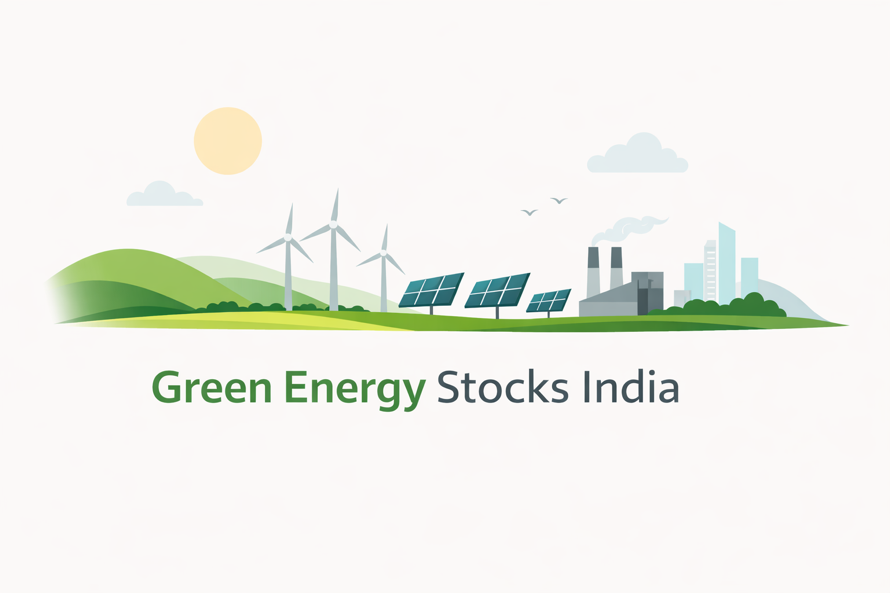
India is in the middle of one of the largest energy transitions in history. With an ambitious target of 500 GW of renewable capacity by 2030 and a fast-growing economy demanding more power, the green energy sector offers investors a rare combination of policy support, structural demand, and long-duration growth.
This article explains the green energy sector’s structure, the key companies across sub-segments, the metrics that matter for evaluating energy stocks, and the risks you must understand.
India’s Renewable Energy Ambition
India currently has approximately 175 GW of installed renewable energy capacity – spanning solar, wind, small hydro, and biomass. The government’s target is 500 GW by 2030, requiring the addition of roughly 50 GW every year for the next few years.
This is not aspirational rhetoric – India has consistently been among the world’s top 5 renewable energy markets by annual additions. Three structural drivers make it investable:
- Economics: Solar power in India now costs less than thermal power on a per-unit basis. Green energy is no longer a subsidy-dependent industry.
- Energy security: India imports 80%+ of its oil and 25%+ of its gas. Domestic renewables reduce this dependency, giving the government a strong incentive to accelerate deployment.
- Climate commitments: India’s NDC targets at COP commit to net-zero by 2070, with renewables at the heart of the transition pathway.
For investors, this creates a decades-long investment cycle in power generation, transmission, and clean energy technology.
Green Energy Sub-Sectors
The renewable energy value chain covers several distinct business models with different risk and return profiles:
| Sub-Sector | Key Companies | Investment Thesis |
|---|---|---|
| Solar Power Generation | Adani Green, Torrent Power | PLI scheme, cost parity with thermal |
| Wind Energy | Suzlon, Inox Wind | Strong order books, offshore wind policy |
| Green Hydrogen | NTPC Green, L&T | Govt’s National Green Hydrogen Mission |
| EV & Charging Infrastructure | Tata Motors, Exide Industries | FAME-III, EV penetration rising fast |
| Power Transmission | Power Grid, Sterlite Power | Grid expansion for renewable integration |
Solar and wind generation companies have utility-like business models – they sell power under long-term Power Purchase Agreements (PPAs) to state electricity boards and industrial buyers. These provide steady, predictable cash flows but require large upfront capital investment.
Green hydrogen is a newer, higher-risk sub-segment. India’s National Green Hydrogen Mission targets 5 MMT of production by 2030. The technology is proven but economics are still evolving – green hydrogen companies are best seen as long-duration bets.
The EV ecosystem is driven by FAME-III policy incentives and rising fuel prices. Both vehicle manufacturers and battery companies benefit as EV penetration rises from under 5% today toward double digits.
“Start investing with confidence! Explore
Lemonn
and grow your wealth.”
Key Metrics for Energy Stocks
Renewable energy companies are capital-intensive businesses. Standard P/E analysis is often misleading because of high depreciation. Use these metrics instead:
| Metric | What to Look For | Why It Matters |
|---|---|---|
| PLF / CUF (Utilisation) | > 20% for solar, > 25% for wind | Higher utilisation = more revenue per MW installed |
| Debt-to-Equity | < 2.5x | High debt is standard but must be manageable |
| Capacity Addition Guidance | Consistent execution vs guidance | Shows whether the company can deliver on its pipeline |
| PPA Coverage | > 90% of capacity | Higher PPA coverage = more revenue visibility |
Plant Load Factor (PLF) for thermal plants and Capacity Utilisation Factor (CUF) for solar and wind are the primary operational metrics. They tell you how efficiently the installed capacity is being used.
Debt levels are high in this sector by nature – building power plants costs thousands of crores. What matters is whether the debt is well-structured with long tenure and whether cash flows from PPAs are sufficient to service it comfortably.
Risks in Green Energy Investing
Despite the strong structural tailwinds, green energy investing carries specific risks:
- Policy risk: Renewable energy tariffs, PLI schemes, and import duties on solar cells can change with government priorities. A reversal of incentive schemes can affect project economics.
- Interest rate sensitivity: Renewable energy companies carry large debt loads. When interest rates rise, the cost of debt increases, compressing project-level returns and reducing equity valuations.
- Execution risk: Large renewable projects often face land acquisition challenges, grid connectivity delays, and equipment supply disruptions. Companies that consistently miss capacity addition targets deserve a valuation discount.
- Merchant price risk: Companies that sell power at market (merchant) rates rather than under fixed PPAs face revenue volatility when power prices fall.
- Currency risk: Indian renewable companies that have raised foreign-currency debt are exposed to rupee depreciation risk.
How to Track Green Energy Stocks on Lemonn
Here is a practical workflow for researching and investing in green energy stocks on Lemonn:
- Use Lemonn’s screener to filter power sector stocks by installed capacity, revenue growth, and debt-to-equity ratio.
- Look at capacity addition updates in quarterly earnings calls – the percentage of guidance delivered is a key management quality signal.
- Check whether the company’s PPAs are with financially strong counterparties (industrial buyers or central government entities are preferable to stressed state electricity boards).
- For a diversified approach, consider the Nifty India Consumption or sector-specific clean energy ETFs alongside individual stocks.
- Place trades on Lemonn with zero brokerage – especially valuable in a sector where you may build positions gradually over time.
With MTF at 12.99% p.a. on Lemonn, investors who want to take a larger position in high-conviction green energy stocks can do so at one of the lowest margin borrowing costs in the market.
FAQs
Q. Is India’s 500 GW renewable target achievable by 2030?
Based on the pace of capacity additions between 2023 and 2025, India is broadly on track, though the last few years will require an acceleration. For investors, what matters more than whether the exact target is met is that the direction and investment commitment is clear – and it is.
Q. What is a PPA and why does it matter for energy stocks?
A Power Purchase Agreement is a long-term contract (typically 25 years) between a renewable energy generator and a buyer (usually a state electricity board or industrial consumer), specifying the tariff at which electricity will be purchased. PPAs provide revenue certainty, which is the foundation of the business model. Companies with a higher percentage of capacity tied to PPAs have more predictable earnings.
Q. Is Suzlon Energy a good long-term investment?
Suzlon is India’s largest wind turbine manufacturer and has historically carried high debt. The company has undergone significant deleveraging in recent years and its order book has recovered strongly. Whether it is a good investment depends on your assessment of wind energy growth, Suzlon’s execution capability, and valuation. This article does not make buy/sell recommendations – always conduct your own due diligence.
Q. What is green hydrogen and why is it a long-term theme?
Green hydrogen is hydrogen produced by electrolysing water using renewable electricity, making it a zero-carbon fuel. It is expected to be critical for hard-to-abate sectors like steel, shipping, and chemicals. India’s National Green Hydrogen Mission aims to make India a global green hydrogen hub. The economics are still maturing, making this a longer-duration investment theme than solar or wind.
Q. Can I buy renewable energy stocks on Lemonn?
Yes. All NSE and BSE listed renewable energy stocks – including Adani Green, Suzlon, NTPC Green, Inox Wind, Power Grid, and others – are available on Lemonn with zero brokerage on delivery trades.
Disclaimer
The stocks mentioned in this article are not recommendations. Please conduct your own research and due diligence before investing. Investment in securities market are subject to market risks, read all the related documents carefully before investing. Please read the Risk Disclosure documents carefully before investing in Equity Shares, Derivatives, Mutual fund, and/or other instruments traded on the Stock Exchanges. As investments are subject to market risks and price fluctuation risk, there is no assurance or guarantee that the investment objectives shall be achieved. Lemonn do not guarantee any assured returns on any investments. Past performance of securities/instruments is not indicative of their future performance.
To read the RA disclaimer
Research Analyst - Gaurav Garg
Related Posts

Download Lemonn
Download my share market app for stock trading—trade stocks effortlessly in the market.



