
BSE Shares Jump 4.5% as CEO Clarifies NSE IPO Rules
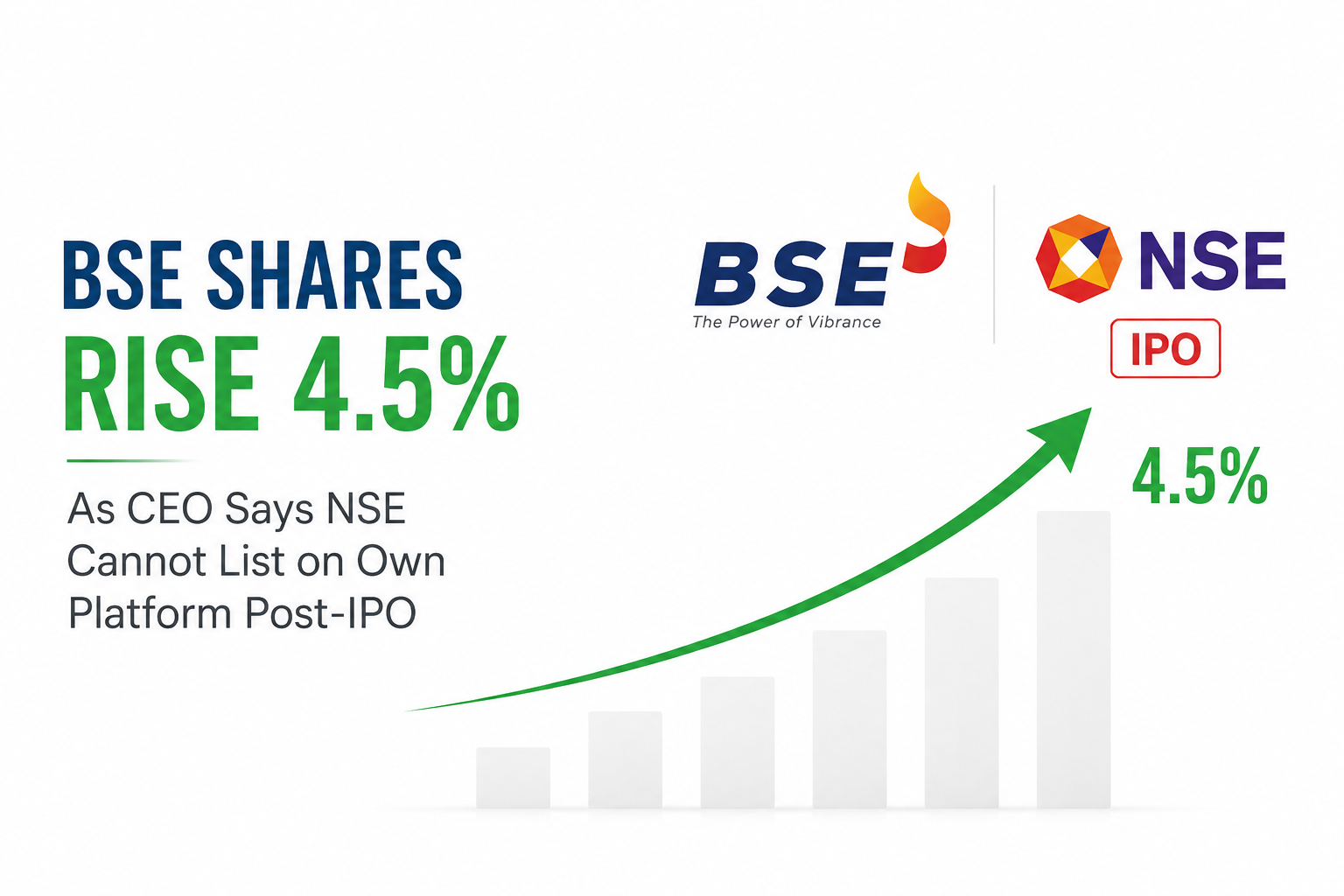
BSE shares jumped as much as 4.5% on September 3 after Managing Director and CEO Sundararaman Ramamurthy said the National Stock Exchange (NSE) cannot list on its own platform after its proposed IPO under the current regulatory framework.
The clarification matters because NSE’s upcoming IPO could make BSE the primary listing venue for shares of India’s largest stock exchange. It also addresses recent speculation that NSE shares could eventually trade on NSE itself after first listing on BSE.
Why did BSE shares rise 4.5%?
BSE shares climbed around 4.5% to ₹3,308 apiece during intraday trade on September 3, according to Moneycontrol. The stock rose after BSE CEO Sundararaman Ramamurthy clarified the position on NSE’s potential self-listing.
Ramamurthy said NSE had confirmed that no addendum would be issued with its offer document to enable self-trading. He also said self-listing is not permitted under the current regulatory framework.
The comments reduced some of the uncertainty surrounding where NSE shares could trade following its IPO.
What did the BSE CEO say about the NSE IPO?
Speaking to CNBC-TV18, Ramamurthy said BSE’s compliance team had checked with NSE about whether it intended to seek permission to trade its shares on its own exchange.
According to Ramamurthy, NSE indicated that reports around such a proposal were speculative and that it would not issue an additional offer-document filing for self-trading.
Ramamurthy also pointed to BSE’s own experience. BSE had sought permission to trade on its own exchange in 2017 but was not allowed to do so.
This precedent is particularly relevant because BSE itself is currently listed on NSE.
“Start investing with confidence! Explore
Lemonn
and grow your wealth.”
Can NSE list its shares on NSE after the IPO?
Under the current regulatory framework, NSE cannot formally list its own shares on the NSE platform.
Stock exchanges in India operate as market infrastructure institutions. Allowing an exchange to list and oversee trading in its own securities can create potential conflicts between its commercial interests and regulatory responsibilities.
The existing framework therefore separates the exchange operating the market from the exchange on which its shares are listed.
For NSE, that makes BSE the natural venue for its proposed public listing.
Could NSE shares still trade on NSE?
This is where the issue becomes more nuanced.
Earlier reports suggested that NSE shares could potentially trade on its own platform under a “permitted to trade”, or PTT, mechanism after being formally listed on BSE.
Under such an arrangement, BSE could remain the formal listing exchange while NSE shares could potentially also become available for trading on NSE, subject to the applicable regulatory framework and approvals.
Reports in August said such a possibility had been discussed during NSE’s IPO roadshows. However, SEBI Chairman Tuhin Kanta Pandey said on August 27 that the regulator had not considered allowing NSE shares to trade on its own platform under the permitted-to-trade category.
BSE’s latest comments have further cooled expectations of such an arrangement being part of the immediate IPO process.
Why does NSE listing on BSE matter for BSE?
An NSE listing could be significant for BSE because NSE is one of India’s most closely watched unlisted companies.
If NSE is formally listed only on BSE, investors wanting to trade NSE shares would initially need access to BSE’s platform. That could support BSE’s cash-market activity and strengthen its position as a listing venue.
The potential benefits include:
- Higher trading activity in BSE’s cash segment
- Increased visibility for the BSE platform
- Greater investor participation
- Listing-related revenue
- Potential improvement in BSE’s competitive positioning
This helps explain why investors reacted positively to the BSE CEO’s clarification.
However, investors should separate the strategic benefit from its actual financial impact. An NSE listing does not automatically translate into a large increase in BSE’s earnings.
Could NSE trading its shares on NSE hurt BSE?
Potentially, yes.
If NSE were eventually permitted to make its shares available for trading on its own platform, some trading volume could move away from BSE.
A PL Capital sensitivity analysis cited by Moneycontrol estimated that such a scenario could affect BSE’s FY27 earnings by roughly 1% to 2%, assuming BSE’s cash-market share does not improve further.
That helps explain why the self-trading question has attracted investor attention.
If NSE shares remain available only through BSE after listing, BSE may capture more of the trading activity associated with the stock. If NSE shares eventually become tradable on both exchanges, that advantage could narrow.
What is the latest update on the NSE IPO?
The NSE IPO has been awaited for years, but recent developments suggest the process is moving closer to a potential public offering.
On August 27, SEBI Chairman Tuhin Kanta Pandey said the regulator was close to approving NSE’s IPO documents.
NSE CEO Ashish Kumar Chauhan had also said earlier that NSE would not self-list because Indian regulations do not permit it. The proposed IPO is expected to be structured as an offer for sale (OFS), meaning existing shareholders would sell shares rather than NSE raising fresh capital through the issue.
The final structure, timeline, price band and other IPO details will depend on regulatory approvals and NSE’s official offer documents.
What else is affecting BSE’s trading volumes?
The NSE IPO was not the only topic discussed by BSE’s management.
Ramamurthy also addressed the recently introduced Closing Auction Session (CAS), saying index option volumes had declined and liquidity during the session remained an issue.
CAS was introduced on August 3 as a mechanism for determining the official closing price of stocks through an auction of buy and sell orders.
It replaced the earlier methodology where closing prices were calculated using trading prices during the final 30 minutes of continuous trading.
Why is the Closing Auction Session important?
Closing auctions are used in several global markets and are designed to improve the process of determining closing prices.
However, liquidity is critical for an auction mechanism to work efficiently.
BSE’s CEO said feedback from dealers included suggestions to:
- Separate F&O expiry from the Closing Auction Session
- Introduce CAS more gradually
- Restrict order modifications during the auction
BSE is collating this feedback for submission to regulators.
How are derivatives volumes at BSE and NSE performing?
Both exchanges have recently seen weaker equity derivatives turnover.
NSE’s monthly equity derivatives turnover reportedly fell to ₹34.48 lakh crore in August, its lowest level since November 2023.
BSE’s August turnover stood at around ₹32.2 lakh crore, its lowest since June 2025.
This means investors evaluating BSE shares should not look at the NSE IPO development in isolation. Market share, derivatives volumes, regulatory changes and trading activity remain important factors for the exchange’s earnings.
What does the NSE IPO development mean for BSE investors?
The immediate market reaction suggests investors see NSE’s inability to self-list as favourable for BSE.
If NSE’s IPO goes ahead and its shares are listed on BSE, the listing could bring a high-profile stock and additional trading activity to BSE’s platform.
Still, the longer-term impact will depend on several factors, including:
| Factor | Why it matters for BSE |
|---|---|
| NSE listing venue | A BSE-only listing could support cash-market activity |
| Permitted-to-trade rules | NSE trading on its own platform could reduce BSE’s advantage |
| NSE IPO size | A large issue could attract substantial investor attention |
| Trading volumes | Higher NSE share turnover could benefit BSE |
| SEBI regulations | Regulatory decisions will determine what trading structures are permitted |
| BSE market share | Broader cash and derivatives market share remains important for earnings |
The 4.5% rise in BSE shares reflects positive sentiment around the clarification, but it should not be treated as evidence that BSE’s earnings will increase by the same magnitude.
Investors will need to watch NSE’s final IPO documents and any subsequent SEBI decisions.
FAQs
Why did BSE shares rise today?
BSE shares rose as much as 4.5% on September 3 after CEO Sundararaman Ramamurthy said NSE cannot self-list after its proposed IPO under the existing regulatory framework. The comments reduced uncertainty around whether NSE could trade its shares on its own platform.
Can NSE list on its own stock exchange?
No, not under the current regulatory framework. NSE cannot formally list its own shares on the exchange it operates. BSE faced a similar restriction when it explored the possibility in 2017.
Where will NSE shares list after the IPO?
NSE is expected to list its shares on BSE rather than its own exchange. The exact listing structure will become clearer through the final IPO and regulatory documents.
Can NSE shares trade on both NSE and BSE?
There has been speculation about NSE shares potentially trading on NSE under the permitted-to-trade mechanism after a formal BSE listing. However, such an arrangement would depend on the regulatory framework and necessary approvals. BSE’s CEO has said NSE will not issue an addendum to its offer document for self-trading.
Is the NSE IPO confirmed?
NSE’s IPO process has advanced, with SEBI Chairman Tuhin Kanta Pandey saying in late August that the regulator was close to approving the IPO documents. Investors should wait for official filings for the final timeline, issue structure and other details.
Is NSE’s IPO good for BSE shares?
An NSE listing on BSE could benefit BSE by bringing a major new stock to its platform and potentially increasing cash-market activity. However, the actual impact on BSE’s earnings will depend on trading volumes, market share and future regulatory decisions.
Key takeaways
- BSE shares jumped around 4.5% on September 3 following comments about NSE’s proposed IPO.
- BSE CEO Sundararaman Ramamurthy said NSE cannot self-list under the current regulatory framework.
- NSE is expected to formally list on BSE if its IPO proceeds.
- Earlier speculation suggested NSE shares could potentially trade on NSE through the permitted-to-trade route, but such a move would require the applicable regulatory clearance.
- SEBI’s chairman recently said the regulator was close to approving NSE’s IPO documents.
- NSE’s listing could support BSE’s cash-market activity, but the eventual earnings impact will depend on actual trading volumes and regulatory decisions.
- Investors should also track BSE’s market share, derivatives turnover and changes to the Closing Auction Session rather than viewing the NSE IPO as the only driver of the stock.
Disclaimer
The stocks mentioned in this article are not recommendations. Please conduct your own research and due diligence before investing. Investment in securities market are subject to market risks, read all the related documents carefully before investing. Please read the Risk Disclosure documents carefully before investing in Equity Shares, Derivatives, Mutual fund, and/or other instruments traded on the Stock Exchanges. As investments are subject to market risks and price fluctuation risk, there is no assurance or guarantee that the investment objectives shall be achieved. Lemonn do not guarantee any assured returns on any investments. Past performance of securities/instruments is not indicative of their future performance.
To read the RA disclaimer
Research Analyst - Gaurav Garg
Related Posts



Download Lemonn
Download my share market app for stock trading—trade stocks effortlessly in the market.



