
Mutual Fund Types: Direct, Regular, Equity and Debt
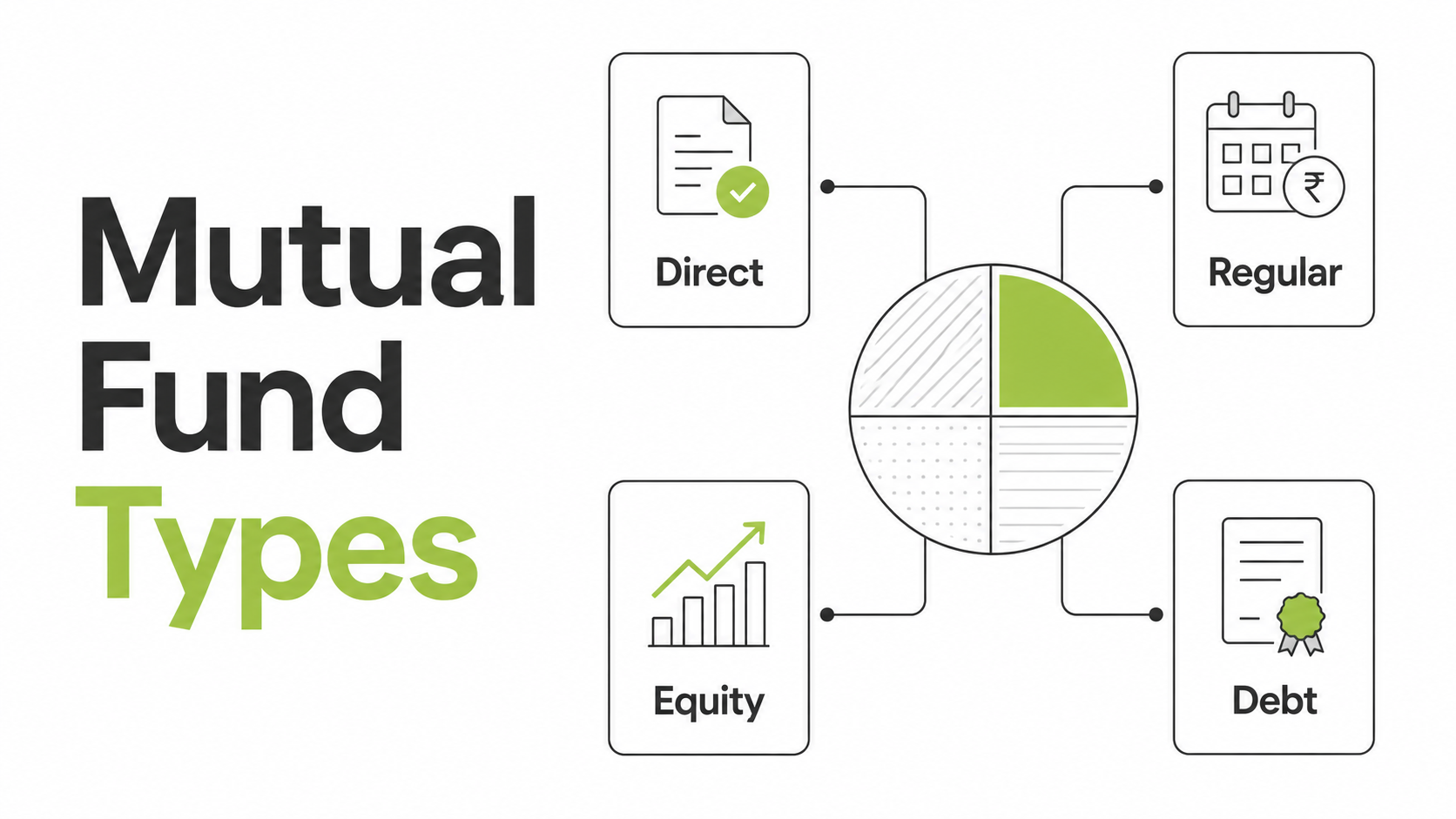
Mutual funds can be classified in several ways, and beginners often mix up two completely different classifications: direct vs regular plans, and equity vs debt funds.
Direct and regular describe how the scheme is distributed and what cost structure applies. Equity and debt describe what the fund invests in.
Understanding this distinction makes fund selection much easier.
What Is a Mutual Fund?
A mutual fund pools money from multiple investors and invests according to a stated objective.
Depending on the scheme, the fund may invest in:
- Shares
- Government securities
- Corporate bonds
- Money-market instruments
- Gold-related assets
- International securities
- Other permitted investments
Investors own units of the scheme.
What Is a Direct Mutual Fund Plan?
A direct plan is purchased without a distributor commission being charged through the regular-plan structure.
Under SEBI’s framework, the direct and regular variants of a scheme generally share the same underlying portfolio, but have different NAVs because their expenses differ. Direct plans are required to have lower expense ratios excluding distribution costs and commissions.
“Start investing with confidence! Explore the best
mutual funds
and grow your wealth.”
What Is a Regular Mutual Fund Plan?
A regular plan is typically purchased through a distributor or intermediary.
Part of the cost structure compensates the distribution channel.
As a result, a regular plan generally has a higher expense ratio than the corresponding direct plan.
Direct vs Regular Mutual Funds
| Feature | Direct Plan | Regular Plan |
|---|---|---|
| Distributor involved | No distribution commission | Usually yes |
| Expense ratio | Lower | Higher |
| Portfolio | Same underlying scheme portfolio | Same underlying scheme portfolio |
| NAV | Different | Different |
| Advice included | Not automatically | May involve distributor support |
| Best for | Self-directed investors | Investors who value intermediary support |
Why Does the Expense Ratio Matter?
Mutual fund expenses are deducted from scheme assets.
A seemingly small annual cost difference can compound over long periods.
Suppose two variants of the same strategy earn the same gross portfolio return but one costs more each year.
Over 15 or 20 years, the lower-cost option can accumulate a meaningfully larger amount.
Costs are not the only factor, but they matter.
Does Direct Always Mean Better?
Direct is generally cheaper.
That does not mean every investor should automatically choose it.
If you are likely to:
- Panic during volatility
- Buy unsuitable funds
- Constantly chase returns
- Ignore asset allocation
professional advice may create value.
The important issue is to understand exactly what service you are paying for.
What Is an Equity Mutual Fund?
Equity funds invest primarily in shares according to their category and mandate.
They are designed for investors who can accept market fluctuations in pursuit of long-term growth.
Equity funds can decline sharply during bad markets.
They should not be treated as fixed deposits.
Major Equity Fund Categories
Large-Cap Funds
These focus on relatively larger listed companies according to the applicable category definition.
They can still be volatile, but large companies may be more established than smaller businesses.
Mid-Cap Funds
Mid-cap funds invest in medium-sized listed businesses.
They can offer significant growth potential alongside greater volatility.
Small-Cap Funds
Small-cap funds invest in smaller listed companies.
These funds can experience very large rises and falls.
They are usually inappropriate for short-term goals.
Flexi-Cap Funds
Flexi-cap funds can invest across company sizes according to the fund manager’s strategy.
Sectoral and Thematic Funds
These focus on a particular industry or theme.
Examples can include:
- Technology
- Banking
- Infrastructure
- Healthcare
Concentration creates additional risk.
Index Funds
Index funds aim to track a specified index rather than rely on active stock selection.
They can be simple and cost-efficient, but investors should still understand the index being tracked.
What Is a Debt Mutual Fund?
Debt funds invest primarily in fixed-income securities.
Possible holdings include:
- Government securities
- Treasury instruments
- Corporate bonds
- Money-market securities
- Other permitted debt instruments
Debt funds are generally less volatile than equity funds, but they are not risk-free.
What Risks Do Debt Funds Carry?
Interest-Rate Risk
When market interest rates change, bond prices can move.
Funds with longer-duration securities may be more sensitive.
Credit Risk
The issuer of a bond may experience financial difficulty or default.
Liquidity Risk
A security may be difficult to sell at a fair price during stressed markets.
Reinvestment Risk
Cash flows may need to be reinvested at lower prevailing rates.
What Is a Hybrid Mutual Fund?
Hybrid funds invest across more than one asset class, commonly equity and debt.
The risk depends on the actual allocation.
A hybrid fund with high equity exposure can still be quite volatile.
Do not assume “hybrid” automatically means low risk.
What Is an ELSS Fund?
Equity Linked Savings Scheme funds are equity-oriented funds associated with Section 80C tax-saving provisions under the applicable regime.
They have a statutory lock-in period.
Their tax benefit matters primarily for eligible investors using a tax regime where Section 80C deduction is available.
The new tax regime generally does not provide the normal Section 80C deduction.
What Is an International Mutual Fund?
International funds provide exposure to assets outside India.
They can add geographic diversification but introduce additional considerations such as:
- Currency movement
- Foreign-market valuations
- Different economic cycles
- Tax treatment
- Fund structure
Growth vs IDCW
Mutual fund investors can also encounter different payout choices.
A growth option generally keeps the scheme’s value invested rather than periodically distributing amounts through an income-distribution mechanism.
IDCW distributions should not be confused with guaranteed interest.
The scheme’s NAV adjusts to reflect distributions and market value.
Equity vs Debt Mutual Funds
| Feature | Equity Funds | Debt Funds |
|---|---|---|
| Primary asset | Shares | Fixed-income securities |
| Volatility | Usually higher | Usually lower |
| Return potential | Higher long-term potential | Usually more moderate |
| Key risks | Market and business risk | Interest, credit and liquidity risk |
| Short-term suitability | Often limited | Depends on category |
| Capital guarantee | No | No |
How Do You Choose the Right Mutual Fund Type?
Start with your financial goal.
Ask:
- When do I need the money?
- How much loss can I tolerate temporarily?
- Do I need growth or stability?
- What other assets do I already own?
- Do I need advice?
- What costs am I paying?
Then select the fund category.
Do not reverse the process by finding a popular fund first and inventing a goal later.
Why Asset Allocation Matters More Than Fund Count
Owning ten mutual funds does not automatically mean you are diversified.
If all ten hold similar large-cap stocks, your portfolio may be highly repetitive.
Diversification comes from exposure to different underlying risks, not the number of app tiles on your screen.
Common Mutual Fund Mistakes
Avoid:
- Choosing only last year’s top performer
- Holding too many overlapping funds
- Assuming direct plans are different portfolios
- Treating debt funds as guaranteed
- Choosing sector funds for core goals
- Ignoring expense ratios
- Investing equity money needed in the short term
- Switching funds constantly
FAQs
What is the difference between direct and regular mutual funds?
They are variants of the same scheme with different cost structures and NAVs. Direct plans exclude distribution commissions and have lower expense ratios under the regulatory framework.
Is a direct mutual fund always better?
It is cheaper, but self-directed investors must still choose appropriate funds and manage their portfolio responsibly.
Are equity mutual funds risky?
Yes. Their value can fall substantially during market declines.
Are debt mutual funds safe?
They typically have lower volatility than equity funds but still carry interest-rate, credit, and liquidity risks.
Can I invest in both equity and debt funds?
Yes. Many investors use both as part of an asset-allocation plan.
Key Takeaways
- Direct vs regular describes distribution and cost.
- Equity vs debt describes the underlying investment.
- Direct plans generally have lower expenses.
- Equity funds offer growth potential with meaningful volatility.
- Debt funds carry different, not zero, risks.
- Hybrid funds combine asset classes.
- Select funds according to your financial goal and asset allocation.
Disclaimer
The stocks mentioned in this article are not recommendations. Please conduct your own research and due diligence before investing. Investment in securities market are subject to market risks, read all the related documents carefully before investing. Please read the Risk Disclosure documents carefully before investing in Equity Shares, Derivatives, Mutual fund, and/or other instruments traded on the Stock Exchanges. As investments are subject to market risks and price fluctuation risk, there is no assurance or guarantee that the investment objectives shall be achieved. Lemonn (Formerly known as NU Investors Technologies Pvt. Ltd) do not guarantee any assured returns on any investments. Past performance of securities/instruments is not indicative of their future performance.
Related Posts



Download Lemonn
Download my mutual fund app - your mutual funds, stock, invest in ipo, mf, trade invest hub with demat account features.



