IPO Subscription Status: How to Read It (A Complete Guide for Retail Investors)
 Written by Team Lemonn
 Reviewed by Gaurav Garg, SEBI-registered Research Analyst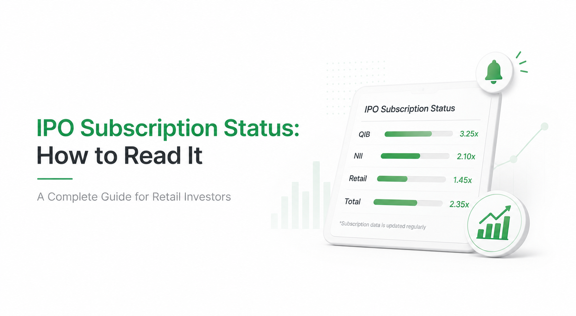
Every open IPO in India comes with a number that updates every few hours: the subscription status. It looks simple on the surface, a multiple like “3.45x” or “112x”. But that single figure hides a lot of nuance, and reading it correctly can meaningfully improve how you approach your next IPO application.
This guide breaks down what IPO subscription status actually measures, how to interpret it category by category, what the historical data says about its predictive power, and where it can mislead you if you lean on it alone.
What Is IPO Subscription Status?
IPO subscription status tells you how many times the shares on offer have been bid for, relative to the shares actually available. If a company offers 1 crore shares and receives bids for 3 crore shares, the issue is subscribed 3 times, written as “3x”.
This data comes directly from the NSE and BSE, updated multiple times a day while the issue is open, so it is one of the few genuinely reliable, real-time signals available to an IPO investor. Unlike Grey Market Premium (GMP), which is an unofficial, unregulated estimate, subscription figures are exchange-reported facts.
You will typically see subscription status broken down by investor category, not just as one overall number, because each category behaves very differently.
The Investor Categories Behind the Numbers
SEBI splits mainboard IPO demand into distinct buckets, each with its own reserved quota and allotment rules. Understanding these is the foundation of reading subscription data correctly.
| Category | Who They Are | Typical Reservation | Bidding Rule | Allotment Method |
| QIB (Qualified Institutional Buyers) | Mutual funds, insurance companies (like LIC), banks, FPIs | Up to 50% | Must quote an exact price, no cut-off bidding, cannot withdraw after close | Proportionate |
| NII / HNI (Non-Institutional Investors / High-net-worth Individual) | Individuals, HUFs, corporates, trusts applying above ₹2 lakh | Around 15% | Must quote an exact price | Proportionate |
| ↳ sNII (Small HNI) | Applications between ₹2 lakh and ₹10 lakh | 1/3rd of NII quota | Same as above | Proportionate |
| ↳ bNII (Big HNI) | Applications above ₹10 lakh | 2/3rd of NII quota | Same as above | Proportionate |
| RII (Retail Individual Investors) | Resident individuals, NRIs, HUFs applying up to ₹2 lakh | At least 35% | Can bid at cut-off price | Lottery, minimum 1 lot per winner |
A quick way to remember it: QIB money is “smart money” backed by research desks, NII money is wealthy individual conviction, and RII demand reflects broad public sentiment, often amplified by GMP chatter and social media buzz.
Why QIB Numbers Matter Most
QIBs run due diligence teams before committing crores of rupees. When this group shows strong demand, it is a meaningful vote of confidence in the company’s valuation. A useful (though informal) rule of thumb some analysts use: a QIB subscription above 10x signals strong institutional interest, while a QIB subscription under 1x is worth pausing over.
One quirk to know: QIBs typically place the bulk of their bids on the last day of bidding, often in the final hours. So a weak QIB number on Day 1 or Day 2 is completely normal and not a red flag by itself.
How to Use IPO Subscription Data While an Issue Is Open
Reading subscription status well is less about the headline number and more about how you sequence your reading across the bidding window.
- Day 1: Retail enthusiasm shows up first. Overall subscription is usually low (0.5x–2x), and QIB and NII numbers lag behind. Treat this as a sentiment snapshot, not a verdict.
- Day 2: NII and more retail applications flow in. A few QIBs may start bidding. This gives a partial, still incomplete, picture.
- Day 3 (closing day): This is when it matters most. QIBs submit the majority of their bids here, so the closing numbers, especially the final one to two hours, carry the fullest picture of real demand.
- Post-close: NSE and BSE publish final, consolidated numbers shortly after the issue closes. This is the number you should anchor your final read on.
Practically, this means: don’t overreact to Day 1 excitement, and don’t dismiss an IPO because QIB demand looks thin midweek. Wait for the Day 3 closing figures, particularly the QIB line, before forming a final view.
Where to check it live: the subscription status is published on the official NSE and BSE websites during the bidding window and mirrored (usually with a short delay) by most brokers and IPO-tracking sites, often under names such as “ipo watch.”
The Empirical Picture: Does Subscription Predict Listing Gains?
This is where it gets interesting, and where retail investors most often oversimplify.
The data does show a real, positive relationship. A 2025 academic study of 107 mainboard IPOs found that subscription level had the strongest positive correlation with listing-day returns among the variables tested (Pearson r = 0.62), ahead of GMP (r = 0.50). IPOs subscribed 50 times or more averaged listing-day gains of roughly 19%, versus a small average loss for issues under 10 times, a statistically significant gap. A separate SEBI-commissioned study of 144 mainboard IPOs (April 2021 to December 2023) also confirmed this positive association.
Industry data backs this directionally: FY2024 mainboard IPOs, which averaged 50x oversubscription, delivered average listing gains of 29%, versus just 12% in FY2023 when average oversubscription was only 15x.
But correlation is not a guarantee, and the exceptions are instructive. Paytm remains the textbook Indian counterexample: heavily subscribed, yet it got listed at a steep discount and kept falling. Several SME IPOs in 2024 saw 300x-700x+ oversubscription with strong initial pops, but long-term performance varied widely; some cooled off sharply after debut. Even among large-cap listings, oversubscription hasn’t always moved in lockstep with post-listing returns; some heavily subscribed issues have underperformed moderately subscribed ones over the following year, largely due to valuation and sector factors.
The takeaway: high subscription genuinely tilts the odds toward a stronger listing, backed by real statistical evidence, but it is a probability shift, not a promise.
What Counts as a “Good” or “Bad” Subscription?
There’s no single official threshold, but here’s a practical, commonly used framework:
| Subscription Level | General Read |
| Below 1x (any category) | Weak demand in that category; if the overall issue stays below 90%, SEBI rules require a full refund and the IPO does not proceed |
| 90%–100% overall | IPO proceeds; proportionate allotment based on actual demand |
| 1x–5x | Modest, healthy demand; typical for reasonably priced, less-hyped issues |
| 5x–15x | Strong demand; usually a positive signal, especially if QIB-led |
| 15x–50x | Very strong demand; often correlates with solid listing gains, per the data above |
| 50x+ | Exceptional demand; historically associated with the strongest average listing-day returns, though allotment odds for small investors drop sharply |
A genuinely “good” subscription reading is not just a high total; it’s one where QIB demand leads or matches retail enthusiasm. A pattern of high RII subscription with tepid or sub-1x QIB demand has historically correlated with weaker post-listing performance, since it suggests the excitement is retail-driven (often GMP or social-media fuelled) rather than backed by institutional research.
What Happens to Undersubscribed Shares?
Subscription shortfalls in one category don’t automatically sink the IPO. SEBI allows unsubscribed shares in the retail or NII portions to be reallocated to other categories to help the overall issue reach full subscription. The one exception: if QIBs don’t fill their reserved portion, those shares cannot be shifted to retail or NII investors. This is one more reason QIB demand is watched so closely; it has no fallback safety net.
Read More: What is an IPO? A Beginner’s Guide for Indian Investors
The Real Risks of Relying Only on Subscription Data
Subscription status is valuable, but leaning on it in isolation creates blind spots:
- It’s a demand signal, not a valuation signal. A stock can be oversubscribed simply because it was priced conservatively by the underwriters, not because the company is a great long-term business.
- Herd behaviour inflates the number. Retail and even some HNI demand is often driven by GMP chatter and social sentiment rather than fundamentals, especially in SME IPOs where three-digit oversubscription multiples have become common.
- Timing distorts the read. Checking subscription status on Day 1 or Day 2 and drawing conclusions before QIBs have bid can lead you badly astray.
- It says nothing about long-term performance. Strong listing-day pops driven by high subscription can and do fade within months if the underlying fundamentals don’t hold up.
- Category quality matters more than the headline multiple. A 100x overall subscription led mostly by NII leverage (many bNII investors apply for far more than they can pay for, funded by short-term loans) is a different signal than a 20x subscription led by QIBs.
- It cannot substitute for the DRHP. Subscription numbers tell you what others are doing with their money, not the company’s financials, litigation history, promoter background, or use of proceeds, all disclosed in the draft prospectus.
The healthiest approach is to treat subscription status as one input, alongside GMP, QIB-specific demand, anchor investor quality, sector context, and your own reading of the company’s fundamentals from its DRHP.
Read More: IPO GMP Explained: Grey Market Premium Meaning & Risk
Quick Summary
- IPO subscription status shows how many times shares on offer have been bid for, category-wise (QIB, NII/HNI, RII).
- QIB demand is the most credible signal because it reflects institutional due diligence; it typically arrives late, on the final bidding day.
- Historical data shows a real, statistically significant positive link between high subscription and listing-day gains, but plenty of exceptions exist (Paytm being the most cited).
- A “good” subscription ideally shows QIB demand leading, not just retail enthusiasm.
- Use subscription data alongside GMP, the DRHP, and sector context, never as the sole basis for an IPO decision.
Frequently Asked Questions (FAQs)
Q: What does “oversubscribed IPO” mean?
A: It means investor applications exceeded the number of shares on offer. A “5x oversubscribed” IPO received bids for five times the available shares.
Q: What is a good QIB subscription number?
A: There’s no official cutoff, but a QIB subscription above 10x is generally seen as strong institutional confidence, while one below 1x is a cautionary sign.
Q: Where can I check the live IPO subscription status?
A: Directly on the NSE and BSE websites during the bidding window, or via most brokers and IPO-tracking platforms, which typically mirror exchange data with a short delay.
Q: Does a high subscription guarantee listing gains?
A: No. It statistically improves the odds of a positive listing, but pricing, market conditions, and company fundamentals still determine the outcome.
Q: Why do QIB numbers stay low until the last day?
A: Institutional bidding involves internal approvals across fund houses, and QIBs often wait to see retail and NII demand before finalising their own bids.
Disclaimer
The stocks mentioned in this article are not recommendations. Please conduct your own research and due diligence before investing. Investment in securities market are subject to market risks, read all the related documents carefully before investing. Please read the Risk Disclosure documents carefully before investing in Equity Shares, Derivatives, Mutual fund, and/or other instruments traded on the Stock Exchanges. As investments are subject to market risks and price fluctuation risk, there is no assurance or guarantee that the investment objectives shall be achieved. Lemonn (Formerly known as NU Investors Technologies Pvt. Ltd) do not guarantee any assured returns on any investments. Past performance of securities/instruments is not indicative of their future performance.