
Options Scalping Terminal India: What Traders Should Look For
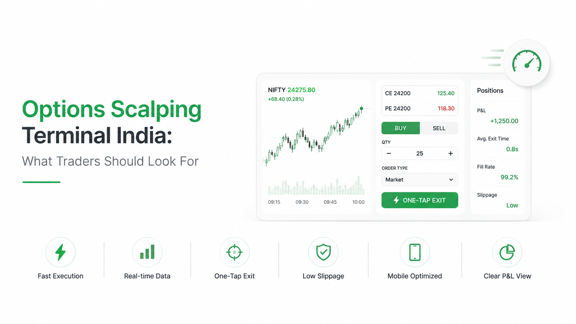
Most traders searching for the best option scalping terminal India compare brands by brokerage, ad claims, or social buzz. Real scalpers look at workflow. In fast-moving Nifty and Bank Nifty options, your terminal matters more than a glossy feature list. The right setup helps you move from chart to strike, place orders faster, react to reversals, and exit cleanly when volatility spikes.
That is why the phrase options scalping terminal India needs its own framework. A trading terminal for scalping is not just any trading app with an options tab. It is a decision-making workspace built for speed, clarity, and control.
In India, this matters even more because options scalpers often work with weekly expiries, 1-minute charts, ATM strike shifts, quick re-entries, and tight stop-losses. A slow interface can cost more than brokerage. If you are evaluating a fast options trading terminal India traders can realistically rely on, the question is simple: does the terminal reduce friction at every step of the trade?
This guide explains what to look for.
What is an options scalping terminal?
An options scalping terminal is a trading interface designed for very short-duration options trades, often held for seconds to minutes. Unlike a general investing app, a scalping terminal puts these things first:
- rapid strike discovery
- quick order placement
- low-friction exits
- clear chart visibility
- market depth and price awareness
- minimal taps between decision and execution
For Indian traders, this usually means a workflow centered on index options such as Nifty and Bank Nifty, where price changes are fast and execution discipline matters. The underlying market structure is governed by exchange and regulator frameworks such as the National Stock Exchange and SEBI, so the terminal must help traders operate well in real market conditions rather than in a demo-like environment.
A true options trading terminal for scalping is less about “having many features” and more about whether the core ones are arranged in the right order.
Why workflow matters more than price for scalpers
Brokerage is visible. Workflow cost is hidden.
If your terminal takes too long to switch strikes, confirm orders, or locate the exit button, the loss does not show up as a fee line item. It shows up as slippage, missed entries, poor stop execution, and hesitation.
That is why many active traders now compare execution feel, chart access, and speed more closely than raw pricing. The broader conversation around fast order execution brokers in India and the fastest options broker India points to the same thing: in short-duration trading, platform responsiveness affects outcomes.
For a scalper, a terminal should answer these questions instantly:
- What is the nearest tradable strike right now?
- Can I switch from one strike to another without losing context?
- Can I place, modify, and cancel quickly?
- Can I exit all or exit now when price whips?
- Can I monitor both chart and option chain together?
- Can I work efficiently from mobile, not just desktop?
If even two of these are weak, the terminal may look good on paper but feel clumsy in live markets.
“Start investing with confidence! Explore
option trading
and grow your wealth.”
The 8 features that define a strong options scalping terminal in India
1. Chart-chain proximity
Scalping decisions often start on the chart but execute on the option. Your terminal should keep chart and chain as close together as possible.
The ideal setup lets you:
- view price action and option selection in the same workspace
- shift from chart analysis to strike execution with minimal taps
- stay aware of expiry, strike, and premium while tracking underlying movement
That is why traders care more about interfaces built around split layouts and tight chart-to-order flow. If you want a deeper look at platform design for this workflow, the discussion around a split screen options trading app is especially relevant.
A terminal that forces you to bounce between multiple screens creates cognitive drag. For scalpers, that drag is expensive.
2. Fast ATM and nearby strike switching
Nifty and Bank Nifty scalpers often rotate around ATM, one-strike ITM, or one-strike OTM contracts depending on momentum, premium decay, and spread behavior. The terminal should make strike switching easy.
Look for:
- quick ATM focus
- easy scroll between nearby strikes
- live premium visibility before entry
- minimal reload lag while changing contracts
This matters because scalping is not just about one trade. It is repeated decisions in a fast sequence. A terminal that helps you handle ATM-focused setups is especially useful for traders who follow the logic explained in ATM option in scalping.
3. One-tap or low-friction exits
Entries get attention. Exits save accounts.
In volatile markets, the ability to flatten a position quickly is one of the biggest tests of a mobile options scalping terminal. If you have to open a new screen, verify details, and then confirm again before exiting, the market may already have moved.
A strong terminal should support:
- fast sell/exit placement
- easy stop-loss modification
- visible position controls
- portfolio-level emergency exits when needed
This is why tools such as Instant Exit Feature vs Auto Square Off matter to scalpers. When the market snaps back, simplicity beats complexity.
4. Stable order flow during volatility
A terminal may feel smooth during flat sessions and still struggle when volumes surge around expiry, opening range breakouts, or macro event moves. Scalpers should judge not only speed but consistency under pressure.
What to assess:
- how quickly orders move from placement to confirmation
- whether the app stays responsive during volatile candles
- whether modification and cancellation are easy in active conditions
- whether the interface freezes, reloads, or becomes visually cluttered
On expiry-focused strategies, the importance of responsiveness becomes even clearer. That is why themes from an expiry day trading app overlap heavily with scalping-terminal evaluation.
5. Clean order controls, not overloaded screens
Many terminals try to impress traders by showing everything at once. For scalpers, that can backfire.
The best layouts show what matters most:
- buy/sell controls
- quantity
- order type
- stop-loss fields
- live price
- position status
A cluttered interface increases the odds of input errors, especially on mobile. A good terminal cuts noise and keeps the decision path short.
This is also why many traders prefer structured execution environments rather than endlessly customizable complexity. You can see that approach in tools and workflows built around one-click F&O strategy execution.
6. Mobile-first practicality
In India, many active traders execute from phones for at least part of the day. A terminal that works only on a large desktop monitor is not enough. A true mobile options scalping terminal should be usable during commute hours, from office breaks, or in short trading windows.
That means:
- thumb-friendly order placement
- readable charts on smaller screens
- quick strike selection
- visible open positions without hunting through menus
- fast switching between watchlist, chain, chart, and positions
For beginners comparing platforms overall, the same mobile usability question appears in guides on the best trading apps in India for beginners. For scalpers, though, the bar is much higher. “Easy to use” is not enough. It also has to stay fast under pressure.
7. Built-in risk-awareness tools
Scalping without risk controls quickly turns into emotional trading. A strong terminal should help traders define risk before momentum takes over.
Helpful features include:
- stop-loss support
- easy quantity adjustment
- visible P&L
- quick square-off options
- reduced chances of wrong-side execution
This is especially important in derivatives, where leverage and speed amplify mistakes. SEBI regularly emphasizes investor protection, risk disclosure, and intermediary obligations through its market regulations and circular framework, which is why a risk-aware trading setup matters in practice as much as strategy does. Traders exploring the basics of what is options trading or what is margin in F&O should treat terminal design as part of risk management, not just convenience.
8. Strategy support, not just raw execution
Some scalpers trade discretionary price action. Others use structured setups, signals, or predefined intraday logic. A good terminal should support both styles.
That may include:
- signal visibility
- strategy templates
- chart-based trigger support
- pre-structured trade ideas
- quick execution from strategy view
For traders who prefer more system-led workflows, the set of tools around built-in F&O signal tools and F&O signals apps shows how terminals are moving beyond simple buy/sell screens.
How to evaluate a scalping terminal before committing
Instead of asking, “Which is the best option scalping terminal India offers?” use this checklist:
If you scalp Nifty or Bank Nifty on 1-minute charts
Choose a terminal with:
- fast chart loading
- clear strike visibility
- low-friction order placement
- reliable exit controls
- minimal screen hopping
If you scalp mostly from mobile
Choose a terminal with:
- large tap targets
- simple position management
- chart and chain proximity
- fast ATM switching
- clean visual hierarchy
If you trade expiry days
Choose a terminal with:
- high responsiveness in fast markets
- quick modifications and cancellations
- visible risk controls
- stable performance during sharp premium swings
If you are still learning scalping
Choose a terminal with:
- limited clutter
- easier navigation
- educational support
- structured workflows rather than pure speed alone
This is where broader comparisons like options scalping broker India or the best options trading app in India can help, but only after you define your workflow.
Mobile vs desktop: which terminal setup is better for scalping?
The honest answer is neither is always better. It depends on how you trade.
Desktop works better when you:
- monitor multiple charts
- analyze several strikes
- prefer a larger workspace
- trade for longer sessions
Mobile works better when you:
- need quick reactions on the go
- take selective setups
- trade around a job or other routines
- rely on simplified execution flow
For many Indian traders, the best approach is hybrid:
- analyze on desktop or web terminal
- execute and manage on mobile if needed
- keep layouts consistent across devices
If you want to understand platform behavior across environments, the Lemonn Web Terminal guide is relevant for desktop-style workflow, while mobile-first users often compare interfaces through broader app-based evaluations.
Common mistakes traders make when choosing a scalping terminal
Choosing only on brokerage
A lower fee helps, but if the terminal slows your decisions, the real cost may be higher.
Confusing features with usability
Having dozens of widgets is not the same as having a fast execution path.
Ignoring exit workflow
Many traders test entry speed but forget to simulate urgent exits.
Not testing live-market conditions
A terminal should be judged during opening volatility, expiry sessions, or fast trending periods, not only during quiet hours.
Using an investing app as a scalping terminal
An app built mainly for long-term investors may support options technically, but still lack the execution flow a scalper needs.
Where Lemonn fits into the conversation
Lemonn’s trading ecosystem is increasingly relevant to scalpers because the focus is not just on access to F&O, but on execution flow, structured tools, and active-trader usability. Traders exploring Trade F&O Fast, the mobile-first BOLT by Lemonn, or chart-linked workflows such as ScalpPro for options trading will notice a common theme: reducing the distance between analysis, action, and exit.
That is the core idea behind a strong scalping terminal India traders can actually use in live conditions.
Conclusion
The right options scalping terminal India traders should choose is not simply the one with the loudest marketing or the lowest headline brokerage. It is the one that helps them think clearly and act quickly.
A true scalping terminal should make these actions easier:
- reading the setup
- selecting the right strike
- placing the order
- managing risk
- exiting without delay
If you judge terminals through that lens, your shortlist becomes much more practical. Focus less on feature bragging and more on trading flow. In scalping, wins and losses are often decided in seconds. Your terminal should be built for those seconds.
FAQs
What is the best option scalping terminal in India?
The best terminal depends on your workflow. For most traders, the right choice is the one with fast strike switching, clear chart access, low-friction exits, and stable performance during volatile sessions.
What should a mobile options scalping terminal have?
A good mobile setup should offer quick ATM strike access, thumb-friendly order controls, visible open positions, and fast exits. It should also avoid screen clutter.
Is brokerage more important than terminal speed for options scalping?
Usually no. For scalpers, execution workflow often affects outcomes more than small fee differences. Delays, extra taps, and poor exits can cost more than brokerage.
Which terminal is better for 1-minute options scalping?
A terminal for 1-minute scalping should prioritize chart-chain proximity, responsive order execution, and fast position management. This is especially important in Nifty and Bank Nifty expiry sessions.
Can beginners use an options scalping terminal?
Yes, but beginners should start with simpler layouts, smaller position sizes, and clear stop-loss discipline. Reading resources like Options Scalping in India and How to start options trading can help build the right foundation first.
How do I know if a terminal is good for Bank Nifty scalping?
Test how quickly it lets you move between strikes, place and modify orders, and exit during fast candles. Bank Nifty scalping demands a terminal that stays usable when volatility rises.
Disclaimer
The stocks mentioned in this article are not recommendations. Please conduct your own research and due diligence before investing. Investment in securities market are subject to market risks, read all the related documents carefully before investing. Please read the Risk Disclosure documents carefully before investing in Equity Shares, Derivatives, Mutual fund, and/or other instruments traded on the Stock Exchanges. As investments are subject to market risks and price fluctuation risk, there is no assurance or guarantee that the investment objectives shall be achieved. Lemonn (Formerly known as NU Investors Technologies Pvt. Ltd) do not guarantee any assured returns on any investments. Past performance of securities/instruments is not indicative of their future performance.
Related Posts



Download Lemonn
Download my app for option trading, IPO, 0 demat account, stocks, and dive into the stock market.



