
Iron Condor Strategy in India: How to Profit in Sideways Markets
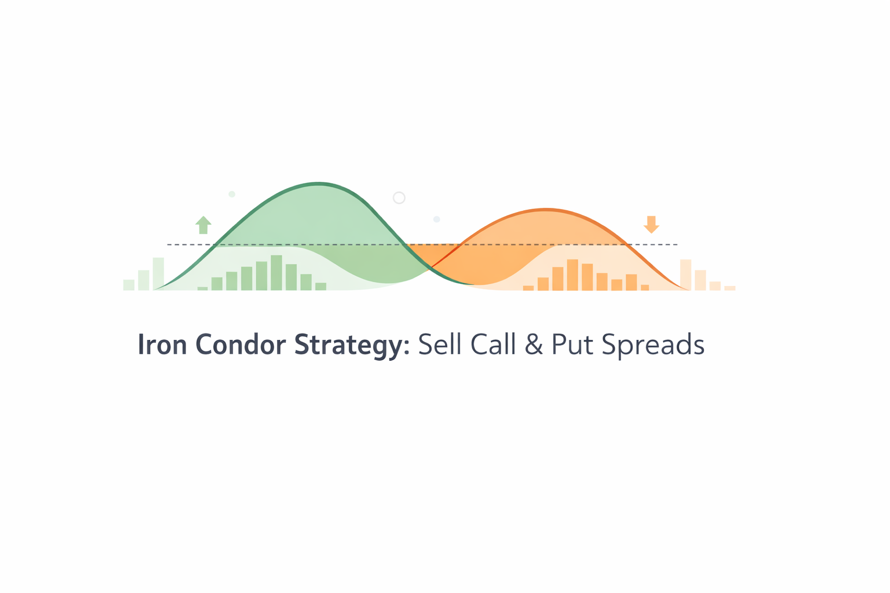
Most F&O strategies need the market to move – up or down – to profit. The iron condor is different. It is designed to profit when the market stays within a defined range. In a country with frequent sideways consolidations between major events, the iron condor is one of the most practical tools in an Indian trader’s arsenal.
This guide explains the iron condor from first principles: what it is, when to use it, how to build it on Nifty or BankNifty, how to manage it, and how to avoid the mistakes that cost traders money.
What Is an Iron Condor?
An iron condor is a four-legged options strategy that combines two credit spreads – one on the call side and one on the put side – to create a defined-risk, limited-profit position that profits from low volatility and sideways price action.
The four legs are:
- Sell an OTM Call (upper short strike)
- Buy a further OTM Call (upper long strike – the wing)
- Sell an OTM Put (lower short strike)
- Buy a further OTM Put (lower long strike – the wing)
You collect net premium upfront (this is your maximum profit). Your maximum loss is limited to the width of either spread minus the premium collected. The position profits if the underlying stays between the two short strikes at expiry.
When to Use Iron Condor
The ideal environment for an iron condor:
- Low to moderate implied volatility (India VIX below 18) – options are not overpriced relative to the actual movement expected.
- Sideways market – Nifty or BankNifty is range-bound, with no clear directional catalyst imminent.
- Post-major event – after a budget, RBI meeting, or election result, IV collapses. Entering a new iron condor in the subsequent low-IV environment makes sense.
- Enough time to expiry – typically 15 to 30 days out. Too close to expiry and Gamma risk is too high. Too far out and Theta decay is too slow.
Avoid iron condors before known binary events (budget, US Fed meetings, quarterly results) – the IV spike will work against you and the market may break your range.
“Start investing with confidence! Explore
option trading
and grow your wealth.”
Building an Iron Condor: Step by Step
Let us build a real example on Nifty 50 currently at 22,000, with 21 days to expiry.
Step 1 – Select Expiry (Weekly vs Monthly)
Weekly expiries (every Thursday for Nifty) offer faster Theta decay but higher Gamma risk. Monthly expiries give more time for the trade to work and allow more room to manage if the market approaches your strikes.
For iron condors, many experienced traders prefer the monthly expiry around 21 days out. This gives good Theta collection without the extreme Gamma risk of the final week. As the position approaches 7 days to expiry, consider closing it rather than riding it to expiry.
Step 2 – Choose the Short Strikes (Typically 1-2 SD Away)
The short strikes define your profit zone. A common approach is to sell strikes that are 1 to 2 standard deviations away from the current price. At India VIX of 16 with 21 DTE, the expected 1-standard-deviation range for Nifty is approximately:
1 SD move = Current Price x (IV/100) x sqrt(DTE/365)
= 22,000 x 0.16 x sqrt(21/365)
= 22,000 x 0.16 x 0.24 = approximately 845 points
So 1 SD range is roughly 21,155 to 22,845. Selling the 22,800 CE and 21,200 PE as short strikes gives you approximately 1 SD on each side. This provides roughly an 84% theoretical probability of the market staying within your range.
Step 3 – Buy Wings for Protection
The wings cap your maximum loss. Buy the 23,100 CE (300 points above your short call) and the 20,900 PE (300 points below your short put). This defines your maximum loss regardless of how far the market moves.
The width of the wing (300 points in this example) determines your risk. Wider wings mean higher maximum loss but also potentially higher net credit collected. Narrower wings reduce risk but also reduce profit.
Step 4 – Check Risk-to-Reward
Example premiums (illustrative):
- Sell 22,800 CE: +Rs.45 per unit
- Buy 23,100 CE: -Rs.20 per unit
- Sell 21,200 PE: +Rs.40 per unit
- Buy 20,900 PE: -Rs.18 per unit
Net Credit = Rs.45 + Rs.40 – Rs.20 – Rs.18 = Rs.47 per unit
Lot Size (Nifty): 75 units
Net Credit in Rupees: Rs.47 x 75 = Rs.3,525
Max Loss per Spread: (300 – 47) x 75 = Rs.18,975
Risk-to-Reward Ratio: Rs.3,525 max profit vs Rs.18,975 max loss (approximately 1:5.4)
This ratio appears unfavourable in isolation, but the probability of achieving maximum profit is approximately 60-70% in a normal low-volatility environment. Professional traders assess expected value, not just the ratio.
Iron Condor P&L Table
Based on the example above: Nifty at 22,000, short strikes at 21,200 PE and 22,800 CE, wings at 20,900 PE and 23,100 CE, net credit Rs.47 per unit.
| Nifty at Expiry | P&L (per unit) | Notes |
|---|---|---|
| Below 20,900 | -Rs.253 | Maximum loss: market breaks below lower wing |
| 20,900 to 21,200 | -Rs.253 to +Rs.47 | Losing zone: between lower wing and lower short strike |
| 21,200 to 22,800 | +Rs.47 | Maximum profit zone: market stays within range |
| 22,800 to 23,100 | +Rs.47 to -Rs.253 | Losing zone: between upper short strike and upper wing |
| Above 23,100 | -Rs.253 | Maximum loss: market breaks above upper wing |
Iron Condor Greeks Profile
At the time of entry, a well-structured iron condor has the following Greeks profile:
- Delta: Near zero. The position is approximately market-neutral at entry. Small moves in either direction have minimal effect on P&L initially.
- Gamma: Negative. You are short Gamma because you have sold options. Large, fast moves hurt this position.
- Theta: Positive. Time decay works in your favour every day. This is the primary profit engine.
- Vega: Negative. If implied volatility rises, your short options become more expensive, hurting the position. This is why iron condors work best in low or falling IV environments.
Managing an Iron Condor
When to exit profitably: Many traders close the position when they have collected 50% of the maximum profit. For our example (Rs.3,525 max credit), closing at Rs.1,760 profit locks in gains while eliminating remaining risk.
Stop-loss rule: A common rule is to exit if the loss reaches 2x the net credit collected. In our example, that means exiting if the position loses Rs.7,050 (2 x Rs.3,525). This prevents small losses from becoming maximum losses.
Rolling a breached strike: If Nifty approaches your upper short strike (22,800) with 10+ days remaining, you can ‘roll’ the call spread – buy back the 22,800/23,100 call spread and sell a new 23,200/23,500 call spread further away, collecting additional credit. This requires careful execution.
Delta adjustment: If the market moves significantly in one direction, your iron condor develops a Delta bias. You can add a long option on the threatened side or adjust legs to re-neutralize Delta.
Iron Condor on Nifty vs BankNifty: Key Differences
| Factor | Nifty 50 | BankNifty |
|---|---|---|
| Lot Size | 75 units | 30 units (higher capital per point move) |
| Typical Daily Range | 0.5% to 1% | 1% to 2% (more volatile) |
| Wing Width Needed | Narrower spreads viable | Wider spreads needed for same buffer |
| Liquidity | Excellent across strikes | Very good but drops sharply at extreme strikes |
| Expiry | Thursday (weekly) | Wednesday (weekly) |
BankNifty’s higher volatility means iron condors need wider short strikes (more OTM) to achieve the same probability of profit. This reduces the premium collected relative to the risk. Many traders find Nifty iron condors more mechanically reliable for this reason.
Risks and Common Mistakes
- Gap openings: A 2% overnight gap in Nifty (400+ points) can immediately breach your short strike. This is the primary risk, especially around global events (US Fed, geopolitical events).
- Ignoring India VIX: Entering an iron condor when India VIX is above 20 means you are selling options when IV may still be elevated. Any further VIX spike will hurt both short option positions simultaneously.
- Over-leveraging: Iron condors have low margin requirements relative to their maximum loss. Traders often put on too many lots, exposing themselves to catastrophic losses if the market moves sharply.
- Holding to expiry: The final week is where Gamma risk explodes. Most professionals close iron condors with 5 to 7 days remaining, not on expiry day.
- Not having a stop-loss plan before entry: Define your exit rules before placing the trade, not after the market moves against you.
FAQs
Q: How much capital do I need for an iron condor on Nifty?
Iron condors require margin for the two short options. A typical Nifty iron condor with the structure described above requires approximately Rs.70,000 to Rs.90,000 in margin. Use Lemonn’s margin calculator for exact requirements.
Q: Can I trade an iron condor on individual stocks?
Q: What is the difference between an iron condor and a short strangle?
A short strangle only involves selling the two options (no wing purchases). It has higher premium income but unlimited loss potential. An iron condor adds the protective wings, converting it to a defined-risk strategy. The wings cost premium but cap your downside.
Q: What happens if I cannot exit before expiry?
If both spreads expire OTM (market stayed within range), you keep the full premium and no further action is needed. If one spread expires ITM, the loss is limited to the wing width minus net credit – your defined maximum loss.
Disclaimer
The stocks mentioned in this article are not recommendations. Please conduct your own research and due diligence before investing. Investment in securities market are subject to market risks, read all the related documents carefully before investing. Please read the Risk Disclosure documents carefully before investing in Equity Shares, Derivatives, Mutual fund, and/or other instruments traded on the Stock Exchanges. As investments are subject to market risks and price fluctuation risk, there is no assurance or guarantee that the investment objectives shall be achieved. Lemonn (Formerly known as NU Investors Technologies Pvt. Ltd) do not guarantee any assured returns on any investments. Past performance of securities/instruments is not indicative of their future performance.
Related Posts



Download Lemonn
Download my app for option trading, IPO, 0 demat account, stocks, and dive into the stock market.



