
Tax Loss Harvesting in India: How to Legally Save Capital Gains Tax Before March 31
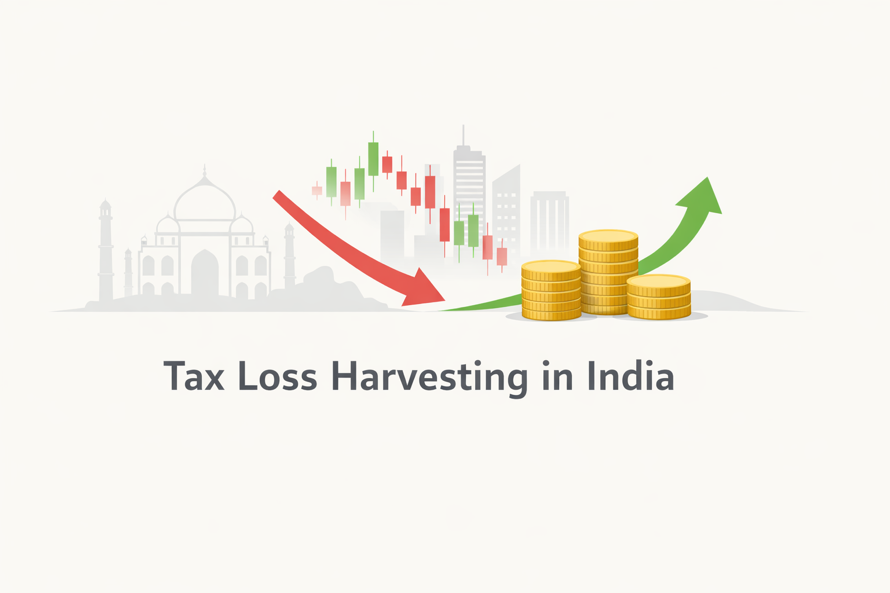
Every year before March 31, investors who know this strategy sell underperforming stocks or funds to book losses – then use those losses to offset profits and reduce their tax bill. It is called tax loss harvesting. It is completely legal in India. And it is one of the most underused tax-saving tools available to retail investors.
What Is Tax Loss Harvesting? (In Plain Terms)
A Simple Example: Stock A Profit, Stock B Loss
- You sold Stock A in January 2026 at a profit of Rs.80,000 (short-term)
- Stock B in your portfolio is currently at a Rs.30,000 loss (unrealised)
- You sell Stock B before March 31 → realise the Rs.30,000 loss → immediately rebuy
- STCG for the year: Rs.80,000 – Rs.30,000 = Rs.50,000 (reduced)
- Tax saved: 20% x Rs.30,000 = Rs.6,000
“Start investing with confidence! Explore
0 demat account
and grow your wealth.”
It’s Legal – No Wash-Sale Rule in India
India has no wash-sale rule. You can sell a stock for a loss and immediately repurchase it the same day – the loss is still valid for tax purposes.
The Rules: Which Losses Can Offset Which Gains
STCL Can Offset STCG and LTCG
Short-term capital loss (STCL) is the most flexible. It can be set off against: Short-term capital gains (STCG) and Long-term capital gains (LTCG). If you sold a stock held for 6 months at a loss, that loss can reduce both short-term and long-term gains.
LTCL Can ONLY Offset LTCG
Long-term capital loss (LTCL) – from selling a stock held for more than 12 months at a loss – can only be set off against long-term capital gains. It cannot reduce STCG. This asymmetry means short-term losses are more valuable because they are more flexible.
F&O Losses: A Separate Set of Rules
F&O losses are non-speculative business losses – not capital losses. They can be set off against capital gains (in the current year) but operate under business income rules. They are tracked separately in Schedule CYLA and CFL, not Schedule CG.
Step-by-Step: How to Do Tax Loss Harvesting on Lemonn
Step 1 – Review Your Unrealised Gains and Losses
Open Lemonn app → Portfolio section. Your holdings show current P&L. Identify positions with significant unrealised gains already booked and positions with unrealised losses that could be harvested. Note holding periods – whether each position is short-term or long-term.
Step 2 – Identify Which Losses to Harvest Before March 31
Match your losses to your gains: have STCG from earlier in the year → prioritise harvesting STCL positions; have LTCG exceeding Rs.1.25 lakh → harvest LTCL positions to offset the excess.
Step 3 – Execute the Sale and Immediately Rebuy (If You Believe in the Stock)
Sell the loss-making position through Lemonn. The settlement will happen T+1 for stocks. You can place a fresh buy order the same day or the next trading day. Your economic position is unchanged (you still own the stock), but you have crystallised a tax loss.
The LTCG Exemption Harvesting Strategy (Rs.1.25 Lakh/Year)
Why You Should Book Up to Rs.1.25L Profit Every Year Even Without Losses
Every Indian resident gets Rs.1.25 lakh in LTCG per financial year completely tax-free. If you don’t use this exemption, it does not carry forward – you lose it. Near March 31, sell enough long-term equity holdings to realise Rs.1.25 lakh in LTCG, then immediately rebuy. You pay zero tax, and your cost basis resets.
Worked Example: Tax Saved Over 5 Years With Annual Harvesting
| Without Harvesting | With Annual Rs.1.25L Harvest |
|---|---|
| Year 5: total LTCG Rs.10L | Year 5: taxable LTCG Rs.3.75L (after 5 x Rs.1.25L harvested) |
| Tax at 12.5%: Rs.1,25,000 | Tax at 12.5%: Rs.46,875 |
| Tax saved over 5 years: Rs.78,125 |
How to Combine Gain-Booking and Loss-Harvesting
Example: LTCG from Fund A = Rs.1,25,000 (tax: Rs.0, within exemption). STCG from Stock B = Rs.40,000. Harvested STCL from Stock C = -Rs.40,000. Net STCG = Rs.0. Total capital gains tax for the year = Rs.0 on combined gains of Rs.1.65 lakh.
Tax Loss Harvesting With Mutual Funds
Selling and Switching Funds Before March 31
Tax loss harvesting works with mutual funds too. If a debt fund or equity fund is sitting on losses, sell it and immediately invest in a comparable fund from a different AMC. Note: switching within the same AMC from one fund to another is also a taxable event.
ELSS Caution: 3-Year Lock-in Prevents Harvesting
ELSS units cannot be sold before the 3-year lock-in regardless of market conditions. Don’t count ELSS losses as harvestable.
Carrying Forward What You Can’t Use This Year
8-Year Carry Forward: How to Track in Your ITR
If your capital losses exceed your capital gains in a year, the excess is carried forward for up to 8 years (both STCL and LTCL: 8 years) in Schedule CFL. Each future year, use the oldest carry-forward loss first against any gains.
The One Condition That Kills Your Carry Forward (Filing Late)
Capital loss carry forward requires filing your ITR on time – by July 31. A belated return loses the carry-forward benefit for losses, just like F&O losses.
Common Mistakes to Avoid
Harvesting Too Late (After March 31)
Losses booked after March 31 belong to the next financial year. The harvest must be completed before the last trading day of March.
Not Rebuying: Missing the Recovery Rally
Some investors sell the loss-making stock, feel relieved, and forget to rebuy. Then the stock rallies. Have a buy order ready immediately after the sell settles.
Confusing Realised and Unrealised Loss in Your Broker Report
Only realised losses (from positions you actually closed before March 31) count for tax purposes. Always check Lemonn’s P&L report to confirm which positions are realised.
Skipping ITR Filing and Losing the Carry Forward
Tax loss harvesting reduces your tax for the current year and builds a carry-forward bank for future years – but only if you file ITR on time. The harvest without the filing achieves nothing for future years.
Tax Harvesting Checklist: What to Do Before March 31
- Download current portfolio with unrealised P&L from Lemonn
- Identify all short-term and long-term gains already booked this year
- Find loss positions that can be harvested to offset those gains
- Check holding period of loss positions (STCL vs LTCL)
- Execute sell orders before the last trading day of March
- Place rebuy orders immediately for positions you want to continue holding
- Book LTCG up to Rs.1.25 lakh in equity positions held > 12 months (tax-free)
- File ITR-2 or ITR-3 by July 31 to preserve carry-forward
Disclaimer
The stocks mentioned in this article are not recommendations. Please conduct your own research and due diligence before investing. Investment in securities market are subject to market risks, read all the related documents carefully before investing. Please read the Risk Disclosure documents carefully before investing in Equity Shares, Derivatives, Mutual fund, and/or other instruments traded on the Stock Exchanges. As investments are subject to market risks and price fluctuation risk, there is no assurance or guarantee that the investment objectives shall be achieved. Lemonn (Formerly known as NU Investors Technologies Pvt. Ltd) do not guarantee any assured returns on any investments. Past performance of securities/instruments is not indicative of their future performance.
Related Posts


Download Lemonn
Download my app for share market trading, ipo investment, trading account, and all your investment needs.



