
Part-Time Day Trading in India: A Realistic Guide for Working Professionals (2026)
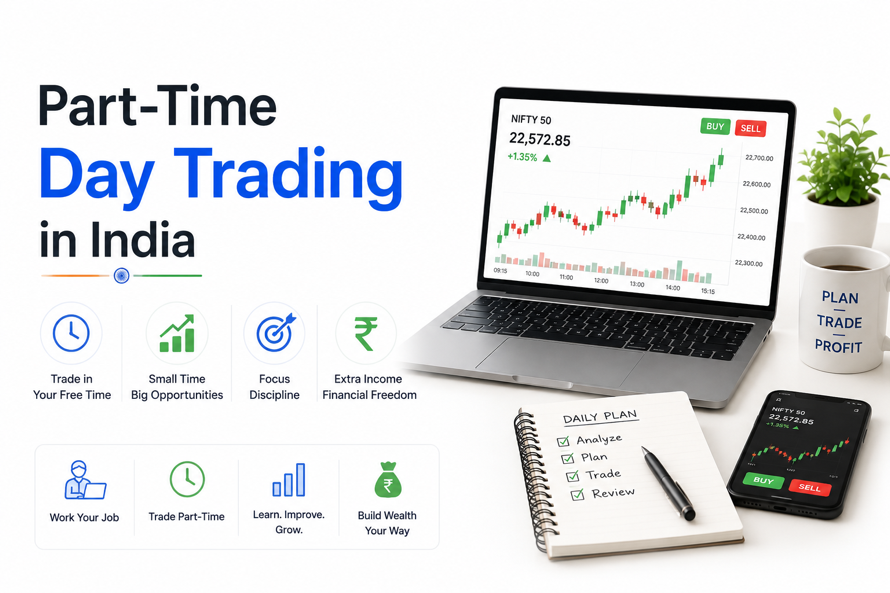
Most day-trading content assumes you can sit in front of 4 monitors from 9:15 AM to 3:30 PM. The reality for nearly every Indian retail trader is different – you have a job, a commute, meetings, and a family. The question is: can you day trade profitably with limited screen time?
The honest answer is yes, but only with the right approach. This guide lays out a realistic part-time day trading plan for Indian working professionals – including time slots that actually work, strategies that fit a busy schedule, and red flags that will save you from losing your savings.
Before you start: the brutal truth
SEBI’s 2023 study on the F&O segment found that 89% of individual traders made net losses between FY22, and the average loss was ~₹1.1 lakh per trader. Equity intraday traders fare similarly.
If you are part-time, your odds get worse, not better. You have less screen time, less practice, and more emotional pressure than full-time traders. So the first rule of part-time day trading is to:
- Trade with risk capital only – money you can fully lose
- Cap that capital at 5–10% of your total investable assets
- Treat day trading as a skill investment – not a salary replacement
If that does not match your expectation, do delivery or swing trading instead. Part-time day trading is for people who genuinely want to learn the craft, not for income hunters.
Step 1: Pick the right time slot for your schedule
The Indian stock market is open 9:15 AM – 3:30 PM IST. Most working professionals can carve out one of three realistic slots.
“Start investing with confidence! Explore
0 demat account
and grow your wealth.”
Slot A: The 30-minute opening (9:15–9:45 AM)
If your job starts at 10 AM, you might have a 30-minute window during your morning. This is the most volatile window of the day, dominated by gap-ups, gap-downs, and overnight news reactions.
- Pros: Big moves possible
- Cons: Many false breakouts, requires fast decision-making
- Best for: Experienced part-timers using opening range breakout (ORB) strategies
- Worst for: Beginners – losses pile up fast here
Slot B: The lunch-break window (12:30–1:30 PM)
The Indian market lunch lull (11:00 AM–1:00 PM) is typically slow, but the transition into the afternoon trend (12:30–1:30 PM) can offer setups. Many working professionals use this window because it aligns with their lunch break.
- Pros: Lower noise, trend continuation setups
- Cons: Limited move size, false signals during the lull
- Best for: Trend-continuation traders, breakout traders
- Strategy fit: Bank Nifty option scalping, momentum stocks at intraday support/resistance
Slot C: The closing session (2:30–3:20 PM)
If you can step away from work for 30–45 minutes in the late afternoon, this is the best part-time window. The closing hour has:
- Institutional rebalancing
- Strong trend continuations
- Clear levels to trade against
You must square off by 3:20 PM (before broker auto-square-off) – but the move quality is typically the best of the day for part-time traders.
- Pros: Trend clarity, good volume, predictable behaviors
- Cons: You have to fight Indian office hours to be free
- Best for: Most working professionals
Step 2: Match strategy to time available
You cannot do everything part-time. Pick one strategy and master it.
Strategy 1: Opening Range Breakout (ORB) – 9:15–9:45 AM
- Mark the high and low of the first 15-minute candle on Nifty 50 / Bank Nifty
- Buy on a clean break above the high with volume
- Sell on a clean break below the low
- Stop-loss: opposite end of the range
- Target: 1.5× to 2× the range
Works on Nifty, Bank Nifty, and high-volume stocks (Reliance, HDFC Bank, Tata Steel).
Strategy 2: Bank Nifty option scalping – 12:30–1:30 PM
Bank Nifty options have high liquidity. A common part-time approach:
- Enter near a key support/resistance level on Bank Nifty 5-min chart
- Use at-the-money (ATM) weekly options
- Define entry, stop, and target in advance
- Hold for 15–30 minutes max
- Use ₹500–₹1,000 stop-loss per lot
Avoid: deep out-of-the-money options on Thursdays (theta will wreck you).
Strategy 3: Closing-hour trend trades – 2:30–3:15 PM
- Identify the day’s trend on a 15-min chart by 2:30 PM
- Enter on a pullback to VWAP or 20-EMA
- Target the day’s high/low
- Exit by 3:15 PM regardless of P&L
This is the most “office-friendly” strategy because it requires only 30–45 minutes of focused screen time.
Step 3: Set up your broker and tools
A part-time trader needs reliable, fast infrastructure even more than a full-timer.
Broker requirements:
- Flat ₹20 brokerage or lower
- Bracket / cover orders (built-in stop-loss + target – critical when you cannot stare at screens)
- Mobile app + web platform sync
- TradingView or strong native charts
- Notifications and alerts that actually work
- One-tap exit for fast risk control when you cannot watch the screen
Recommended: Zerodha (Kite), Upstox Pro, Fyers, and Lemonn – all have strong mobile platforms for part-time use. Lemonn’s Instant Exit and Basket Orders are particularly useful when you are squeezing trades into a 30-minute lunch break and need to flatten positions quickly if a meeting starts.
Essential tools:
- Price alerts on TradingView for entry levels
- Bracket orders to lock in stops and targets before walking away
- Trading journal (Google Sheet or Excel) – non-negotiable
- Backup data connection – losing internet at 2:55 PM on an open MIS position is brutal
Step 4: Risk management for part-time traders
This is more important than strategy. Part-time traders need tighter risk controls because they cannot adapt in real-time.
The non-negotiable rules:
- Risk 0.5–1% per trade (not the standard 2% – you have less control)
- Maximum 2 trades per day (over-trading destroys part-time accounts faster than full-time)
- Daily max loss: 2% of capital – if hit, log off for the day
- Weekly max loss: 5% of capital – if hit, stop trading until next Monday
- No averaging down on a losing trade, ever
- Always use bracket orders or hard stop-loss – never “I will exit at the right time”
If you have ₹1,00,000 capital, max risk per trade = ₹500–₹1,000. That is a realistic position size. Beginners often size 5–10x larger and blow up in weeks.
Step 5: Manage the day-job + trade conflict
Day trading from your office desk is risky for two reasons: your employer may not allow it, and you cannot give it full focus. Some practical advice:
- Check your employment contract – many financial-sector and IT companies prohibit personal trading or require pre-clearance
- Use bracket orders before stepping into meetings so trades manage themselves
- Do not trade during high-focus work hours – review chart only during breaks
- Place orders from your phone, not your office laptop – avoid policy issues
- Set explicit “trading hours” – perhaps just 30 minutes a day, no more
If your job is in finance/banking, run any personal trading by your compliance officer.
Step 6: Build a learning routine
The traders who survive part-time spend more time studying than trading:
- 30 min/day reviewing your trades (post-market)
- 2 hours/weekend reviewing the past week’s charts
- One book per month – start with Trading in the Zone by Mark Douglas
- Maintain a journal: entry, stop, target, exit, emotion, lesson
A journal review of your last 50 trades reveals patterns no course can teach. Your real edge as a part-time trader comes from this disciplined feedback loop.
Realistic profit expectations
Honest math:
- A good part-time intraday trader makes 2–4% per month on trading capital (after taxes and brokerage)
- A great part-time trader makes 5–8% per month – but they are rare and inconsistent
- Most part-time traders lose money in their first 12–24 months
On ₹1,00,000 capital, 3% per month is ₹3,000/month – useful side income, but not a salary replacement. People who quit their jobs to “go full-time” off Telegram-tip profits usually return to a worse job within a year.
The right mindset: earn from your job, save through equity SIPs, learn day trading as a slow skill on a small capital pool.
Tax considerations for part-time day traders
Intraday equity profits and losses are treated as speculative business income in India:
- Taxed at your income slab rate
- Losses can offset only other speculative income, and can be carried forward for 4 years
- You must declare it in ITR-3 (not the simpler ITR-1 / ITR-2 used by salaried people)
- A tax audit may apply once turnover crosses prescribed thresholds – typically ₹2 crore in turnover
Maintain proper records. Use a CA familiar with trader taxation; many file specifically for retail traders.
When part-time day trading is not for you
Be honest with yourself. Skip this entirely if:
- You need every rupee of your savings for life goals
- You cannot afford to lose 10% of your trading capital in a bad month
- You cannot maintain emotional control during fast losses
- Your job already mentally exhausts you to the point you need rest, not screen time
- You are tempted to “double your money” rather than learn a craft
In any of those cases, swing trading or pure SIP investing will serve you far better. There is no shame in it.
A 90-day part-time day trading plan
- Days 1–14: Read Trading in the Zone + Zerodha Varsity Module 9 (technical analysis). Open paper-trading account.
- Days 15–30: Paper trade one strategy (ORB or closing-hour). No real money yet.
- Days 31–60: Start with ₹25,000 of risk capital. Trade 1 setup, 1–2 trades/day max. Journal everything.
- Days 61–90: Review 60+ paper + live trades. Look for: win rate, average R-multiple, common errors.
- After 90 days: Decide – scale up cautiously, or pivot to swing trading.
The traders who succeed take 12–24 months to become consistently profitable. There is no shortcut.
FAQs
Q. Can I do day trading with a full-time job?
Yes, but with constraints. Pick one short time window (closing hour is best), use bracket orders, cap trades per day at 2, and treat it as a skill investment, not a salary replacement.
Q. How much capital do I need to start part-time day trading?
₹25,000–₹50,000 is enough to start meaningfully. Anything less makes brokerage and STT a large drag on returns. Do not start with more than 10% of your investable savings.
Q. Is day trading legal while employed in India?
Yes, generally – but check your employment contract, especially if you work in finance, banking, or compliance-sensitive roles. Many employers require pre-clearance for personal trading.
Q. Which strategy works best for part-time day traders?
The closing-hour trend trade (2:30–3:15 PM) is most office-friendly. Opening range breakout works for those with morning flexibility. Both demand strict risk management.
Q. How much can a part-time day trader realistically earn?
Good part-timers make 2–4% per month on capital, after costs. Most make much less or lose money in the first year. It is not a reliable income source until you have 2+ years of consistent profitability.
Conclusion
Part-time day trading in India is possible – but only with a narrow time window, a single strategy, tight risk rules, and the patience to learn over years rather than weeks. The retail traders who succeed treat their 9-to-5 job as the main engine and their trading capital as a slowly-compounding side investment, not a quick exit ramp from employment.If you decide to try it, start with paper trading, scale up cautiously, and journal religiously. Open a zero-AMC Demat on Lemonn if you want a mobile-first platform with Basket Orders and Instant Exit built in – features designed exactly for traders who cannot watch the screen all day. And if you find that part-time intraday is too stressful, our trading style comparison can help you choose a more sustainable path like swing trading.
Disclaimer
The stocks mentioned in this article are not recommendations. Please conduct your own research and due diligence before investing. Investment in securities market are subject to market risks, read all the related documents carefully before investing. Please read the Risk Disclosure documents carefully before investing in Equity Shares, Derivatives, Mutual fund, and/or other instruments traded on the Stock Exchanges. As investments are subject to market risks and price fluctuation risk, there is no assurance or guarantee that the investment objectives shall be achieved. Lemonn (Formerly known as NU Investors Technologies Pvt. Ltd) do not guarantee any assured returns on any investments. Past performance of securities/instruments is not indicative of their future performance.
Related Posts

Download Lemonn
Download my app for share market trading, ipo investment, trading account, and all your investment needs.



