Safe Broker Checklist: How to Choose a Trusted Trading App in India
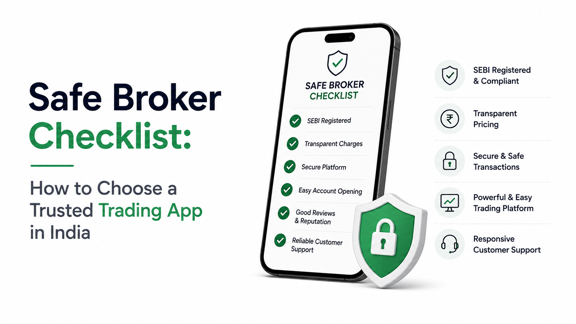
Choosing a broker used to be about brokerage rates, app design, and maybe a friend’s recommendation. Today, that is not enough.
If two trading apps look similar on the surface, the real difference often comes down to trust, safety, and operational reliability. A slick interface cannot compensate for poor grievance handling, confusing charges, weak compliance culture, or unreliable fund withdrawals. That is why a safe broker checklist matters.
This guide gives you a practical framework to evaluate any broker or trading app in India. Instead of getting influenced by ads, app ratings, influencer reviews, or “zero fee” claims, you can use the same trust-first method every time. If you are comparing apps for your first demat account, switching brokers, or looking for a more dependable platform, this checklist will help you make a better decision.
If you are still at the account-opening stage, it also helps to first understand how a demat account works and what documents you need before choosing a platform. See this beginner guide on demat accounts in India and this step-by-step guide on how to open a demat account.
Why a trust-first checklist matters
Many investors search for the “best trading app” and then compare speed, charts, or price. Those are useful, but they come later. The first question should be simpler:
Is this broker safe enough for me to trust with my money, securities, and personal data?
In India, investors have access to formal protections through regulated intermediaries, depositories, stock exchanges, and complaint mechanisms. SEBI maintains lists of recognised intermediaries and registered stock brokers, which makes regulatory verification a non-negotiable first step. SEBI’s recognised intermediaries database and registered stock broker records are useful starting points.
Similarly, depository relationships matter because your securities are held in demat form through depository participants, which act as the link between you and the depository. CDSL states that a Depository Participant is the link between the investor, the company, and the depository for demat-related services. CDSL’s services page explains this clearly.
So before asking which broker is “best,” ask whether it passes a broker trust checklist.
The Safe Broker Checklist: 6 factors that matter most
Here is a simple scoring model you can use. Give each section a score from 1 to 5.
- 5 = clear, verifiable, investor-friendly
- 3 = acceptable but incomplete
- 1 = unclear, hard to verify, or concerning
A broker that scores well across all six areas is usually a safer shortlist candidate than one that wins on just price or branding.
“Start investing with confidence! Explore
0 demat account
and grow your wealth.”
1. Regulatory status: Can you verify the broker easily?
The first and most important step in learning how to choose a safe broker in India is regulatory verification.
A credible broker should make it easy for you to confirm:
- SEBI registration
- Exchange membership
- Compliance contact details
- Investor-facing regulatory disclosures
You should not have to dig through social media comments or app store reviews to find this information. If the regulatory identity is hidden, vague, or inconsistent, treat that as a red flag.
For example, Lemonn publishes a dedicated Regulatory and Other Information page, which is exactly the kind of transparency investors should look for. If you are new to the market, this explainer on what SEBI is and its role in India can help you understand why this matters.
What to check
- Is the broker listed in SEBI’s records?
- Are exchange memberships clearly disclosed?
- Are compliance and grievance details visible on the website?
- Does the broker provide investor charter, risk disclosures, and policy documents?
Red flags
- No clear registration details
- No investor grievance information
- Only marketing language, no compliance disclosures
- A mismatch between app branding and legal entity details
2. Depository and demat reliability: Who holds your securities?
A secure demat account app should not only help you place trades. It should also inspire confidence about where your holdings sit and how your account is serviced.
In India, your demat account is maintained through a Depository Participant linked to a depository such as CDSL. CDSL also provides a “Know your Depository Participant” database to help investors verify the DP they are dealing with. CDSL’s DP database is useful for this check.
This is important because many beginners assume the mobile app itself “holds” their shares. That is not the correct way to think about it. The app is your interface, but the legal-account and depository structure behind it matters.
If you want a simpler foundation before evaluating brokers, read What is a demat account in stock market? and How to open a demat account and start investing with Lemonn.
What to check
- Is the broker’s DP relationship clearly stated?
- Can you verify the DP independently?
- Are demat statements and account records easy to access?
- Are deposit and withdrawal processes explained clearly?
Red flags
- Confusing account ownership structure
- No explanation of demat servicing
- Hard-to-find contract notes, statements, or ledger records
- Poor transparency around transfers or withdrawals
3. Grievance redressal: If something goes wrong, what happens next?
This is where many brokers reveal their real quality.
A trusted trading app in India should not only work well when markets are calm. It should also have a visible path for support and escalation when there is an issue with orders, balances, settlements, or account access.
SEBI’s investor portal highlights complaint and investor support channels, including helpline access and caution resources for investors. SEBI Investor provides these resources.
At the exchange level, investors can also file complaints through the NSE NICE Plus complaint portal or BSE’s eComplaint portal. BSE also explains how complaints against trading members are handled through its investor grievance mechanism. BSE’s grievance page outlines the process.
A reliable broker should make these paths visible before you need them.
Lemonn also provides an Investor Grievance and Escalation Matrix, which is a strong trust signal because it tells users where to go if frontline support does not solve the problem.
What to check
- Does the broker publish support and escalation contacts?
- Is there a defined complaint process?
- Are turnaround times or issue categories explained?
- Can you identify when a matter should go to the broker, exchange, or regulator?
Red flags
- No escalation matrix
- Only chatbot support for serious money-related issues
- Support that is hard to reach during market hours
- No explanation of complaint filing or dispute handling
4. Pricing clarity: Are the charges actually understandable?
Low brokerage can attract users. Hidden costs push them away later.
One of the most practical best broker safety factors is pricing clarity. Safe brokers explain charges in a way that normal users can understand before they trade. This includes brokerage, statutory charges, platform fees, margin-related costs, and any subscription-linked pricing.
If you are comparing brokers, read A Detailed Look at Lemonn Brokerage Charges and Fees and use the Brokerage Calculator to estimate real trading costs.
You should also understand basic terms such as brokerage before evaluating any platform. This FAQ on what is brokerage in trading helps.
What to check
- Is the tariff sheet easy to find?
- Are all charges disclosed clearly?
- Are leverage or margin funding rates shown transparently?
- Can you estimate actual trade costs before placing orders?
Red flags
- “Zero brokerage” marketing with unclear exceptions
- Add-on fees disclosed only after signup
- Subscription benefits that are hard to decode
- No calculator or example-based pricing breakdown
5. App permissions, security behaviour, and fraud awareness
A broker may be regulated and still do a poor job on user security hygiene.
When evaluating a trusted trading app in India, pay attention to how the app behaves:
- Does it ask for too many phone permissions?
- Does it push users toward off-platform groups or tips?
- Does it educate users about impersonation and scam risks?
- Does it support secure login and account controls?
Fraud awareness is now a major trust signal. Investors increasingly face impersonation scams on messaging platforms, fake trading communities, and misleading “guaranteed return” offers. A broker that actively warns users about such risks is showing maturity.
Lemonn has published investor education resources on impersonation and investment fraud warning signs and a separate alert on online scams impersonating trusted brands. That kind of proactive communication matters because safety is not just about the backend. It is also about user protection.
What to check
- Is login security clearly explained?
- Does the broker warn users against scams and impersonation?
- Are suspicious communication channels identified?
- Does the app request only relevant permissions?
Red flags
- Guaranteed-profit messaging
- Pressure to join Telegram or WhatsApp tip groups
- No public education around scams
- Overbroad app permissions with poor explanation
6. Product suitability: Is this broker right for the way you invest?
A safe broker is not only trustworthy. It is also suitable for your investing or trading style.
This is where many users make avoidable mistakes. They choose a broker built for high-frequency F&O trading when they only want SIPs and delivery investing. Or they choose a simple investing app and later discover it does not support the tools they need as their activity grows.
Suitability is a safety factor because the wrong product setup increases the chance of user error, confusion, and cost leakage.
If you are evaluating trading apps more broadly, these guides may help:
- How To Choose A Good Stockbroker In India: A Guide
- Best Trading Apps in India for Beginners (2026)
- Lemonn Review 2026: Charges, Features, and Who It Fits
What to check
- Does the broker fit your use case: investing, swing trading, intraday, F&O, or mutual funds?
- Are the tools simple enough for your skill level?
- Are risky products presented responsibly?
- Is educational content available to help you grow?
Red flags
- Overemphasis on risky products for beginners
- Too many advanced features without guidance
- Poor product disclosures
- Mismatch between your needs and the platform’s strengths
A simple broker trust checklist scorecard
Use this 30-point scorecard before opening an account:
| Factor | Score 1–5 |
| Regulatory verification | |
| Depository/demat transparency | |
| Complaint and escalation process | |
| Pricing clarity | |
| App security and fraud awareness | |
| Product suitability |
How to interpret the score
- 25–30: Strong shortlist candidate
- 19–24: Worth considering, but verify weak spots
- 13–18: Proceed cautiously
- Below 13: Avoid unless major concerns are resolved
This scorecard is useful because it forces you to evaluate a broker systematically instead of emotionally. That is the real value of a safe broker checklist.
Common mistakes people make when choosing a broker
Choosing based only on price
The cheapest-looking app is not always the safest or most suitable one.
Trusting ratings without verification
App store ratings can be useful, but they are not a substitute for checking regulation, grievance paths, and pricing disclosures.
Ignoring withdrawal reliability
A good broker should make fund movement and support predictable, not stressful.
Confusing popularity with safety
A popular app may still be a poor fit for your use case.
Skipping the disclosure pages
The boring pages often reveal the most useful truth about a broker.
Why trust signals matter more than marketing claims
A lot of brokers can promise fast execution, low brokerage, and user-friendly UI. Fewer can show:
- strong regulatory visibility,
- clear complaint pathways,
- honest pricing,
- investor education,
- and responsible product design.
That is the difference between a broker that merely acquires users and one that earns long-term trust.
If you want a platform overview, you can explore Lemonn’s main platform and review pages such as Invest with Lemonn. But the bigger lesson is this: whichever broker you shortlist, apply the same checklist consistently.
Conclusion
The safest way to choose a broker is not to chase the loudest brand, the lowest fee headline, or the most downloaded app. It is to use a repeatable framework.
A strong broker trust checklist should cover:
- regulatory status,
- depository and demat transparency,
- grievance escalation,
- pricing clarity,
- app security and fraud awareness,
- and product suitability.
If a broker performs well across these six areas, you are much more likely to end up with a reliable investing experience. If it fails in two or three of them, treat that as a decision signal, not a minor detail.
In a crowded market, trust is the feature that matters most.
FAQs
What is a safe broker checklist?
A safe broker checklist is a simple framework used to evaluate whether a broker is trustworthy, transparent, and suitable for your needs. It usually includes regulation, demat and depository linkage, pricing clarity, complaint handling, security hygiene, and product fit.
How do I choose a trusted trading app in India?
Start by verifying the broker’s SEBI registration, exchange membership, and grievance process. Then review its charges, demat structure, fraud awareness practices, and whether its products match your investing style. This is the safest approach to how to choose a safe broker in India.
Is SEBI registration enough to trust a broker?
No. SEBI registration is essential, but not sufficient on its own. You should also check complaint escalation, depository transparency, pricing disclosures, and operational reliability.
What are the best broker safety factors for beginners?
For beginners, the most important safety factors are regulatory clarity, easy-to-understand charges, visible support, educational content, and a clean app experience without pressure toward risky trades.
How can I check if a demat account app is secure?
Look for transparent disclosures, clear demat servicing information, scam warnings, support quality, and reasonable app permissions. A secure demat account app should protect both your money flow and your account access.
What is the biggest red flag when choosing a broker?
The biggest red flag is lack of transparency. If you cannot clearly verify regulation, charges, support channels, or grievance escalation, do not proceed quickly.
Disclaimer
The stocks mentioned in this article are not recommendations. Please conduct your own research and due diligence before investing. Investment in securities market are subject to market risks, read all the related documents carefully before investing. Please read the Risk Disclosure documents carefully before investing in Equity Shares, Derivatives, Mutual fund, and/or other instruments traded on the Stock Exchanges. As investments are subject to market risks and price fluctuation risk, there is no assurance or guarantee that the investment objectives shall be achieved. Lemonn (Formerly known as NU Investors Technologies Pvt. Ltd) do not guarantee any assured returns on any investments. Past performance of securities/instruments is not indicative of their future performance.
Related Posts


Download Lemonn
Download my app for share market trading, ipo investment, trading account, and all your investment needs.