Pre Built Algo Strategies India: How to Compare Before You Invest
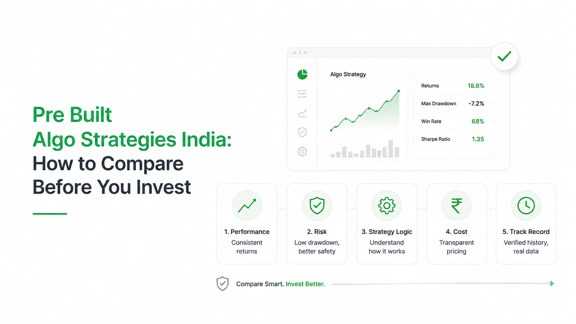
A pre-built strategy can sound like the perfect investing shortcut.
You do not need to learn coding. You do not need to sit in front of charts all day. You do not need to manually enter every order. For busy retail investors, especially salaried professionals, that promise is naturally appealing.
That is also why due diligence matters.
In India, pre built algo strategies are becoming more visible across trading and investing platforms. Many are marketed with clean dashboards, historical returns, backtest snapshots, and simple “start now” prompts. Yet a strategy that looks attractive on paper may behave very differently once real capital meets live markets, slippage, drawdowns, brokerage, and execution delays.
If you are evaluating pre built algo strategies India, the right question is not just “What returns does this strategy show?” A better one is: What should I verify before I trust it with real money?
This guide is for retail investors who want a practical, buyer-side checklist. It explains how to compare expert built algo strategies India, what to look for in historical P&L and drawdown algo investing, how to assess execution quality, and why platform dependence matters more than most investors realize.
For readers who are still getting familiar with automated investing, Lemonn has also explained broker native algo investing in India with SmartInvest and covered algorithmic investing platforms in India, both of which help frame the bigger picture.
What are pre-built algo strategies?
Pre-built algo strategies are ready-made rule-based investing or trading systems created by strategy designers, brokers, or platform teams. Instead of building your own system, you choose an existing one and let it execute according to predefined rules.
These rules can include entry conditions, exit logic, position sizing, portfolio allocation, rebalancing frequency, and risk controls. In a true no-code setup, the investor does not create the strategy logic manually. That is why terms like no code pre built strategies India and pre built algo strategies for retail investors are gaining search demand.
At a basic level, think of them as model-driven portfolios or systematic strategies that try to remove impulse decisions. The concept overlaps with what many investors call robo-advisory or rules-based investing. Some platforms go beyond simple asset allocation and offer active, signal-driven execution as well. If you want a broader foundation, robo advisory in India is a useful adjacent concept, while the Securities and Exchange Board of India remains the key regulatory body retail investors should understand.
Why retail investors are drawn to pre-built strategies
The appeal is easy to understand.
Most retail investors face one or more of these constraints:
- Limited time to monitor markets
- Difficulty following a consistent process
- Emotional decision-making during volatility
- Lack of coding or quant skills
- Weak execution discipline when acting manually
Pre-built strategies try to solve all five at once. If the strategy is well designed and executed inside the broker environment, the experience can feel far simpler than patching together third-party alerts, spreadsheets, and manual trades.
That is one reason products like SmartInvest attract attention from investors looking for automation without operational complexity. Lemonn’s coverage of automated investing apps in India and what is algo trading reflects this shift toward more accessible systematic investing.
Still, accessibility is not the same as quality. A strategy being available does not mean it is suitable for you.
“Start investing with confidence! Explore
0 demat account
and grow your wealth.”
The biggest mistake: comparing strategies only on returns
The most common investor mistake is simple: choosing a strategy because the return number looks the best.
That approach is incomplete.
A 28% historical return with a 35% drawdown may be less suitable than an 18% return with a 10% drawdown, depending on your capital, temperament, and time horizon. A strategy with impressive backtested returns may also fail in live conditions if execution assumptions are unrealistic.
According to the National Institute of Securities Markets, investor suitability and risk understanding are central to responsible participation in market-linked products. That principle matters even more in algorithmic investing, where a polished interface can hide real risk.
So when asking how to compare algo strategies India, use a fuller checklist.
1. Start with the strategy’s objective, not its marketing label
Before you look at P&L, identify exactly what the strategy is trying to do.
Is it designed for:
- Trend following?
- Mean reversion?
- Index-based allocation?
- Swing participation?
- Momentum rotation?
- Volatility harvesting?
- Intraday execution?
- Positional investing?
A vague label like “smart equity strategy” is not enough. You should understand the broad logic, even if every formula is not disclosed. If the objective is unclear, you will struggle to judge whether the results are reasonable or whether the strategy fits your own goals.
For example, a salaried investor seeking low-maintenance wealth building may prefer a process-led investing approach over a high-turnover trading system. That is very different from a trader comparing best intraday trading strategies in India or studying scalping vs swing trading in F&O India.
2. Check whether performance is backtested, live, or hybrid
This is one of the most important filters.
Many strategy pages show historical performance, but not all history is equal. Separate:
- Backtested performance: generated from historical data using rules
- Paper-traded performance: simulated forward performance without real orders
- Live performance: actual deployment with real market execution
- Hybrid track record: some backtest history plus some live history
Backtests are useful, but they are not proof. They can suffer from overfitting, unrealistic fills, survivorship bias, and selective time windows. Live track records are usually more valuable because they include slippage, latency, and operational friction.
The Reserve Bank of India may not regulate broker strategy design directly, but its broader communication on financial consumer awareness supports a core principle that fits here: investors should understand the product mechanics before committing money. In practice, that means asking whether a strategy’s published curve is mostly backtest or actual deployed experience.
3. Evaluate drawdown, not just headline return
When comparing historical pnl and drawdown algo investing, drawdown deserves as much attention as return, often more.
Drawdown tells you how deep the portfolio or strategy fell from a peak before recovering. This is the number most closely tied to investor pain, panic exits, and mismatch with expectations.
Ask these questions:
- What is the maximum drawdown shown?
- Over what period was it measured?
- Was that drawdown from backtest or live trading?
- How long did recovery take?
- Were there multiple drawdowns close to the maximum?
- How did the strategy behave during volatile periods?
A strategy with a respectable return may still be unsuitable if its drawdowns are too steep for your comfort. Lemonn’s explanation of maximum drawdown can help investors think about downside behavior more clearly.
4. Understand the execution pathway
This is where many marketplace-style strategy offerings get messy.
You need to know exactly how the strategy gets executed. Does it run:
- Natively inside the broker app?
- Through an API bridge?
- Through a separate platform login?
- Through webhooks, alerts, or connector tools?
- With manual confirmation at each trade?
- Fully automatically once enabled?
This matters because every extra dependency creates another point of failure. A strategy may look strong in theory but depend on a fragile setup in practice.
For retail investors, broker-native execution is often easier to monitor and usually simpler operationally than stitching together multiple vendors. That is one reason some investors prefer Lemonn SmartInvest to simplify algo trading for retail investors rather than using disconnected tools.
5. Ask what happens during missed trades, outages, or slippage
A real comparison framework should include failure scenarios.
Suppose your strategy is supposed to rebalance at a specific time. What happens if:
- The platform has an outage?
- The order is partially filled?
- The stock hits a circuit?
- Liquidity is weak?
- Your account has insufficient balance?
- A compliance or risk control blocks the order?
The answer tells you whether the system is solid or merely convenient in ideal conditions.
This also connects to the quality of the broker infrastructure itself. Investors who care about consistent trade handling should understand how platforms approach execution and order flow. Related reading on fast order execution brokers in India and the Lemonn Web Terminal user guide helps show why execution architecture matters.
6. Review capital requirements and position sizing logic
A strategy is not “retail friendly” just because it is automated.
You should verify:
- Minimum starting capital
- Whether capital scales linearly
- Number of positions held at once
- Typical cash utilization
- Whether idle cash remains uninvested
- Rebalance frequency
- Position concentration limits
This matters most for salaried investors comparing options between manual SIP-style investing and more systematic equity deployment. Capital structure affects risk behavior more than many new investors expect. For a basic investing foundation, how much money is needed to start stock market investing and how to start investing with small money provide useful context.
7. Inspect costs beyond the strategy narrative
Returns shown without cost context can mislead.
When comparing pre-built strategies, include:
- Brokerage
- Statutory charges
- Slippage
- Taxes
- Subscription or platform fees
- Turnover-related costs
- Exit or switching frictions
A high-turnover strategy may look attractive gross of cost but weaken meaningfully net of cost. That is why investors should look beyond “returns since launch” and estimate what they might actually keep.
On Lemonn, readers can understand brokerage charges and fees in more depth and even use the brokerage calculator to think through execution cost impact more practically.
8. Look for transparency in rebalancing and decision rules
You do not need the source code, but you do need enough transparency to judge what you are buying.
At minimum, a high-trust pre-built strategy should help you understand:
- The investment universe
- Selection logic at a broad level
- Rebalance schedule
- Risk controls
- Exit framework
- Whether discretion can override the model
- Whether the rules change over time
If rules change, ask how those changes are disclosed. A strategy that quietly evolves without clear investor communication becomes hard to evaluate honestly.
This is also where expert-built strategies should prove their worth. “Expert-built” should mean more than branding. It should suggest repeatable logic, monitoring discipline, and a documented process.
9. Separate strategy quality from platform quality
A good strategy on a weak platform can still create a poor investor experience.
Likewise, a polished app does not guarantee a sound investment process.
Try to score both separately:
Strategy quality
- Clarity of objective
- Depth of track record
- Drawdown behavior
- Risk controls
- Transparency
- Suitability for your goals
Platform quality
- Native execution
- Ease of onboarding
- Reporting quality
- Portfolio visibility
- Reliability
- Support and communication
- Regulatory disclosures
If you are evaluating a broker-led experience, it also helps to understand the platform itself through pages like Lemonn Review 2026: Charges, Features, and Who It Fits and About Us.
10. Match the strategy to your own behavior
A strategy can be “good” and still be wrong for you.
This is one of the least discussed parts of how to compare algo strategies India.
Ask yourself:
- Can I tolerate the likely drawdown?
- Will I stay invested during a flat six-month period?
- Do I need regular liquidity?
- Am I expecting too much too quickly?
- Do I understand whether this is investing or trading?
- Am I choosing automation to improve discipline, or to chase returns?
If your expectations are unrealistic, even an objectively sensible strategy may disappoint you. Process-led investing works best when the investor accepts that systematic approaches still go through losing phases.
A practical comparison checklist for pre built algo strategies India
Before funding any strategy, run through this shortlist:
- What is the strategy trying to achieve?
- Is the performance backtested, live, or mixed?
- What is the maximum drawdown and recovery time?
- How exactly are trades executed?
- Is execution native to the broker or dependent on third parties?
- What minimum capital is needed?
- How concentrated is the portfolio?
- What are the all-in costs after brokerage and charges?
- How transparent are rebalancing, risk, and rule changes?
- Does the strategy match my time horizon and risk tolerance?
If a provider cannot answer these clearly, that is already useful information.
Where SmartInvest fits in this conversation
For investors comparing no code pre built strategies India, SmartInvest is relevant because it frames automation as a broker-native experience rather than a patchwork workflow. That makes the due diligence simpler: you can focus on strategy logic, transparency, execution, and suitability inside one setup.
Readers exploring that model can review Lemonn SmartInvest Review 2026, understand algo trading in India 2026 and SEBI rules, and assess whether automated investing apps in India are solving the right problem for them.
The key is not to assume automation automatically means lower risk. Automation improves process consistency. It does not eliminate market risk, drawdown, or strategy mismatch.
Conclusion
The best way to evaluate pre built algo strategies India is to act less like a shopper and more like an allocator.
Do not stop at return charts. Ask what powers the strategy, how it executes, what it costs, where it can fail, and how much pain it has historically required investors to tolerate. A serious evaluation of pre built algo strategies for retail investors should include objective, transparent checks around drawdown, live execution, operational dependence, and decision logic.
That is how you turn marketing claims into real due diligence.
If you are comparing expert built algo strategies India, the winners are rarely the ones with the flashiest headline numbers. They are usually the ones with the clearest process, the most understandable risk profile, and the smoothest path from strategy design to actual execution.
For most retail investors, especially those seeking no code pre built strategies India, that clarity is what should earn your trust before your money does.
FAQs
What are pre built algo strategies in India?
Pre-built algo strategies are ready-made rule-based investing or trading systems that retail investors can use without designing the logic themselves. They are typically built by experts, platforms, or brokers and may include automatic selection, rebalancing, entries, exits, and risk controls.
How should I compare algo strategies in India before investing?
Start with the basics: strategy objective, live vs backtested results, maximum drawdown, execution method, costs, capital requirement, and transparency of rule changes. If you cannot clearly explain how a strategy works at a high level, you probably should not fund it yet.
Are historical P&L numbers enough to choose an algo strategy?
No. Historical P&L alone is incomplete. You should also review drawdown, recovery time, turnover, slippage assumptions, and whether the published results come from backtests or real live execution.
Are no-code pre built strategies suitable for retail investors?
They can be, especially for investors who want process-led investing without coding or daily market tracking. But suitability depends on your capital, risk tolerance, and ability to stay invested through underperformance periods.
What should I verify in expert built algo strategies India?
Check who built the strategy, how the logic is governed, whether execution is broker-native or third-party dependent, how performance is reported, and what downside behavior investors should realistically expect.
Disclaimer
The stocks mentioned in this article are not recommendations. Please conduct your own research and due diligence before investing. Investment in securities market are subject to market risks, read all the related documents carefully before investing. Please read the Risk Disclosure documents carefully before investing in Equity Shares, Derivatives, Mutual fund, and/or other instruments traded on the Stock Exchanges. As investments are subject to market risks and price fluctuation risk, there is no assurance or guarantee that the investment objectives shall be achieved. Lemonn (Formerly known as NU Investors Technologies Pvt. Ltd) do not guarantee any assured returns on any investments. Past performance of securities/instruments is not indicative of their future performance.
Related Posts



Download Lemonn
Download my app for share market trading, ipo investment, trading account, and all your investment needs.