
Gold Price Forecast India 2026-2030: Trends, Predictions & Investment Outlook
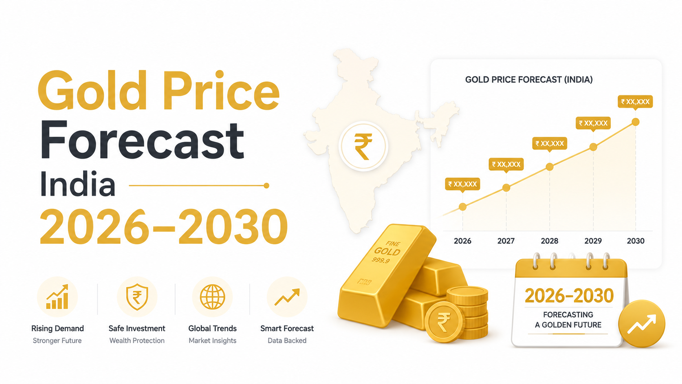
Gold has always held a special place in Indian households. From weddings and festivals to long-term wealth preservation, gold remains one of the country’s most trusted assets.
Over the last two decades, gold prices in India have experienced significant appreciation, driven by inflation, currency depreciation, geopolitical uncertainty, central bank demand, and global economic cycles.
As investors increasingly search for a reliable gold price forecast India, the key question is: where could gold prices head between 2026 and 2030?
While no forecast can guarantee future prices, analyzing historical trends, economic drivers, and market conditions can help investors understand the possible direction of gold over the coming years.
In this guide, we’ll examine historical gold performance, major price drivers, year-by-year forecasts through 2030, and whether gold deserves a place in your investment portfolio.
Gold Price History in India
Before forecasting future prices, it’s useful to understand how gold has performed historically.
Gold has generated substantial long-term returns despite periods of volatility.
Historical Gold Prices in India
| Year | Approx. Gold Price (24K per 10g) |
|---|---|
| 2005 | ₹7,000 |
| 2010 | ₹18,500 |
| 2015 | ₹26,000 |
| 2020 | ₹50,000 |
| 2023 | ₹60,000+ |
| 2025 | ₹95,000–₹1,00,000+* |
*Approximate market range depending on international gold prices and currency movements.
“Start investing with confidence! Explore
0 demat account
and grow your wealth.”
What This Tells Us
Gold has historically benefited from:
- Inflation protection
- Economic uncertainty
- Currency depreciation
- Safe-haven demand
While returns have not been linear, the long-term trend remains upward.
Why Gold Prices Rise Over Time
Gold is unlike stocks or bonds.
It does not generate earnings, dividends, or interest.
Its value is primarily driven by supply, demand, and investor sentiment.
Several macroeconomic factors influence gold prices.
1. Inflation
Inflation remains one of the strongest drivers of gold demand.
When purchasing power declines:
- Cash loses value
- Fixed-income returns may weaken
- Investors seek inflation hedges
Gold has historically served as a store of value during inflationary periods.
Example
If inflation averages 6% annually over several years, investors often increase gold allocations to preserve wealth.
2. US Federal Reserve Interest Rates
Gold and interest rates frequently move in opposite directions.
When Rates Rise
- Bonds become more attractive
- Gold demand may weaken
When Rates Fall
- Gold becomes relatively more attractive
- Safe-haven demand often increases
Federal Reserve policy remains one of the most important influences on global gold prices.
3. Indian Rupee vs US Dollar
Gold is priced internationally in US dollars.
This means Indian investors are affected by both:
- Global gold prices
- USD/INR exchange rates
Even if global gold prices remain stable, rupee depreciation can push domestic gold prices higher.
4. Central Bank Buying
Central banks around the world have increased gold reserves in recent years.
Reasons include:
- Diversification away from dollar assets
- Reserve management
- Geopolitical uncertainty
Sustained central bank demand can support long-term gold prices.
5. Geopolitical Risks
Gold often performs well during periods of uncertainty.
Examples include:
- Wars
- Trade disputes
- Banking crises
- Recession fears
Investors frequently turn to gold when risk sentiment deteriorates.
Gold Price Forecast India 2026
Expected Range: ₹1,05,000–₹1,15,000 per 10 grams
Several factors could support gold prices in 2026:
- Continued central bank accumulation
- Moderating interest rates
- Persistent inflation concerns
- Strong retail demand in India
Bull Case
If global economic growth weakens significantly and rate cuts accelerate, gold could exceed expectations.
Bear Case
Stronger-than-expected growth and higher interest rates could temporarily limit upside.
Gold Price Forecast India 2027
Expected Range: ₹1,10,000–₹1,25,000 per 10 grams
By 2027, structural demand drivers may remain intact.
Potential catalysts include:
- Continued ETF inflows
- Global debt concerns
- Currency depreciation
- Rising investment demand
Gold’s role as a portfolio diversifier is likely to remain important.
Gold Price Forecast India 2028
Expected Range: ₹1,20,000–₹1,35,000 per 10 grams
The long-term outlook may continue benefiting from:
- Emerging market demand
- Global monetary expansion
- Inflation expectations
At this stage, investment demand could become a major driver.
Gold Price Forecast India 2029
Expected Range: ₹1,30,000–₹1,45,000 per 10 grams
Assuming current macro trends continue, gold may maintain its upward trajectory.
Key variables include:
- Global interest rates
- Economic growth
- Geopolitical developments
- Central bank purchases
Gold Price Forecast India 2030
Expected Range: ₹1,40,000–₹1,60,000 per 10 grams
Under a long-term base-case scenario, gold could continue benefiting from:
- Inflation protection demand
- Reserve diversification
- Rising wealth levels
- Currency depreciation effects
While short-term volatility is inevitable, long-term trends remain supportive.
Gold Price Forecast Summary (2026–2030)
| Year | Forecast Range (24K Gold per 10g) |
|---|---|
| 2026 | ₹1,05,000–₹1,15,000 |
| 2027 | ₹1,10,000–₹1,25,000 |
| 2028 | ₹1,20,000–₹1,35,000 |
| 2029 | ₹1,30,000–₹1,45,000 |
| 2030 | ₹1,40,000–₹1,60,000 |
Important Note
These forecasts are estimates based on current economic conditions and should not be interpreted as guarantees.
Gold vs Equity vs Fixed Deposits
Investors often wonder where gold fits within a diversified portfolio.
Let’s compare.
| Factor | Gold | Equity | Fixed Deposits |
|---|---|---|---|
| Return Potential | Moderate | High | Low to Moderate |
| Volatility | Medium | High | Low |
| Inflation Protection | Strong | Moderate | Weak |
| Income Generation | No | Dividends | Interest |
| Liquidity | High | High | Moderate |
| Wealth Preservation | Strong | Moderate | Weak |
Gold’s Role
Gold is generally better suited for:
- Capital preservation
- Diversification
- Inflation hedging
- Crisis protection
Equities remain superior for long-term wealth creation.
How Much Gold Should Investors Own?
There is no universal answer.
Many financial planners recommend:
Conservative Investors
5%–10% allocation
Balanced Investors
10%–15% allocation
Aggressive Investors
5%–10% allocation as diversification
The objective is not to maximize returns but to reduce overall portfolio risk.
Best Ways to Invest in Gold in India
Today’s investors have several options.
1. Physical Gold
Examples:
- Jewellery
- Coins
- Bars
Pros
- Tangible asset
- Widely accepted
Cons
- Making charges
- Storage concerns
- Purity issues
2. Gold ETFs
Gold Exchange Traded Funds track gold prices.
Advantages
- Demat-based
- High liquidity
- No storage issues
Suitable for investors seeking convenience.
3. Gold Mutual Funds
These funds invest in gold ETFs.
Advantages include:
- SIP investments
- Professional management
- Easy accessibility
4. Sovereign Gold Bonds (SGBs)
SGBs are government-backed gold investments.
Benefits include:
- Gold price exposure
- Additional interest income
- Sovereign backing
Many long-term investors consider SGBs one of the most efficient gold investment vehicles.
5. Digital Gold
Several fintech platforms offer digital gold purchases.
Advantages include:
- Small-ticket investing
- Convenience
- Easy transactions
However, investors should evaluate platform credibility carefully.
Risks to the Gold Price Forecast
Every forecast carries uncertainty.
Several factors could affect future prices.
Higher Interest Rates
Persistently high rates may reduce gold demand.
Strong Economic Growth
When growth accelerates, investors may favor equities over defensive assets.
Reduced Central Bank Demand
A slowdown in reserve purchases could weaken support.
Currency Appreciation
A stronger Indian rupee may reduce domestic gold price gains.
Who Should Invest in Gold?
Gold may be appropriate for:
- Conservative investors
- Long-term savers
- Portfolio diversifiers
- Inflation-conscious investors
Gold may not be ideal for investors seeking:
- High income
- Rapid wealth creation
- Aggressive growth
Key Takeaways
- Gold has historically protected wealth during inflation and uncertainty.
- Central bank demand, inflation, and interest rates remain key price drivers.
- Gold prices in India could continue trending higher through 2030 under current macroeconomic assumptions.
- Equities generally offer higher growth potential, while gold provides diversification.
- Investors can access gold through ETFs, mutual funds, SGBs, digital gold, and physical purchases.
- A balanced portfolio often benefits from a modest gold allocation.
Frequently Asked Questions
Q. What is the gold price forecast in India for 2030?
Under a long-term base-case scenario, gold prices could potentially reach ₹1.4 lakh to ₹1.6 lakh per 10 grams by 2030, depending on macroeconomic conditions.
Q. Will gold prices increase in the next five years?
Many analysts expect gold to remain supported by inflation concerns, central bank demand, and global economic uncertainty.
Q. Is gold a better investment than fixed deposits?
Gold generally offers better inflation protection, while fixed deposits provide predictable interest income.
Q. Is gold better than stocks?
Gold and stocks serve different purposes. Stocks are typically better for long-term wealth creation, while gold helps diversify and protect portfolios.
Q. What is the safest way to invest in gold in India?
Gold ETFs, Sovereign Gold Bonds, and gold mutual funds are among the most popular and convenient investment options.
Conclusion
The outlook for gold price forecast India remains constructive over the 2026–2030 period, supported by inflation concerns, central bank demand, global uncertainty, and long-term currency trends. While short-term fluctuations are inevitable, gold continues to play an important role as a wealth preservation and portfolio diversification asset.
For most investors, gold should not replace equities or fixed-income investments. Instead, it should complement them. By maintaining a balanced allocation and choosing the right investment vehicle, investors can benefit from gold’s unique ability to provide stability during uncertain times while participating in long-term wealth creation.
Disclaimer
The stocks mentioned in this article are not recommendations. Please conduct your own research and due diligence before investing. Investment in securities market are subject to market risks, read all the related documents carefully before investing. Please read the Risk Disclosure documents carefully before investing in Equity Shares, Derivatives, Mutual fund, and/or other instruments traded on the Stock Exchanges. As investments are subject to market risks and price fluctuation risk, there is no assurance or guarantee that the investment objectives shall be achieved. Lemonn (Formerly known as NU Investors Technologies Pvt. Ltd) do not guarantee any assured returns on any investments. Past performance of securities/instruments is not indicative of their future performance.
Related Posts



Download Lemonn
Download my app for share market trading, ipo investment, trading account, and all your investment needs.



