
NCDEX RAINMUMBAI Contract Explained: India’s Weather Futures
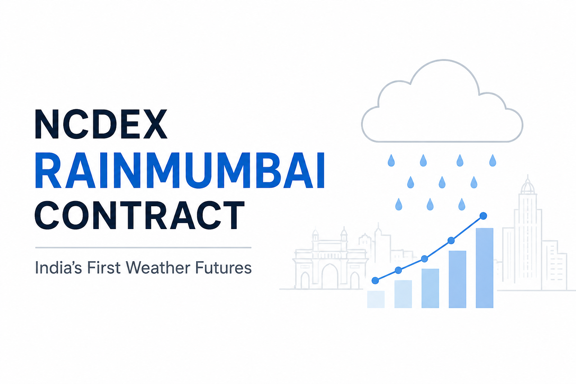
The NCDEX RAINMUMBAI contract is India’s first exchange-traded weather derivatives contract approved by SEBI. Instead of tracking a commodity like wheat or cotton, it tracks Mumbai’s cumulative monsoon rainfall. The contract helps businesses and traders manage financial risks associated with excess or deficient rainfall.
For industries that rely heavily on weather, such as agriculture, construction, power, and logistics, this innovative financial product offers a new way to hedge against unpredictable monsoons. Retail traders can also participate, provided their broker supports the contract.
In this guide, we’ll explain how the NCDEX RAINMUMBAI contract works, who should use it, its benefits, risks, and everything else you need to know.
What Is the NCDEX RAINMUMBAI Contract?
The NCDEX RAINMUMBAI contract is a weather futures contract listed on the National Commodity and Derivatives Exchange (NCDEX).
Unlike traditional commodity futures, there is no physical asset involved. Instead, the contract derives its value from Mumbai’s cumulative rainfall during the southwest monsoon season.
The underlying benchmark is the Cumulative Deviation Rainfall (CDR) Index, which measures how actual rainfall differs from Mumbai’s Long Period Average (LPA).
This allows participants to hedge against financial losses caused by unexpected weather conditions.
Why Did NCDEX Launch a Rainfall Futures Contract?
India’s economy remains highly dependent on monsoon rainfall.
Many sectors experience significant financial impacts due to variations in rainfall, including:
- Agriculture
- Food processing
- Construction
- Hydropower generation
- Insurance
- Transportation
- Hospitality
Traditional insurance products only cover certain weather-related losses. Weather derivatives provide businesses with an additional financial tool to reduce income uncertainty.
The launch also aligns India with global markets where weather derivatives have been used for decades.
“Start investing with confidence! Explore
0 demat account
and grow your wealth.”
How Does the NCDEX RAINMUMBAI Contract Work?
The contract tracks rainfall recorded by the India Meteorological Department (IMD).
Step 1: Rainfall Is Recorded
The IMD collects rainfall data from Mumbai’s designated weather stations.
Step 2: Rainfall Is Compared With the Long Period Average
The rainfall is measured against the 30-year Long Period Average (1991-2020).
The difference forms the Cumulative Deviation Rainfall (CDR) Index.
Step 3: Contract Settlement
At expiry, the final CDR value determines the cash settlement amount.
There is no physical delivery because rainfall cannot be delivered like agricultural commodities.
Key Features of the NCDEX RAINMUMBAI Contract
| Feature | Details |
|---|---|
| Exchange | NCDEX |
| Contract Symbol | RAINMUMBAI |
| Underlying | Mumbai Cumulative Rainfall |
| Data Source | India Meteorological Department (IMD) |
| Settlement | Cash Settled |
| Delivery | No Physical Delivery |
| Benchmark | Cumulative Deviation Rainfall (CDR) Index |
| Trading Purpose | Hedging and Trading |
Understanding the Cumulative Deviation Rainfall (CDR) Index
The CDR Index is the core of the contract.
It measures:
Actual Rainfall − Long Period Average Rainfall
For example:
| Scenario | Rainfall Outcome |
|---|---|
| Above Normal Rainfall | Positive Deviation |
| Below Normal Rainfall | Negative Deviation |
| Normal Rainfall | Little or No Deviation |
This index determines the contract’s final settlement value.
Who Can Use the RAINMUMBAI Contract?
The contract is suitable for organizations whose revenue depends on weather conditions.
Farmers and Agribusinesses
Crop production depends heavily on monsoon rainfall. The contract can reduce weather-related income volatility.
Construction Companies
Heavy rainfall often delays infrastructure projects. A rainfall futures position may help offset financial losses.
Power Companies
Hydroelectric power generation is closely linked to rainfall.
Insurance Companies
Weather-linked insurance providers can hedge exposure more effectively.
Logistics Businesses
Transportation disruptions during excessive rainfall can impact profitability.
Retail Traders
Investors interested in weather-linked financial products may trade the contract if their broker offers access.
Benefits of the NCDEX RAINMUMBAI Contract
Better Weather Risk Management
Businesses can hedge financial exposure instead of relying solely on insurance.
Diversification
Weather futures behave differently from stocks, commodities, and currencies.
Transparent Pricing
Settlement is based on official IMD rainfall data.
Cash Settlement
There is no storage, transportation, or delivery risk.
Regulated Trading
The contract is traded on a SEBI-regulated exchange, increasing transparency and market integrity.
Risks of Trading Weather Futures
Although weather futures offer new opportunities, they also involve risks.
Limited Liquidity
As a new product, trading volumes may initially remain low.
Complex Pricing
Rainfall derivatives differ significantly from traditional commodity futures.
Forecast Risk
Weather forecasts are uncertain and should not be treated as guarantees.
Volatility
Unexpected rainfall events can lead to sharp price movements.
Weather Futures vs Commodity Futures
| Feature | Weather Futures | Commodity Futures |
|---|---|---|
| Underlying Asset | Rainfall | Physical Commodity |
| Physical Delivery | No | Sometimes |
| Settlement | Cash | Cash or Delivery |
| Price Driver | Weather Data | Supply and Demand |
| Storage Costs | None | Possible |
Example of the NCDEX RAINMUMBAI Contract
Imagine a construction company expects unusually heavy rainfall during the monsoon.
The company purchases RAINMUMBAI futures.
If rainfall significantly exceeds normal levels, project delays may reduce business revenue. However, gains from the weather futures contract can help compensate for those operational losses.
Similarly, businesses expecting below-normal rainfall can take the opposite market position.
How Is the Contract Settled?
Settlement is entirely cash based.
At expiry:
- IMD publishes the final rainfall data.
- NCDEX calculates the final CDR Index.
- Open positions are settled in cash.
- No physical delivery occurs.
Can Retail Investors Trade the NCDEX RAINMUMBAI Contract?
Yes, provided their commodity broker supports the contract.
However, investors should first understand:
- Weather derivative pricing
- Contract specifications
- Margin requirements
- Liquidity conditions
- Risk management practices
Because the product is relatively new, broker availability may be limited.
Why Is India’s First Weather Derivatives Contract Important?
The introduction of the NCDEX RAINMUMBAI contract represents a major milestone in India’s derivatives market.
It expands the range of financial instruments available for managing climate-related risks.
As climate variability increases, weather derivatives may become valuable tools for businesses seeking more predictable financial outcomes.
If liquidity improves over time, India could eventually see additional contracts based on rainfall, temperature, or other weather indices.
Frequently Asked Questions
Q. What is the NCDEX RAINMUMBAI contract?
It is India’s first exchange-traded weather futures contract that tracks Mumbai’s cumulative monsoon rainfall using the Cumulative Deviation Rainfall (CDR) Index.
Q. Is the RAINMUMBAI contract physically delivered?
No. The contract is cash settled based on official rainfall data from the India Meteorological Department (IMD).
Q. Who should trade the NCDEX RAINMUMBAI contract?
Businesses exposed to weather risks, including agriculture, construction, logistics, insurance, and power companies, along with experienced traders.
Q. What data determines settlement?
Settlement is based on rainfall data published by the India Meteorological Department and the resulting CDR Index.
Q. Is the contract regulated?
Yes. The RAINMUMBAI contract is listed on NCDEX, which operates under the regulatory framework established by SEBI.
Q. Can retail investors trade weather futures?
Yes, if their commodity broker provides access to the contract and they meet applicable trading requirements.
Key Takeaways
- India’s first SEBI-regulated weather derivatives contract.
- Tracks Mumbai’s cumulative monsoon rainfall.
- Uses the Cumulative Deviation Rainfall (CDR) Index.
- Helps businesses hedge weather-related financial risks.
- Cash settled with no physical delivery.
- Suitable for agriculture, construction, insurance, logistics, and power sectors.
- Offers portfolio diversification but carries liquidity and weather forecasting risks.
Disclaimer
The stocks mentioned in this article are not recommendations. Please conduct your own research and due diligence before investing. Investment in securities market are subject to market risks, read all the related documents carefully before investing. Please read the Risk Disclosure documents carefully before investing in Equity Shares, Derivatives, Mutual fund, and/or other instruments traded on the Stock Exchanges. As investments are subject to market risks and price fluctuation risk, there is no assurance or guarantee that the investment objectives shall be achieved. Lemonn (Formerly known as NU Investors Technologies Pvt. Ltd) do not guarantee any assured returns on any investments. Past performance of securities/instruments is not indicative of their future performance.
Related Posts
Download Lemonn
Download my app for share market trading, ipo investment, trading account, and all your investment needs.



