MTF vs Loan Against Shares: Key Differences in India
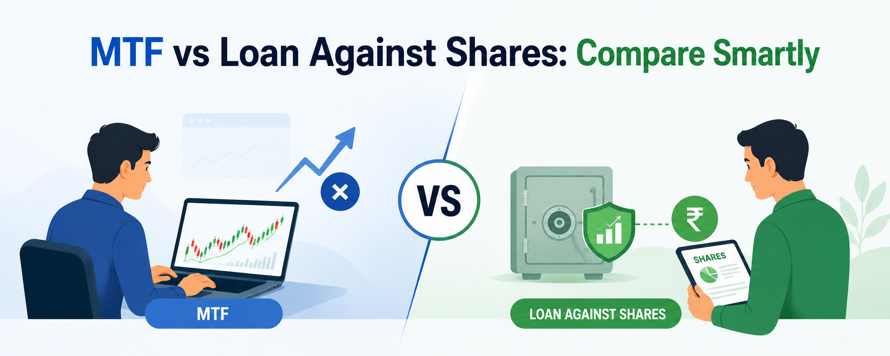
Many investors in India use the terms MTF, loan against shares, and loan against securities almost interchangeably. That is understandable: in all three cases, securities and borrowing are involved. But they are not the same product, and choosing the wrong one can lead to avoidable costs, forced liquidation, or poor cash-flow planning.
If your goal is to buy more shares using leverage, Margin Trading Facility (MTF) may fit better. If your goal is to raise cash against existing holdings for personal, business, or emergency needs, a loan against shares (LAS) or broader loan against securities (LAS/LASec) is usually the more suitable route.
This guide explains mtf vs loan against shares in plain language, with a practical decision path built around real investor needs: buying more stocks, meeting short-term liquidity needs, or borrowing without selling long-term investments.
For a base understanding of MTF first, see What Is Margin Trading Facility (MTF) in India?. If you want a broader borrowing overview, Lemonn also has All About Loan Against Securities (LAS).
What is MTF?
Margin Trading Facility (MTF) is a broker-offered facility that lets you buy approved securities by paying only part of the total trade value upfront, while the broker funds the rest. In India, MTF is regulated by SEBI and can be offered only within the prescribed framework. SEBI’s MTF rules and subsequent circulars govern margin requirements, pledge mechanics, and risk controls. (sebi.gov.in)
In simple terms:
- You bring the required margin.
- The broker funds the balance.
- The purchased shares are held subject to the MTF arrangement.
- If margins fall short, you may face a margin call and eventual square-off or liquidation.
If you are evaluating MTF from a user perspective, these guides may help:
- MTF: A Complete Guide to Margin Trading Facility
- How to Use MTF to Buy More Stocks on Lemonn
- MTF @ 10.95%
What is a Loan Against Shares?
A loan against shares is a type of loan against securities, where you pledge shares you already own to a lender—typically a bank or NBFC—and borrow money against them. The lender applies a loan-to-value (LTV) ratio, meaning you receive only a portion of your portfolio’s market value as a loan.
Unlike MTF, the purpose here is generally liquidity, not trade funding. You may use the borrowed funds for business, personal, or temporary cash needs, depending on the lender’s terms and applicable rules. RBI has issued prudential directions around lending against shares for regulated entities, especially NBFCs. (rbi.org.in)
So while both MTF and LAS involve securities and leverage, the starting point is different:
- MTF: borrow to buy securities
- LAS: borrow against securities you already own
That single difference changes ownership structure, repayment style, risk, and suitability.
“Start investing with confidence! Explore
0 demat account
and grow your wealth.”
MTF vs Loan Against Shares: The Core Difference
Here is the simplest way to understand the difference between MTF and LAS:
| Factor | MTF | Loan Against Shares |
| Primary purpose | To buy more market exposure | To unlock liquidity from existing holdings |
| Who offers it | Stock broker | Bank or NBFC, sometimes financial institutions |
| Securities involved | Usually newly purchased approved MTF securities | Existing shares/securities already owned by you |
| Use of funds | Typically restricted to securities purchase under MTF | Usually cash loan for broader needs, subject to lender rules |
| Risk trigger | Margin shortfall, mark-to-market pressure | Fall in collateral value can trigger top-up/sell-down risk |
| Repayment structure | Interest on funded amount; position maintained while margins are adequate | EMI/overdraft-style or revolving structures depending on product |
| Exit | Sell position / add funds / reduce leverage | Repay loan and release pledged shares |
| Tenure logic | Trade/investment leverage oriented | Liquidity/credit oriented |
If you are comparing MTF with other trading styles too, MTF vs Intraday Trading: Key Differences helps frame the leverage side clearly.
How ownership and pledge structure differ
This is where many investors get confused.
In MTF
Under the MTF structure, the purchase itself is funded partly by the broker. The shares are acquired for your account, but they remain tied to the broker’s margin framework and pledge process. If margin requirements are not maintained, the broker can liquidate positions as per the agreed terms and regulatory framework. SEBI’s framework and later changes, including treatment of funded securities and margin handling, shape this process. (sebi.gov.in)
In loan against shares
You already own the shares before taking the loan. You pledge them to the lender as collateral. If you repay the loan as agreed, the pledge is released. If collateral value drops materially or you breach loan conditions, the lender may ask for additional security, partial repayment, or enforce the pledge according to the agreement and applicable rules. RBI’s directions for lenders dealing in loans against shares set prudential boundaries around such lending. (rbi.org.in)
Practical meaning:
With MTF, the borrowing is embedded into the market position itself. With LAS, the borrowing is a separate credit product secured by your portfolio.
End-use restrictions: the most practical decision point
This is one of the most important differences in mtf vs loan against securities India.
If you need capital specifically to buy more approved stocks, MTF is the natural fit. That is exactly what it is designed for.
If instead you need cash for:
- tax payments,
- business working capital,
- a family emergency,
- short-term personal liquidity,
- education or medical needs,
- temporarily avoiding a distressed sale of long-term holdings,
then MTF is usually the wrong tool. In such cases, a loan against shares is often more aligned because the objective is liquidity, not portfolio expansion.
A simple rule:
- Use MTF when the end use is investment leverage
- Use LAS when the end use is non-trading liquidity
This sounds obvious, but it prevents one of the biggest investor mistakes in India: using market leverage to solve a cash-flow problem.
Cost comparison: interest is only part of the story
When people compare loan against shares vs margin trading, they often look only at the headline interest rate. That is incomplete.
MTF costs may include:
- Interest on the funded amount
- Brokerage on buy and sell transactions
- Statutory charges and taxes
- Potential impact of forced liquidation if margins are not maintained
You can estimate trading-side costs with Lemonn’s Brokerage Calculator and understand the fee structure via A Detailed Look at Lemonn Brokerage Charges and Fees.
Loan against shares costs may include:
- Interest on the sanctioned/used amount
- Processing fees
- Pledge invocation or documentation charges
- Penal interest on overdue amounts
- Renewal or maintenance charges depending on lender design
So which is cheaper depends on what you are doing.
If you borrow for 10–20 trading days to exploit a market opportunity, MTF may be operationally more direct than taking a separate secured loan.
If you need liquidity for several months for a non-market purpose, LAS may be more sensible because it is structured as a financing product rather than a trading product.
Tenure and holding period: can you stay overnight?
A common investor question is whether MTF can be carried overnight. In practice, yes, MTF is meant for carry-forward positions in approved securities, subject to broker policy, margin maintenance, and regulatory requirements. This is different from intraday leverage, which is usually same-day in nature. SEBI’s MTF regime recognizes funded positions beyond a single session, with continuing margin obligations. (sebi.gov.in)
But “can hold overnight” does not mean “can hold forever without pressure.”
In MTF:
- daily mark-to-market matters,
- collateral value matters,
- concentration matters,
- and margin calls can force action at the wrong time.
In LAS:
- the loan tenor is generally more explicit,
- repayment mode may be more predictable,
- and market volatility still matters, but often through LTV monitoring rather than day-to-day trading pressure.
In short:
- MTF tenure is market-behaviour-dependent
- LAS tenure is credit-agreement-dependent
Mark-to-market pressure vs liquidity pressure
This is the deepest risk difference.
MTF risk
MTF creates mark-to-market pressure. If the stock price falls, your equity cushion shrinks. That can trigger:
- additional margin requirements,
- partial position reduction,
- or forced liquidation if you do not top up in time.
SEBI’s framework for MTF is built precisely around this risk-control approach. (sebi.gov.in)
For a fuller risk discussion, read Risks of Margin Trading Facility (MTF) in India and Margin Shortfall: Understanding Risk Management.
LAS risk
LAS creates more of a collateral-driven liquidity risk. If the pledged shares drop significantly, the lender may:
- ask you to top up collateral,
- ask you to reduce outstanding loan,
- or sell pledged shares if the shortfall is not corrected.
So both products carry liquidation risk, but the context differs:
- In MTF, liquidation is tied closely to your leveraged market position.
- In LAS, liquidation is tied to the lender’s collateral coverage on a credit exposure.
That distinction matters emotionally too. MTF can feel more stressful in a volatile market because the funded position itself is the reason you borrowed.
Tax treatment: don’t oversimplify it
Tax is one area where investors often expect a neat one-line answer. Reality is more nuanced.
When you sell shares, capital gains taxation depends on the nature of the asset, holding period, and applicable tax rules. The Income Tax Department explains that the cost of acquisition can include expenses incurred to acquire the capital asset, while STT is not deductible for capital gains calculation. (incometaxindia.gov.in)
What does that mean in the context of MTF or LAS?
- MTF interest is not automatically “tax-saving” in a universal sense.
- LAS interest is not automatically deductible just because shares are pledged.
- Tax outcome depends on whether the borrowing is linked to acquisition, business use, trading activity, or some other purpose, and on the nature of your income classification.
Because tax treatment varies by facts and filing profile, investors should avoid making a high-leverage decision based on casual social-media tax advice. The Income Tax Department’s guidance for individuals with business or profession income also makes clear that return selection and treatment depend on the nature of income reported. (incometax.gov.in)
Practical takeaway: compare MTF and LAS primarily on purpose, risk, and cash-flow, then confirm tax treatment with a qualified tax professional for your case.
Emergency liquidity scenarios: MTF is usually not the answer
Suppose markets are weak, but you urgently need money for a hospital bill, school fees, or short-term business payments.
Many investors think: “Why not just use MTF instead of selling shares?”
Because MTF does not solve the same problem. It increases market exposure. It does not primarily create free-use cash for life expenses.
In an emergency:
- LAS may help you borrow without selling
- MTF may increase your portfolio stress
That is why emergency-liquidity planning and market leverage should not be mixed casually. If you are building a safer investing base overall, it is also worth reading What is emergency fund? and How much emergency fund should I keep?.
MTF vs LAS in a real-life decision framework
Let’s make this practical.
Choose MTF if:
- You want to buy more approved shares than your current cash allows.
- You understand margin requirements and can handle volatility.
- You have a clear investing or trading thesis.
- You can monitor positions actively.
- You are comfortable with the possibility of margin calls and square-offs.
Choose Loan Against Shares if:
- You already own a portfolio and want to unlock liquidity without selling.
- Your cash need is for non-market uses.
- You want a more conventional borrowing structure.
- You need potentially longer repayment visibility.
- You do not want to create additional leveraged equity exposure.
MTF or LAS: which is better?
The honest answer is: neither is universally better.
The better product is the one that matches your goal.
MTF is better when:
You want controlled leverage to increase market exposure and are prepared for market-linked risk.
LAS is better when:
You want cash while keeping long-term investments intact and your primary need is liquidity, not speculation or portfolio expansion.
So if you are asking mtf or las which is better, the answer is:
- For buying more shares: MTF
- For borrowing against existing shares: LAS
- For emergencies or non-market expenses: usually LAS
- For active leveraged investing: usually MTF
Final verdict
The confusion around mtf vs loan against shares happens because both involve borrowing and securities. But they solve different problems.
MTF is a market participation tool. It helps you take larger positions in approved securities, but it comes with margin pressure, mark-to-market risk, and liquidation sensitivity.
Loan against shares is a liquidity tool. It helps you raise money against an existing portfolio without selling it outright, but it comes with lender-driven collateral monitoring and repayment obligations.
If your question is, “How do I buy more shares with leverage?” think MTF.
If your question is, “How do I get cash without selling my shares?” think LAS.
And if your need is urgent household liquidity, avoid turning a cash problem into a leverage problem.
To explore MTF in more detail, start with What Is Margin Trading Facility (MTF) in India?, then go deeper with SEBI MTF Rules India 2026 and How to Use MTF to Buy More Stocks on Lemonn.
FAQs
What is the main difference between MTF and loan against shares?
MTF is used to buy securities using broker funding, while loan against shares is used to borrow cash against shares you already own. MTF is market-exposure leverage; LAS is collateral-backed liquidity.
Is MTF the same as loan against securities in India?
No. MTF is a broker-regulated funding product for securities purchase, while loan against securities is generally a lending product offered by banks or NBFCs against existing collateral.
Can I use MTF for personal expenses?
Typically, no. MTF is designed for funding eligible stock purchases, not for general personal-use borrowing.
Can I hold MTF positions overnight and for a long time?
Yes, MTF positions can usually be carried forward subject to broker policy, approved securities, and margin maintenance. But they remain exposed to mark-to-market and margin-call risk.
Which is safer: MTF or loan against shares?
For pure liquidity needs, loan against shares is usually more suitable than MTF. For leveraged market exposure, MTF is purpose-built, but it can be riskier during volatility because shortfalls may trigger forced liquidation.
MTF or LAS which is better for retail investors?
Choose MTF if you want to increase market exposure and can manage leverage responsibly. Choose LAS if you need liquidity without selling your long-term holdings.
Disclaimer
The stocks mentioned in this article are not recommendations. Please conduct your own research and due diligence before investing. Investment in securities market are subject to market risks, read all the related documents carefully before investing. Please read the Risk Disclosure documents carefully before investing in Equity Shares, Derivatives, Mutual fund, and/or other instruments traded on the Stock Exchanges. As investments are subject to market risks and price fluctuation risk, there is no assurance or guarantee that the investment objectives shall be achieved. Lemonn (Formerly known as NU Investors Technologies Pvt. Ltd) do not guarantee any assured returns on any investments. Past performance of securities/instruments is not indicative of their future performance.
Related Posts



Download Lemonn
Download my app for share market trading, ipo investment, trading account, and all your investment needs.