
Lemonn Web Terminal review for active F&O traders
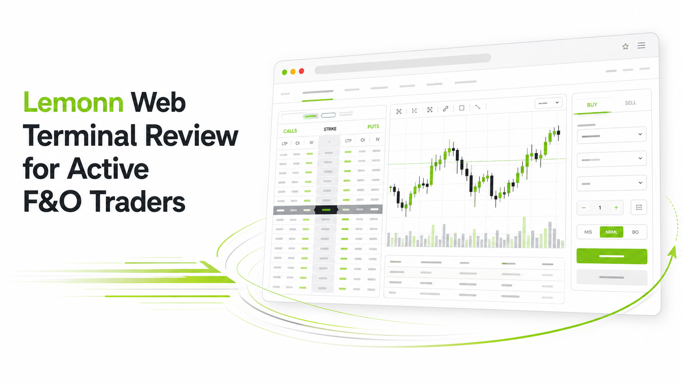
If you trade F&O actively, app-only trading starts to feel cramped after a point.
The issue is not just screen size. It is workflow size.
An active trader usually runs through the same chain again and again: spot a setup, validate it on charts, compare strikes or instruments, place the order fast, set risk controls, and stay ready to exit when the market turns. On a mobile-first platform, each step can work on its own. But in a fast session, especially around expiry or index momentum bursts, switching between windows starts to cost attention.
That is what a desktop terminal needs to fix.
This lemonn web terminal review looks at Lemonn from that workflow angle, not as a generic broker feature list, but as a practical tool for traders who want research, charting, order placement, and risk-managed exits closer together. If you are comparing the best web terminal for stock trading in India with TradingView or the best desktop trading platform for F&O traders in India, that distinction matters more than a flashy checklist.
Lemonn positions itself as a simple, fast, and secure investing and trading platform with stocks, ETFs, mutual funds, IPOs, and F&O in one place. For active traders, its desktop stack adds a TradingView-powered terminal plus execution tools such as GTD orders, Slicing, Dash, and Exit Now / Exit All on top of flat per-order pricing and structured, in-app F&O tools. You can see the broader all-in-one positioning on the Lemonn platform overview and the TradingView-powered charts page. Lemonn’s regulated broking entity, NU Investors Technologies Private Limited, is listed with SEBI and also publishes its registration details publicly in its regulatory information page. Investments in securities market are subject to market risks.
Why active F&O traders outgrow app-only trading
Mobile apps are excellent for access. They are not always ideal for execution density.
If you are a casual investor or occasional trader, a phone may be enough. Active F&O traders usually need more context visible at once: charts, multiple watchlists, strike references, pending orders, and positions that may need quick adjustments. The pressure rises further in intraday and expiry-day trading. Seconds matter less than clarity, but clarity disappears when you keep hopping between tabs.
This is why many traders start looking for a desktop setup once they get some market experience. The question changes from “Can I place an order?” to “Can I think and act from the same screen?”
That shift is common among scalpers, watchlist-driven traders, and index options participants. If that sounds familiar, these friction points probably do too:
- Repeated app switching between charts, option chains, and order windows.
- Reduced situational awareness because only one piece of information is visible at a time.
- Slower decision loops when a setup appears and the order flow is not on the same screen.
- Messier exits during fast markets, especially when multiple positions are open.
Those are the exact trader problems behind split-screen and chart-linked execution setups. Lemonn’s own view on this shows up in its Web Terminal guide and its discussion of what traders should expect from an options scalping terminal in India.
There is also a discipline angle here. The SEBI study on equity F&O outcomes found that 93% of individual traders in equity F&O incurred losses between FY22 and FY24. That does not mean desktop platforms solve risk on their own. It does mean tools that reduce confusion, support defined entries, and make exits faster can matter in real trading behaviour.
Can Lemonn Web Terminal reduce chart-to-order friction?
In simple terms, yes. That is where Lemonn Web Terminal is strongest.
The core promise of the lemonn web terminal is not that it magically improves trading outcomes. It shortens the distance between analysis and execution. Lemonn’s desktop environment is built around TradingView-powered charting, with the aim of helping users analyse and place trades from the same working surface instead of bouncing between a charting app and a broker app. That integration is central to the TradingView experience and the desktop product walkthrough.
For active F&O traders, that matters because chart-to-order friction shows up in small but costly ways:
- You spot a breakout, but lose tempo while changing screens.
- You want to compare price action before entering, but the trading window blocks your view.
- You intend to place a pending order with a specific level in mind, but your workflow gets interrupted.
- You need to exit multiple open F&O positions fast, but the app flow becomes manual and repetitive.
Lemonn addresses that friction by keeping charting, monitoring, and action close together on one screen. For the trader, the real benefit is not “more features.” It is fewer handoffs in the decision chain.
That makes the platform especially relevant for users who already know their setups and want a cleaner process around them. If you are still mainly learning market basics, a simpler mobile-only routine may be enough. But if your routine already includes structured entries, watchlist scans, or expiry-day reaction speed, a desktop terminal is easier to justify.
“Start investing with confidence! Explore
0 demat account
and grow your wealth.”
Research to execution on one screen: the TradingView workflow
This is where Lemonn starts to feel ready for serious traders.
TradingView is familiar ground for many serious retail traders in India. The appeal is obvious: richer charting, flexible layouts, indicators, and a workspace traders already trust. Lemonn builds on that by connecting TradingView-powered analysis with live trading flow inside its own ecosystem, as described on the TradingView + Lemonn page.
In practice, the desktop workflow follows a simple sequence:
- Start With The Chart
You analyse price action, structure, levels, or indicators in a TradingView-style environment.
- Track Your Instruments
You keep relevant contracts or stocks on a watchlist without losing chart visibility.
- Move To Execution Quickly
You place the trade from the same working setup instead of opening a separate broker stack.
- Stay With The Position
You continue monitoring the setup from the same screen rather than shifting back to a phone app view.
That is why Lemonn can reasonably enter the conversation around the best web terminal for stock trading in India with TradingView. Not because TradingView appears in the product copy, but because the terminal is built around the workflow active traders actually want: chart first, then order, then position management.
This setup also works for traders who combine chart-based ideas with structured F&O tools. Lemonn’s signal engine, Zing, is designed as broker-native, manual-execution signals with defined entry, target, and stop-loss parameters inside the app ecosystem, not as guaranteed tips or hands-off automation. You can understand that positioning better through the Zing overview and the comparison of F&O signals apps and Telegram tips. That broker-native flow matters because many retail traders still patch together charts on one platform, trade ideas from a social channel, and execution somewhere else. Lemonn’s desktop-plus-native-tooling approach aims to shorten that stack.
How Lemonn supports disciplined trading with defined entries and exits
For serious F&O traders, speed matters. Discipline matters more.
A desktop terminal is genuinely useful only when it helps you trade according to a plan, not just click faster. On this front, Lemonn’s ecosystem is more interesting than a plain charting terminal because it combines execution tools with structured trade-management thinking.
The clearest example is Zing. Lemonn frames it as structured F&O signals with predefined entry, target, and stop-loss levels, while keeping order confirmation manual and in the trader’s control through the Zing product page and its note on structured F&O trades. That distinction matters. These are not assured-profit tips. They are setups with defined parameters that a user may choose to execute.
That discipline-first framing fits how many active traders use a desktop terminal:
- The Idea Is Defined Before Entry
You are not reacting blindly to price noise. You are entering around a level or setup.
- The Risk Is Considered At Entry
A stop-loss or exit condition is part of the trade logic, not an afterthought.
- The Exit Is Operationally Easier
Risk management is more practical when your positions and controls stay visible.
Lemonn supports this risk-managed style further with Auto TP/SL in its F&O stack and with fast-exit tools such as Exit Now and Exit All, which it has described in the exit feature update. If your trading style depends on quick reaction after entry, the operational value of instant exit tooling is hard to ignore.
That said, discipline still sits with the trader. No terminal can replace position sizing, stop-loss adherence, or realistic expectations. SEBI’s findings on retail F&O losses remain an important reminder that better tools do not remove market risk. They simply make it easier to trade the plan you already have. Past performance is not indicative of future results.
Managing fast markets: large orders, pending orders and emergency exits
Fast markets expose weak workflows immediately.
This is where Lemonn’s power-trading features deserve a closer look, especially for traders who do more than single-click entries in calm conditions.
Slicing for large F&O orders
Larger F&O orders can create execution friction of their own. Lemonn’s Slicing feature is designed to auto-split large F&O orders for smoother execution, which the company explains in its Slicing product update. For traders handling larger lot counts, that can reduce the hassle of manual splitting.
GTD orders for planned entries
Not every trade should be chased live. Lemonn offers GTD orders, described in the GTD announcement, for limit orders that can remain valid longer than a standard intraday routine. That is useful for traders who map levels in advance and want execution discipline without rebuilding the same order every session.
Exit Now / Exit All for emergency control
During sudden moves, the main value of a terminal is often not entry at all. It is exit. Lemonn’s Exit Now and Exit All features are built for quicker closing of open F&O positions, which can be particularly relevant on event spikes or expiry volatility. The difference between “I know what to do” and “I can do it immediately” matters a lot when markets move fast.
Dash as a smart price assistant
Lemonn also offers Dash, positioned as a smart trading assistant for better entries, with more context in the Dash product update. For traders who want help around order pricing rather than pure manual trial and error, this is a practical assistive layer.
Taken together, these tools make a stronger case for Lemonn as a contender for the best desktop trading platform for F&O traders in India than charting alone would. The desktop value is not only visual. It is also operational: planned pending orders, large-order handling, and emergency exits in one environment.
Desktop use cases: scalping, expiry-day setups and watchlist-driven trading
The lemonn web terminal will not fit every trader equally. It is most useful when matched to a specific job.
Scalping
Scalpers need low-friction observation and execution. They do not always need dozens of complex tools, but they do need chart visibility and fast action without app hopping. Lemonn’s desktop model fits that use case well, especially when paired with its broader content around options scalping brokers in India and one-tap exit checks for options scalping.
Expiry-day trading
Expiry sessions punish hesitation. Traders often need compact reaction loops: chart, confirm, place, watch, exit. Lemonn’s execution-first positioning is especially relevant here, and its content on fast order execution for expiry-day trades and expiry-day trading app requirements aligns with that use case.
Watchlist-driven trading
Some traders are not pure scalpers. They track a focused list of stocks or contracts, wait for structure, and act only when those names set up. For them, a good desktop terminal is less about rapid-fire clicks and more about keeping context. The ability to keep layouts, lists, and execution accessible from one workspace becomes a real quality-of-life advantage.
Signal-assisted but manually controlled trading
This is a meaningful niche. Many traders want structured setup ideas but still want to approve every trade themselves. Lemonn’s Zing workflow supports that middle ground: broker-native, parameter-defined signals with manual execution. For traders moving away from impulsive channel-based tips, that is a stronger proposition than either social noise or fully opaque automation.
Pricing, broker checks and safety signals before you switch
Before switching any broker or terminal, active traders should check three things: pricing, regulation, and operational trust.
Pricing
Lemonn states a flat ₹20 per executed order across equity delivery, intraday, futures, and options. If cost predictability matters to your trading style, that flat structure is straightforward to understand. Traders who want the full fee breakdown can review the brokerage charges explainer or test scenarios with the brokerage calculator. Rates and charges are subject to change.
Regulation and broker verification
Lemonn’s broking entity is NU Investors Technologies Private Limited. The company publishes its registration details, including SEBI stock broking registration INZ000304837 and Research Analyst registration INH000016764, on its regulatory information page. Traders can also verify intermediaries independently through SEBI’s recognised intermediaries database.
Depository and compliance signals
Lemonn states that it is a CDSL depository participant and highlights security and compliance credentials such as ISO/IEC 27001:2022 certification and bank-grade encryption in its platform materials, including the trading app page. CDSL’s depository participant records also list NU Investors Technologies Private Limited as a participant entry, which traders can independently inspect through CDSL’s DP directory.
Risk reality
None of those trust signals change the basic fact that F&O is high risk. The SEBI press release on retail F&O loss data is worth reading before opening or moving an active account. A reliable broker and a capable terminal matter, but they do not remove leverage risk, execution risk, or strategy risk. Investments in securities market are subject to market risks.
Lemonn Web Terminal review: who should choose it and who should not
So, is Lemonn a serious option for active F&O traders?
For the right user, yes.
The lemonn web terminal is strongest for traders who already have a process and want to reduce friction between charting and execution. It is not trying to be just another desktop skin over a mobile broker. Its clearest strength is how it connects TradingView-powered charting with live execution, then adds practical F&O controls around that experience.
Choose Lemonn Web Terminal if you:
- Trade F&O actively and want chart-to-order flow in one workspace.
- Use TradingView-style charting heavily and prefer analysis plus execution on the same screen.
- Value structured trading discipline with defined entries, targets, and stop-loss logic.
- Need fast operational controls such as GTD orders, Slicing, and rapid exits.
- Prefer flat, predictable brokerage over a more fragmented fee structure.
- Want an all-in-one broker setup that also covers stocks, ETFs, mutual funds, IPOs, and margin products.
It may not be the best fit if you:
- Trade only occasionally and are perfectly comfortable with mobile-only execution.
- Do not use charts deeply and mostly invest rather than trade.
- Expect tools to replace strategy or want guaranteed outcomes, which no regulated broker should imply.
- Need highly specialised institutional-style workflows beyond the scope of a retail desktop terminal.
If your job to be done is simple, take an idea from chart to order to risk-managed exit with fewer moving parts, Lemonn makes a credible case. That is why it belongs on the shortlist for traders evaluating the best web terminal for stock trading in India with TradingView and the best desktop trading platform for F&O traders in India.
For active Indian retail traders, the strongest reason to consider it is straightforward. It respects how trading actually happens in fast markets. You need to see the setup, act without clumsy handoffs, and manage risk before emotion takes over. Lemonn’s desktop stack is built around that workflow.
FAQs
Is Lemonn Web Terminal only for advanced traders?
No. It is more useful for active traders than casual investors, but the interface is designed to stay approachable. Beginners can still use it, though they may start with simpler workflows before using advanced F&O features.
Does Lemonn Web Terminal guarantee better trading outcomes?
No. A desktop terminal can improve workflow, speed, and visibility, but it cannot guarantee profits or eliminate risk. F&O trading remains high risk, and trading results still depend on strategy, sizing, discipline, and market conditions. Investments in securities market are subject to market risks.
Is Lemonn Web Terminal good for expiry-day trading?
It can be a strong fit for expiry-day traders because the desktop setup reduces chart-to-order friction and includes fast-exit tools. That said, expiry-day trading is especially risky and should be approached with defined risk controls.
Can I use Lemonn for more than F&O?
Yes. Lemonn is an all-in-one platform that also offers stocks, ETFs, mutual funds, IPOs, and margin-based products. If you want one broker for both trading and broader investing, that is part of its appeal.
How should I verify Lemonn before opening an account?
Check the broker’s published regulatory information, confirm registration details on SEBI’s recognised intermediaries database, and review the platform’s pricing and terms before making a switch.
Disclaimer
The stocks mentioned in this article are not recommendations. Please conduct your own research and due diligence before investing. Investment in securities market are subject to market risks, read all the related documents carefully before investing. Please read the Risk Disclosure documents carefully before investing in Equity Shares, Derivatives, Mutual fund, and/or other instruments traded on the Stock Exchanges. As investments are subject to market risks and price fluctuation risk, there is no assurance or guarantee that the investment objectives shall be achieved. Lemonn (Formerly known as NU Investors Technologies Pvt. Ltd) do not guarantee any assured returns on any investments. Past performance of securities/instruments is not indicative of their future performance.
Related Posts

Download Lemonn
Download my app for share market trading, ipo investment, trading account, and all your investment needs.



