
Kisan Vikas Patra (KVP): Interest Rate & Rules 2026
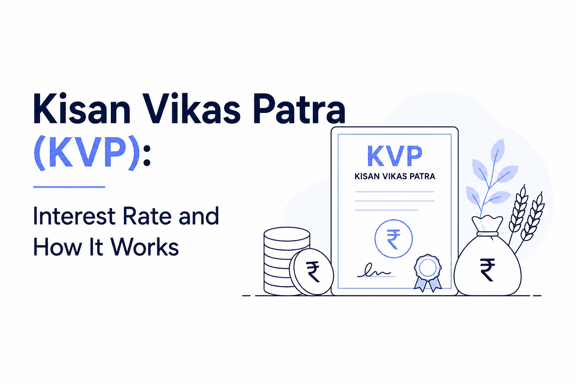
Kisan Vikas Patra, or KVP, is a savings certificate sold by India Post and select banks that simply doubles your money over a fixed period. At the current interest rate of 7.5% per annum for the April to June 2026 quarter, your investment takes roughly 115 months, or about 9 years and 7 months, to double.
That is the entire pitch of KVP: no complicated math, no market risk, just a government backed promise that your money will double if you leave it untouched for the full term. It has been around for decades and remains popular with people who want something simple and predictable.
What Exactly Is Kisan Vikas Patra?
KVP is a small savings scheme backed by the Government of India. Despite the name suggesting it is meant only for farmers (kisan), it is actually open to any resident Indian individual. You buy a certificate, hold it for the specified period, and get double the amount back at maturity.
It works a lot like a fixed deposit, except the return is expressed as a doubling period rather than a percentage, which makes it easy to understand even if you are not comfortable with compounding calculations.
Current KVP Interest Rate and Doubling Period
For the April to June 2026 quarter, KVP offers 7.5% per annum, compounded annually. At this rate, the doubling period works out to about 115 months.
A few things worth knowing about this rate:
- The government reviews and announces small savings scheme rates every quarter, so the rate you get is locked in at the time you buy the certificate.
- The doubling period itself is recalculated each quarter based on the prevailing rate. If rates go up, the doubling period gets shorter. If rates fall, it stretches out a bit.
- Once you have purchased your certificate, the rate applicable to you stays fixed for that certificate’s tenure, regardless of what happens to rates afterward.
This is one of the reasons KVP appeals to conservative investors. You know upfront exactly how long it will take for your money to double, and that number does not change once you have invested.
Who Should Consider KVP?
KVP works well for people who:
- Want a guaranteed doubling of their money without tracking compound interest formulas.
- Prefer government backed safety over market linked instruments.
- Have a medium to long term horizon of around 9 to 10 years and do not need the money sooner.
- Want an investment that can be transferred to someone else if needed.
It is not designed for tax saving. If you are looking for both safety and a tax deduction, schemes like PPF or NSC (National Savings Certificate) are more suitable, since KVP does not offer any deduction benefit.
Minimum Investment and Limits
You can start investing in KVP with as little as Rs 1,000. There is no upper limit, so you can invest as much as you want, in multiples of Rs 1,000, whether that is a few thousand rupees or several lakhs.
This makes it flexible for both small savers and people wanting to park a larger lump sum safely. You can also hold multiple certificates if you want to stagger your investments over time.
Tax Treatment: No Section 80C Benefit
This is where KVP differs sharply from PPF, SSY or tax saving fixed deposits. KVP does not qualify for any deduction under Section 80C of the Income Tax Act. Whatever you invest does not reduce your taxable income.
The interest earned on KVP is also fully taxable. It gets added to your total income and taxed as per your applicable income tax slab. That said, no TDS (tax deducted at source) is cut on this interest, so the responsibility of declaring it and paying tax falls entirely on you when you file your return.
In short, KVP gives you safety and a guaranteed doubling of capital, but it is not a tax saving instrument.
When Can You Encash a KVP Certificate?
You can encash your KVP certificate after 2.5 years from the date of purchase. This is the earliest exit window built into the scheme.
If you encash before maturity but after this 2.5 year lock-in, you will get a lower, pre-determined return rather than the full doubling amount, since you are exiting early. The exact reduced value depends on the rules in effect when you invested.
If you hold on until the full maturity period of around 115 months (based on the current rate), you receive the complete doubled amount as promised.
Can You Transfer a KVP Certificate?
Yes, and this is a feature many people overlook. KVP certificates are transferable in two ways:
- From one person to another: You can transfer the certificate to a different individual, subject to the rules and procedures set by India Post or the issuing bank.
- From one post office to another: If you move cities or simply prefer a different branch, you can get the certificate transferred without breaking your investment or losing your accumulated tenure.
This flexibility is useful for people who relocate often or who want to gift or pass on the investment to a family member.
How to Buy a Kisan Vikas Patra
You can purchase KVP certificates at any post office or at select public and private sector banks authorised to sell them. The process typically involves:
- Filling out the KVP application form (Form A).
- Submitting KYC documents such as PAN and address proof.
- Making the payment through cash, cheque, or demand draft, depending on the amount and the issuing office’s rules.
- Nominating a beneficiary, which is a good practice for any long-term savings instrument.
Certificates can be held in single or joint names, and there is also a provision for minors, where a guardian holds the certificate on the child’s behalf.
KVP vs Other Small Savings Schemes: A Quick Comparison
| Feature | KVP | PPF | NSC |
|---|---|---|---|
| Section 80C benefit | No | Yes | Yes |
| Interest taxable | Yes | No | Yes (but reinvested amount qualifies for 80C in some years) |
| Lock-in | 2.5 years | 15 years | 5 years |
| Return structure | Doubles in ~115 months | Compounding, tax free | Fixed rate, compounding |
This table shows why KVP suits people who specifically want simplicity and guaranteed doubling, rather than those chasing tax efficiency.
Final Thoughts
Kisan Vikas Patra remains one of the easiest small savings instruments to understand: put money in, wait roughly 9 years and 7 months at the current 7.5% rate, and take out double. It will not save you tax and the interest is fully taxable, but the safety, simplicity, and transferability make it a reasonable choice for conservative savers who already have their tax saving investments sorted elsewhere and want a separate, low-effort avenue to grow a lump sum securely.
Key takeaways
- KVP currently offers 7.5% per annum interest (April to June 2026 quarter), doubling your investment in about 115 months (9 years 7 months).
- The doubling period is recalculated every quarter based on the prevailing rate, though your locked-in rate stays fixed once you invest.
- Minimum investment is Rs 1,000, with no maximum limit, in multiples of Rs 1,000.
- There is no Section 80C tax deduction, and interest earned is fully taxable, though no TDS is deducted.
- You can encash the certificate after 2.5 years, though early encashment before maturity gives a reduced return.
- Certificates are transferable between individuals and between post offices, adding useful flexibility.
- Available through India Post and select banks, with single, joint, and minor-guardian holding options.
FAQs
1. How long does it take for money to double in KVP?
At the current interest rate of 7.5% per annum for the April to June 2026 quarter, it takes about 115 months, roughly 9 years and 7 months, for your investment to double. This period is recalculated each quarter based on the prevailing rate, so it can shift slightly for new investments in future quarters.
2. Is Kisan Vikas Patra only for farmers?
No, despite the name, KVP is open to any resident Indian individual, not just farmers. It can also be held on behalf of a minor by a guardian, or jointly by two adults.
3. Does KVP offer any tax benefit under Section 80C?
No, KVP does not qualify for a deduction under Section 80C. The interest earned is also fully taxable as per your income tax slab, though the payer does not deduct TDS on it.
4. Can I withdraw my KVP investment before maturity?
Yes, you can encash your certificate after 2.5 years from the date of purchase. However, exiting before full maturity means you get a reduced, pre-set return instead of the complete doubled amount.
5. Can a KVP certificate be transferred to someone else?
Yes, KVP certificates can be transferred from one person to another, and also from one post office to another, following the standard transfer procedure at the issuing office.
6. What is the minimum amount needed to invest in KVP?
You can start with as little as Rs 1,000, and there is no upper limit on how much you can invest, as long as it is in multiples of Rs 1,000.
Disclaimer
The stocks mentioned in this article are not recommendations. Please conduct your own research and due diligence before investing. Investment in securities market are subject to market risks, read all the related documents carefully before investing. Please read the Risk Disclosure documents carefully before investing in Equity Shares, Derivatives, Mutual fund, and/or other instruments traded on the Stock Exchanges. As investments are subject to market risks and price fluctuation risk, there is no assurance or guarantee that the investment objectives shall be achieved. Lemonn (Formerly known as NU Investors Technologies Pvt. Ltd) do not guarantee any assured returns on any investments. Past performance of securities/instruments is not indicative of their future performance.
Related Posts

Download Lemonn
Download my app for share market trading, ipo investment, trading account, and all your investment needs.



