CDSL vs NSDL Brokers: What Indian Investors Should Check First
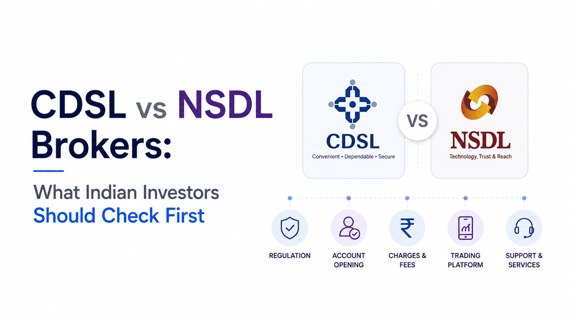
If you are comparing brokers in India, it is easy to get distracted by the usual checklist: brokerage charges, app design, charts, speed, rewards, and sign-up offers. But before all of that, there is a more basic trust question worth asking: is the broker connected to a recognised depository, and what exactly does that tell you?
That is where the CDSL vs NSDL brokers conversation starts.
Many investors see phrases like “CDSL backed broker” or “NSDL backed demat account” and assume it means the broker is automatically safer, more regulated, or somehow superior. The truth is more nuanced. In India, CDSL and NSDL are the two SEBI-recognised depositories, and brokers that offer demat services usually act through a registered Depository Participant (DP) framework. But depository backing is only one layer of trust, not the whole story. (sebi.gov.in)
So if you are wondering about the nsdl vs cdsl difference, which depository is better in India, or how to do a proper depository participant check in India, this guide will break it down in plain English.
Why this question matters more than most broker comparisons
A lot of broker comparison pages focus almost entirely on fees. Charges do matter, of course. If you want a practical view of costs, see A Detailed Look at Lemonn Brokerage Charges and Fees and Lowest Brokerage Broker in India: Full 2026 Guide. But trust infrastructure should come first.
Why? Because your broker is not just an app. It sits inside a larger market structure that includes:
- SEBI as the regulator
- Stock exchanges like NSE and BSE
- Clearing corporations
- Depositories like CDSL and NSDL
- Depository Participants and stock brokers that connect you to the system
SEBI’s recognised intermediary lists show that depository participants and stock brokers are separate but regulated categories, which is why serious investors should verify both rather than rely on branding language alone. (sebi.gov.in)
In other words, a broker saying “we are CDSL backed” may be reassuring, but it is not the final answer. It is the starting point.
First, what are CDSL and NSDL?
CDSL stands for Central Depository Services (India) Limited.
NSDL stands for National Securities Depository Limited.
Both are depositories in India. Their core role is to hold securities in electronic form and support transfers, settlements, and ownership records within the market system. SEBI’s depository listings recognise both entities within India’s securities infrastructure. (sebi.gov.in)
Think of them as the electronic custody layer behind your demat account.
Your broker app may be the interface you use daily, but the depository system is one of the key pipes in the background. That is why the phrase cdsl backed broker meaning really comes down to this: the broker’s demat services are connected through the CDSL depository ecosystem, usually via a registered DP arrangement.
The same logic applies to NSDL-backed brokers.
“Start investing with confidence! Explore
0 demat account
and grow your wealth.”
CDSL vs NSDL: what is the actual difference for investors?
Here is the practical truth: for most retail investors, both depositories serve the same broad purpose. They both enable dematerialised holding of securities and operate within SEBI’s regulatory framework. The average long-term investor will usually not choose a broker purely because it uses one depository over the other. (sebi.gov.in)
That said, when people search broker depository comparison or which depository is better India, they are usually trying to judge trust. On that question, keep these points in mind:
1. The presence of either CDSL or NSDL is normal, not exceptional
A broker offering demat services should be connected to the regulated depository system. If it is associated with either CDSL or NSDL through the proper channel, that is expected market infrastructure, not a premium feature. SEBI’s registered intermediary pages separately list hundreds of DPs under both CDSL and NSDL. As of late June 2026, SEBI’s recognised intermediary records show 747 registered depository participants under CDSL and 346 under NSDL. (sebi.gov.in)
2. “CDSL backed” does not mean “risk-free”
Depository linkage helps with the holding and settlement framework. It does not mean every risk disappears. It does not tell you whether the broker has the best support, the cleanest compliance history, the fastest platform, or the most suitable pricing for your style.
That is why a trust-first broker evaluation should also include SEBI registration checks, exchange membership, grievance redressal pathways, and clear risk disclosures. For example, Lemonn publishes Regulatory and Other Information and an Investor Grievance and Escalation Matrix, both of which are exactly the kind of pages serious users should look for before opening an account.
3. For most users, broker quality matters more than depository brand
Once depository legitimacy is confirmed, the bigger differentiators usually become:
- execution quality
- brokerage transparency
- app reliability
- product fit
- risk controls
- customer support
- clarity of disclosures
That is why, after trust checks, it makes sense to compare whether the platform fits your use case. For example, beginners might care more about app simplicity and education, while active traders may care more about speed and order flow. Relevant reads include How To Choose A Good Stockbroker In India: A Guide, Best Trading Apps in India for Beginners (2026), and Lemonn Review 2026: Charges, Features, and Who It Fits.
What does “CDSL backed broker” actually protect?
This is where many comparisons go wrong.
A CDSL-backed broker or NSDL-backed broker generally tells you that the demat side of the offering is plugged into one of India’s official depository systems. That matters because investor holdings are part of a recognised market infrastructure rather than being maintained in some informal or opaque manner. The legal and operational framework for depositories and participants sits under SEBI’s Depositories and Participants Regulations. (sebi.gov.in)
What it helps indicate:
- the broker’s demat operations are part of a regulated depository framework
- there is a formal participant structure, not an unrecognised custody setup
- the broker can be checked against official records if it is a registered DP
What it does not automatically guarantee:
- low charges
- good trade execution
- better app performance
- absence of operational issues
- suitability for options, investing, or MTF usage
- that every communication using the broker’s name is genuine
That last point matters more than ever. Investors should also stay alert to impersonation and fake investment schemes. See Impersonation & Investment Fraud: Don’t Let Scammers Trade on Your Trust and Beware of Online Scams Impersonating Trusted Brands.
So, which depository is better in India?
For most retail users, “better” is usually the wrong question.
A better question is: Is the broker properly connected to a recognised depository and can I verify that relationship?
Both CDSL and NSDL are recognised depositories. For the end user, the practical experience is usually shaped more by the broker platform than by the depository label alone. SEBI’s own listings frame both as legitimate parts of the market infrastructure, not as a “good one vs bad one” ranking. (sebi.gov.in)
So if you are doing a cdsl vs nsdl brokers comparison, do not treat the depository name as a shortcut for quality. Treat it as a trust checkpoint.
What Indian investors should check first before opening a demat account
Here is the trust-first checklist that matters more than flashy claims.
1. Check if the broker is SEBI registered
This sounds obvious, but many users never verify it independently. SEBI maintains official recognised intermediary records, including stock brokers and depository participants. That makes SEBI the first place to confirm whether the entity is actually registered in the category it claims. (sebi.gov.in)
If you want a simple primer, read Who regulates stock market in India? and What Is SEBI And Its Role In India?.
2. Check whether the broker is tied to CDSL or NSDL for demat services
This is the heart of the depository participant check India process. If the broker offers demat accounts, see whether it clearly discloses the depository relationship and whether that relationship can be matched to official records.
SEBI provides separate searchable pages for Registered Depository Participants – CDSL and Registered Depository Participants – NSDL, which investors can use to verify participant details. (sebi.gov.in)
3. Check exchange membership and regulatory disclosures
A trustworthy broker should not hide the boring but important pages. Look for:
- regulatory information
- risk disclosures
- investor charter
- grievance escalation process
- terms and conditions
- fee schedule
For example, useful benchmarks for what transparency looks like include Regulatory and Other Information, Risk Disclosure Derivatives, and Investor Charter.
4. Check whether pricing is clearly explained, not just advertised
A “free” or “discount” claim means little unless charges are explained properly. Use a fee explainer and, ideally, a calculator. Lemonn users can review A Detailed Look at Lemonn Brokerage Charges and Fees and test scenarios with the Brokerage Calculator.
5. Check whether the product fit matches your actual use case
A broker can be compliant and still be a poor fit for your needs.
Ask yourself:
- Are you a beginner investor?
- Are you mainly buying delivery stocks?
- Do you want mutual funds too?
- Are you an active intraday or F&O trader?
- Do you care about web terminal tools or chart trading?
If you are still figuring out the basics, start with Demat Account Explained (2026 Guide): Meaning, Benefits, Charges & How It Works in India and How to Open a Demat Account: A Beginner’s Guide.
A simple framework for broker depository comparison
Instead of asking “CDSL or NSDL?”, use this decision order:
Step 1: Is the broker regulated?
Verify SEBI registration and the relevant intermediary category. (sebi.gov.in)
Step 2: Is the demat side connected to a recognised depository?
Confirm whether the broker or its DP arrangement is visible in the official CDSL or NSDL participant records. (sebi.gov.in)
Step 3: Are disclosures easy to find?
If a broker makes it hard to find risk, complaints, charges, and legal pages, treat that as a red flag.
Step 4: Does the platform fit your goals?
Only now should you compare brokerage, speed, charting, and features.
This order matters because it prevents a common beginner mistake: choosing a broker based only on low fees or influencer hype without checking the trust stack first.
Where Lemonn fits in this trust-first approach
Lemonn’s value is strongest when viewed through this more practical lens. Instead of starting with flashy comparison claims, start with trust, clarity, and suitability.
Users exploring Lemonn can review the core platform at Invest in Stocks, Mutual Funds, F&Os & IPOs., open an account through Open Free Demat Account, and evaluate disclosures through Regulatory and Other Information. If your focus is beginner investing, Best App for First-Time Stock Investors in India is a good next read. If your focus is active trading, Best F&O Trading App in India for Retail Traders (2026) offers more context.
The key point is this: depository backing matters, but it should be used correctly. It is a trust signal, not a complete broker review.
Common mistakes investors make when comparing CDSL vs NSDL brokers
Mistake 1: Assuming one depository automatically makes a broker better
For retail users, that jump is usually unjustified. The broker experience depends more on the broker than on whether the demat setup runs through CDSL or NSDL.
Mistake 2: Not verifying official records
Never rely only on homepage claims or social posts. Official SEBI intermediary databases are a better source for verification. (sebi.gov.in)
Mistake 3: Ignoring grievance and disclosure pages
When something goes wrong, these pages matter more than marketing copy.
Mistake 4: Comparing only charges
A cheaper broker that is unclear about regulation, support, or risk communication may still be a worse choice.
Final takeaway
The real lesson in the CDSL vs NSDL brokers debate is simple: do not use depository backing as a shortcut for trust, but do use it as a first filter.
A broker connected to CDSL or NSDL is operating within India’s recognised depository infrastructure, and that is important. But it is only one part of the due diligence process. You should still verify SEBI registration, check official participant records, review disclosures, understand charges, and compare the platform against your actual investing or trading needs. SEBI’s depository and intermediary records make those checks possible, and investors should use them before opening a demat account. (sebi.gov.in)
If you get that order right, you will make better broker decisions than someone who starts and ends with a price table.
FAQs
What is the meaning of a CDSL backed broker?
A CDSL backed broker usually means the broker’s demat services are connected to the CDSL depository framework, often through a registered Depository Participant structure. It signals recognised infrastructure, but it does not automatically mean the broker is the cheapest, fastest, or safest in every sense. You should still verify SEBI registration and disclosures. (sebi.gov.in)
What is the difference between NSDL and CDSL?
The main nsdl vs cdsl difference is that they are two separate SEBI-recognised depositories in India. For most retail investors, both serve the same broad purpose of holding securities in electronic form and supporting market settlement. In practice, broker quality usually matters more than the depository name alone. (sebi.gov.in)
Which depository is better in India for retail investors?
For most retail users, neither is universally “better.” The more useful check is whether your broker is properly connected to a recognised depository and whether you can confirm that through official records. (sebi.gov.in)
How can I do a depository participant check in India?
Use SEBI’s official recognised intermediary pages for Registered Depository Participants – CDSL and Registered Depository Participants – NSDL to search for the participant name or registration details. Also check the broker’s regulatory and grievance pages before opening an account. (sebi.gov.in)
Should I choose a broker based only on CDSL or NSDL backing?
No. Depository backing is a trust checkpoint, not a full comparison method. After that, compare charges, product fit, service quality, platform stability, and risk controls.
Disclaimer
The stocks mentioned in this article are not recommendations. Please conduct your own research and due diligence before investing. Investment in securities market are subject to market risks, read all the related documents carefully before investing. Please read the Risk Disclosure documents carefully before investing in Equity Shares, Derivatives, Mutual fund, and/or other instruments traded on the Stock Exchanges. As investments are subject to market risks and price fluctuation risk, there is no assurance or guarantee that the investment objectives shall be achieved. Lemonn (Formerly known as NU Investors Technologies Pvt. Ltd) do not guarantee any assured returns on any investments. Past performance of securities/instruments is not indicative of their future performance.
Related Posts



Download Lemonn
Download my app for share market trading, ipo investment, trading account, and all your investment needs.