GDP vs GDP Per Capita: Key Differences Explained
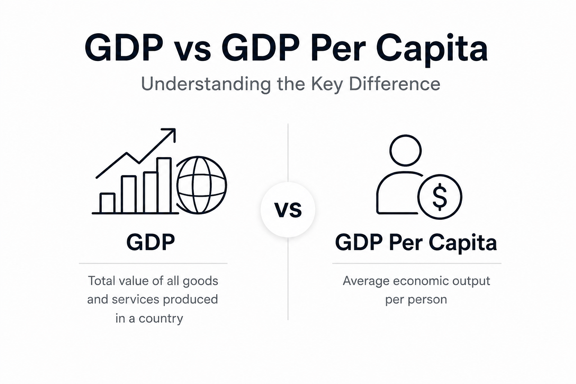
When comparing the economic performance of countries, you’ll often come across two terms: GDP and GDP per capita. While they sound similar, they measure different aspects of an economy.
GDP measures the total value of goods and services produced by a country, while GDP per capita measures the average economic output per person. Together, these metrics help governments, investors, businesses, and individuals understand a country’s economic size and the average standard of living.
This guide explains the differences between GDP and GDP per capita, how they are calculated, their advantages and limitations, and why both indicators matter.
What Is GDP?
Gross Domestic Product (GDP) is the total monetary value of all final goods and services produced within a country’s borders during a specific period, usually one year or one quarter.
GDP is one of the most widely used indicators of economic performance because it reflects the size and health of a nation’s economy.
GDP Formula
There are several ways to calculate GDP, but the expenditure approach is the most common:
GDP = Consumption + Investment + Government Spending + (Exports − Imports)
What GDP Measures
GDP provides insights into:
- Economic growth
- National production
- Business activity
- Consumer spending
- Government expenditure
- Trade performance
For example, countries like the United States, China, Germany, and India have some of the world’s largest GDPs because they produce massive amounts of goods and services.
What Is GDP Per Capita?
GDP per capita measures the average economic output generated for each person in a country.
It is calculated by dividing a country’s GDP by its total population.
GDP Per Capita Formula
GDP per Capita = GDP ÷ Population
This metric helps compare living standards between countries with different population sizes.
For example:
- GDP: £1 trillion
- Population: 50 million
GDP per capita:
£1 trillion ÷ 50 million = £20,000
This means the economy produces an average of £20,000 worth of goods and services per person.
GDP vs GDP Per Capita: Quick Comparison
| Feature | GDP | GDP Per Capita |
|---|---|---|
| Definition | Total value of goods and services produced | Average economic output per person |
| Formula | Total national production | GDP ÷ Population |
| Measures | Size of the economy | Average prosperity |
| Population considered | No | Yes |
| Best for | Comparing economic size | Comparing living standards |
| Example | India has a high GDP | Luxembourg has a high GDP per capita |
Why GDP and GDP Per Capita Matter
Although related, these two metrics answer different questions.
GDP Answers:
- How large is the country’s economy?
- Is the economy growing?
- How much does the country produce?
Businesses and investors often use GDP to identify expanding markets and investment opportunities.
GDP Per Capita Answers:
- How much economic output exists for each resident?
- What is the average standard of living?
- How productive is the economy on a per-person basis?
Economists frequently use GDP per capita to compare wealth and development across countries.
Example: GDP vs GDP Per Capita
Consider two hypothetical countries.
| Country | GDP | Population | GDP Per Capita |
|---|---|---|---|
| Country A | £5 trillion | 250 million | £20,000 |
| Country B | £800 billion | 8 million | £100,000 |
Country A has a much larger economy.
Country B has a much higher GDP per capita, suggesting that, on average, its residents enjoy greater economic output and potentially higher living standards.
This example shows why GDP alone does not tell the full story.
Advantages of GDP
GDP is useful because it:
- Measures overall economic performance
- Tracks economic growth over time
- Helps governments create fiscal policies
- Supports investment decisions
- Enables international economic comparisons
Limitations of GDP
Despite its importance, GDP has several limitations.
It Does Not Measure Income Distribution
GDP can increase while income inequality worsens.
It Ignores Cost of Living
Two countries with similar GDP per capita may have very different purchasing power.
It Excludes Unpaid Work
Household work and volunteer activities are not included.
It Does Not Measure Happiness
GDP says little about health, education, environmental quality, or life satisfaction.
Advantages of GDP Per Capita
GDP per capita offers several benefits.
- Adjusts economic output for population size
- Makes international comparisons more meaningful
- Acts as a rough indicator of living standards
- Helps assess economic productivity
Limitations of GDP Per Capita
GDP per capita also has shortcomings.
It Represents an Average
High-income individuals can raise the average significantly, even if many people earn much less.
It Does Not Reflect Wealth Distribution
A high GDP per capita does not necessarily mean wealth is shared equally.
It Omits Social Indicators
Education, healthcare, environmental quality, and overall well-being require additional measures.
Which Metric Is More Important?
Neither metric is better in every situation.
Use GDP when you want to understand:
- Economic size
- National production
- Growth trends
- Market potential
Use GDP per capita when you want to understand:
- Average prosperity
- Living standards
- Productivity per person
- International development comparisons
Most economists analyse both metrics together for a complete picture of a country’s economy.
GDP vs GDP Per Capita: Real-World Examples
India
India ranks among the world’s largest economies by GDP. However, because of its large population, its GDP per capita remains much lower than many developed nations.
Luxembourg
Luxembourg has a relatively small economy by total GDP but consistently ranks among the world’s highest in GDP per capita, reflecting high productivity and income levels.
United States
The United States combines one of the world’s largest GDPs with a relatively high GDP per capita, making it both a large and wealthy economy.
Frequently Asked Questions
Q. Is GDP the same as GDP per capita?
No. GDP measures the total value of a country’s production, while GDP per capita measures the average economic output per person.
Q. Why is GDP per capita important?
GDP per capita provides a better estimate of average living standards because it accounts for population size.
Q. Can a country have a high GDP but low GDP per capita?
Yes. Countries with very large populations may have enormous GDPs but relatively modest GDP per capita.
Q. Which is a better indicator of wealth?
GDP per capita is generally a better indicator of average prosperity, while GDP measures the size of the economy.
Q. Does GDP per capita measure income?
Not directly. It measures average economic output rather than the actual income earned by each individual.
Key Takeaways
- GDP measures the total value of goods and services produced in a country.
- GDP per capita measures economic output per person.
- GDP reflects the size of an economy.
- GDP per capita helps compare living standards across countries.
- Neither metric tells the complete story on its own.
- Economists use both indicators together to assess economic performance and prosperity.
Conclusion
GDP and GDP per capita are two of the most important economic indicators, but they serve different purposes. GDP reveals the overall size and strength of an economy, while GDP per capita provides insight into average economic output and living standards.
Understanding the difference between these measures allows investors, students, policymakers, and business leaders to interpret economic data more accurately. Rather than relying on a single metric, analysing both GDP and GDP per capita provides a more balanced view of a country’s economic health.
Disclaimer
The stocks mentioned in this article are not recommendations. Please conduct your own research and due diligence before investing. Investment in securities market are subject to market risks, read all the related documents carefully before investing. Please read the Risk Disclosure documents carefully before investing in Equity Shares, Derivatives, Mutual fund, and/or other instruments traded on the Stock Exchanges. As investments are subject to market risks and price fluctuation risk, there is no assurance or guarantee that the investment objectives shall be achieved. Lemonn (Formerly known as NU Investors Technologies Pvt. Ltd) do not guarantee any assured returns on any investments. Past performance of securities/instruments is not indicative of their future performance.